
5,814 local-government appointments face revocation over exam score anomalies
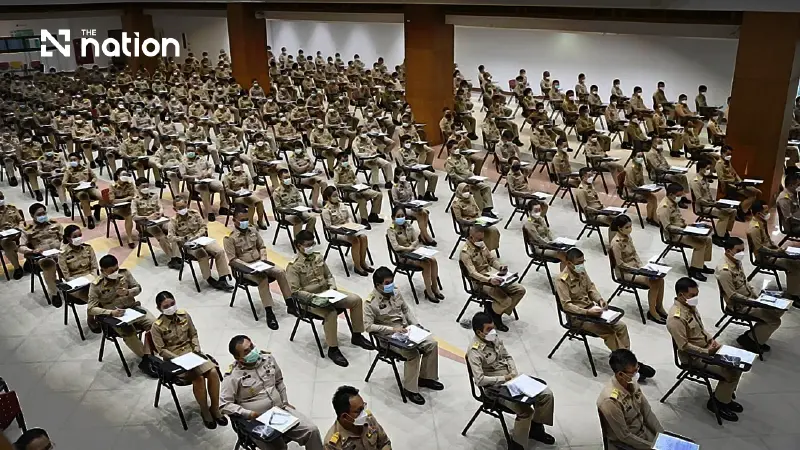


Thailand’s examination committee has referred 5,814 local-government appointees for possible revocation after raw scores were found to differ from the published results.
The central local-government examination committee has referred the cases of 5,814 appointees to three personnel panels for a decision on whether their appointments should be revoked after investigators found irregularities in their examination scores.
Interior Ministry Permanent Secretary Arsit Samphantharat said on Wednesday (July 15) that the Department of Local Administration had compared the raw examination scores with the officially published results in cooperation with the Office of the Public Sector Anti-Corruption Commission and the Department of Special Investigation.
The comparison identified discrepancies involving 5,814 candidates who had already been appointed to positions at local administrative organisations. Their names will now be submitted to the central personnel committees overseeing provincial administrative organisations, municipalities and subdistrict administrative organisations.
The three committees are expected to consider the cases on July 23. However, the discovery of an irregular score does not by itself establish that every affected appointee knowingly participated in examination fraud. Decisions over the validity of appointments are being handled separately from criminal and disciplinary investigations into those suspected of involvement in the alleged scheme.
Three groups of score discrepancies identified
The affected candidates were divided into three groups according to the nature of the discrepancies.
The first group consisted of 3,621 candidates whose verified scores were below the passing threshold but whose published scores had been increased sufficiently for them to pass.
The second group comprised 1,713 candidates who had already passed the examination but whose scores were increased further, potentially improving their positions in the candidate rankings.
The third group involved 480 candidates with small score discrepancies or unclear scans of their answer sheets. These cases will require further verification against the original examination documents.
The latest figure supersedes a preliminary Interior Ministry review reported on Tuesday, which had classified 5,372 appointments as involving irregular scores and left another 399 cases under further examination.
That earlier review covered 15,520 successful candidates called for appointment, of whom 14,988 reported and took up their positions. It found that 9,217 had normal scores at that stage.
Final revocation orders rest with local authorities
Arsit said the central examination committee did not itself have the final authority to revoke the appointments. Its role was to forward the findings to the three central local-government personnel committees for consideration.
Should those panels approve revocation, the chief executive of each local administrative organisation employing an affected official would have to issue the final order cancelling the appointment.
Authorities must also conduct a full recount and verification of the examination scores before candidates on reserve lists can be promoted to fill any resulting vacancies. The original answer sheets are currently held by the National Anti-Corruption Commission.
The Department of Local Administration will separately determine whether salaries already paid to any officials whose appointments are cancelled can or should be recovered.
Evidence points to possible manipulation of results
The examination controversy emerged after officials found differences between scores shown in stored images of answer sheets and the processed results used to announce successful candidates.
The Interior Ministry’s preliminary investigation also found that the successful-candidate data file had been accessed 115 times. An employee of a private company linked to the examination process reportedly appeared in the file’s editing history, raising suspicions that information may have been altered while the results and candidate lists were being processed.
Criminal and disciplinary inquiries continue
Police have detained three suspects over allegations including document falsification and the entry of false or manipulated information into a computer system. The suspects have denied the allegations and remain presumed innocent unless convicted by a final court ruling.
A serious disciplinary investigation into officials allegedly connected with the examination process is also under way. The panel has been given a 120-day framework and may expand its inquiry beyond the officials identified during the initial fact-finding process if further evidence emerges.
Arsit said the investigation was not necessarily limited to the latest appointment round. Although authorities have not ordered an automatic review of all approximately 50,000 people who passed the 2025 examination, earlier results could be examined if evidence from the continuing investigation points to wider irregularities.
He also said an official appointed as secretary to one of the investigative committees had withdrawn after the person’s name emerged in NACC material. The official would no longer take part in the process in order to avoid a potential conflict and demonstrate impartiality.
The prime minister has instructed the authorities to pursue the case fully and ensure that the findings and subsequent action can be clearly explained to the public.
