
Thai Military Demands Cambodian Probe Into Border Blasts and Halts to Troop Movements
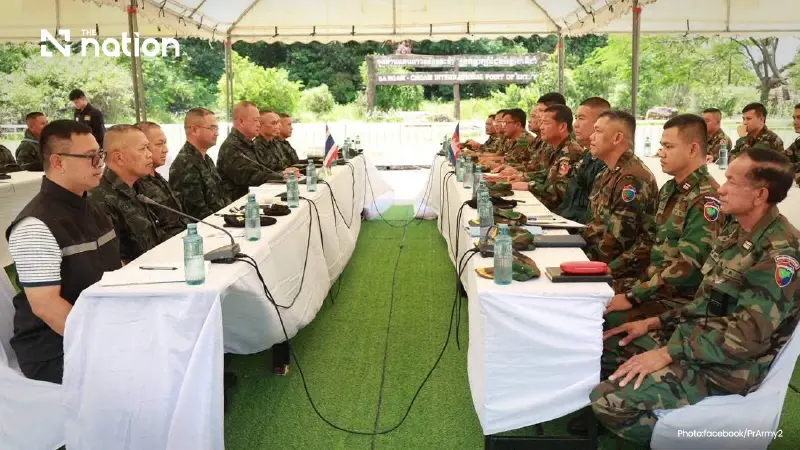


Thai Second Army Region presses Cambodia to investigate six July explosions and halt troop deployments near the razor-wire border fence to prevent clashes
- Thailand's Second Army Region has formally demanded that Cambodia investigate a series of unexplained explosions along their shared border, including six recent blasts in July.
- The Thai military has also directed Cambodian forces to halt forward troop movements and stop establishing new operational bases near the border fence to prevent accidental clashes.
- Thai officials confirmed their own units were not responsible for the detonations and made the requests during a bilateral border committee meeting.
The Thai Second Army Region presses Cambodia to investigate six July explosions and halt troop deployments near the razor-wire border fence to prevent clashes.
Thailand’s Second Army Region has formally requested that Cambodian authorities launch an immediate investigation into a series of unexplained explosions along the shared border while warning Cambodian forces against positioning operational bases too close to the border fence.
The diplomatic and security friction was addressed during a bilateral coordination meeting held on Wednesday at the Chong Sa-ngam permanent border checkpoint in Phu Sing District, Sisaket Province.
The talks brought together the secretariats of the Thailand–Cambodia Regional Border Committee (RBC), representing Thailand’s Second Army Region and Cambodia’s 4th Military Region.

Rising Tensions Over Unexplained Explosions
The primary catalyst for the emergency coordination was a sharp rise in unexplained detonations near the Huai Ta Maria border sector.
According to Thai local units stationed near Chong Khan, a total of 19 explosions have been recorded since April 2026, with six distinct blasts reported in July alone.
Thai military officials confirmed they had thoroughly cross-checked all domestic units in the sector and verified that no Thai military operations, weapons training, or controlled demolitions had taken place.
To mitigate growing anxieties along the frontier, the Thai delegation pressed their Cambodian counterparts to audit their own units and identify the source of the blasts.

In tandem with the blast inquiry, the Second Army Region issued a strict directive requesting that Cambodian forces halt forward troop movements and refrain from establishing new operational bases in close proximity to the border's razor-wire fencing.
Thai commanders warned that allowing military outposts to operate within such tight quarters significantly increases the risk of accidental tactical engagements or unintended border clashes.
Fostering Cooperation and De-escalating Friction
Despite the current security concerns, both secretariats noted that bilateral communication mechanisms remain highly active.
Over the six months following the 3rd General Border Committee (GBC) meeting on 27 December 2025, the two sides have coordinated 142 times, enabling rapid, peaceful resolutions to localised border incidents.
The Thai delegation expressed its gratitude to Cambodia for this ongoing institutional cooperation, specifically thanking Cambodian authorities for the successful repatriation of Mr Yot Sainoi, a Thai national who had inadvertently crossed the border on 15 May 2026.

To maintain stability, the committee outlined several key operational parameters moving forward:
Joint Anti-Disinformation Framework: Both nations pledged to thoroughly verify facts before reacting to border incidents, working together to counter the spread of "fake news" by malicious actors attempting to amplify border anxieties in the media.
Border Infrastructure Transparency: The Thai delegation clarified that ongoing road construction along the frontier is strictly funded by the Thai government and private sector, confined entirely to Thai territory, and utilises proportionate explosive ordnance disposal (EOD) personnel without any additional troop build-ups.
Adherence to the GBC Roadmap: Both sides agreed to strictly follow the guidelines established at the 3rd GBC meeting, routing all future misunderstandings through designated liaison teams.
The Second Army Region reasserted its commitment to utilising established military dialogue alongside its constitutional duty to defend national sovereignty.
Assuring the public of their readiness, Thai military officials stated they are monitoring the frontier meticulously within international legal frameworks to guarantee the safety of border communities and their property.
