
Srettha honoured as Ratchaburi Zero Dropout Sandbox shapes national educational policy
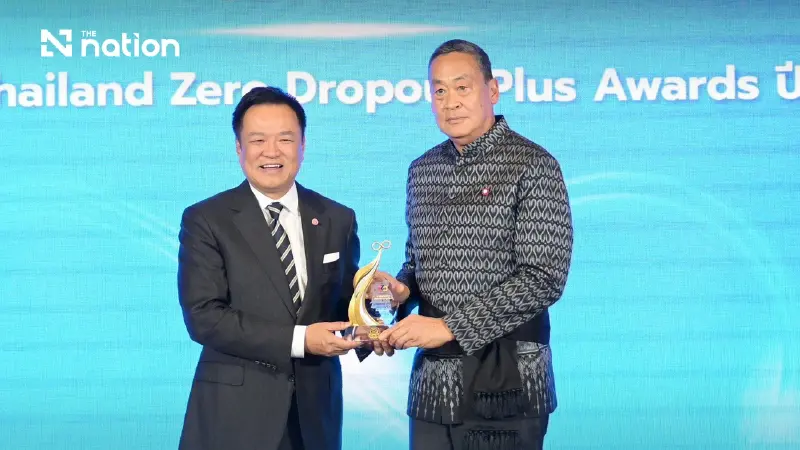


Srettha Thavisin and Sansiri were honoured for a 100-million-baht Ratchaburi pilot that helped shape Thailand’s national Zero Dropout drive
- Former Prime Minister Srettha Thavisin received an honorary national education award for his role in expanding the Zero Dropout initiative into a nationwide campaign.
- Srettha was recognized as the initiator of the program, which began as a privately funded pilot in Ratchaburi while he was the head of Sansiri Public Company Limited.
- After becoming prime minister, he continued to promote the initiative as a national policy, resulting in the Cabinet acknowledging a national package of Thailand Zero Dropout measures.
- The program's goal is to find children outside the education system and return them to suitable, flexible forms of learning, including academic and vocational training.
Former prime minister Srettha Thavisin received an honorary national education award on July 24 for his role in turning a privately funded pilot in Ratchaburi into the nationwide Thailand Zero Dropout campaign.
Prime Minister Anutin Charnvirakul presented Srettha with the honorary Prime Minister’s Thailand Zero Dropout Plus (TZD+) Award at Government House. Srettha was recognised as the initiator of the programme, which seeks to find children and young people outside the education system and return them to suitable forms of learning.

Sansiri Public Company Limited, which Srettha led before entering government, also received an award as an organisation driving Zero Dropout.
The national award programme recognises provinces, organisations, flexible-learning initiatives and individuals involved in reducing the number of children outside formal education.
Ratchaburi pilot becomes national model
Srettha launched the original Zero Dropout initiative while serving as Sansiri’s president and chief executive.

In 2022, the property developer partnered with the Equitable Education Fund to raise 100 million baht through a bond fundraising scheme for an education programme in Ratchaburi. Sansiri and the fund described it as the first bond of its kind in Asia to raise money for national education development.
Ratchaburi was selected because of its relatively high number of children at risk of leaving school and the varied forms of inequality found across its urban, rural and border communities.
Sansiri said it had no property development or commercial interests in the province, reducing the risk of a conflict between the project and its core business.
The initiative began as a three-year pilot in 2022. Sansiri’s latest account presents the Ratchaburi model as a longer programme running through 2027.
Under the funding structure described by the company, at least 80% of the budget is allocated to student grants and direct assistance, while no more than 20% may be used for administration and research.
The pilot combined individual student records with local networks to identify children at risk, provide financial and social assistance and develop learning options suited to each student’s circumstances.
The Cabinet acknowledged a national package of Thailand Zero Dropout measures in May 2024. The measures covered inter-agency data integration, individual support, flexible education and incentives for private companies to participate in learning and vocational programmes.
Srettha calls for more private-sector support

Srettha said the initial investment was not large enough to solve the problem nationwide but had demonstrated how private-sector action could encourage broader participation.
“The 100 million baht raised by Sansiri could not help children across the entire country, but it helped spark action and encouraged every sector to become involved,” he said.
After becoming prime minister, Srettha continued to promote the initiative as a national policy intended to ensure that no child or young person was excluded from education.
He said the programme should use individual student-registration data to find children proactively and offer flexible forms of learning suited to their lives.
The approach includes academic education, vocational training and life skills rather than requiring every child to return to a conventional classroom.
Srettha urged other companies to work with provincial authorities, schools and community organisations rather than rely only on short-term donations.
“If we had 20 organisations, each gradually helping one province, I believe the picture of education for Thai children would change within five to 10 years,” he said.
Project reports broader reach
The Equitable Education Fund reported in May 2024 that the Ratchaburi initiative had helped prevent 8,769 children and young people aged six to 24 from leaving education. Its network covered 350 schools, three education service areas and all 10 districts of the province.
Sansiri said the broader Ratchaburi model, developed with the fund and other partners, had now provided educational or vocational support to more than 20,000 children. The latest company figure covers a wider range of assistance than the earlier count of children prevented from dropping out.
Supporters of the programme say its use of flexible learning has also contributed to wider discussion about reforming Thailand’s education system.
The Education Ministry is drafting a new National Education Bill intended to create a more flexible system that supports lifelong learning. The legislation remained at the drafting and public-consultation stage in June and July 2026 and had not yet become law.
Srettha said the long-term goal should remain unchanged: no child or young person in Thailand should be allowed to lose access to education because the existing system cannot accommodate their circumstances.

