
Transport Ministry to propose Bangkok–Phitsanulok high-speed rail
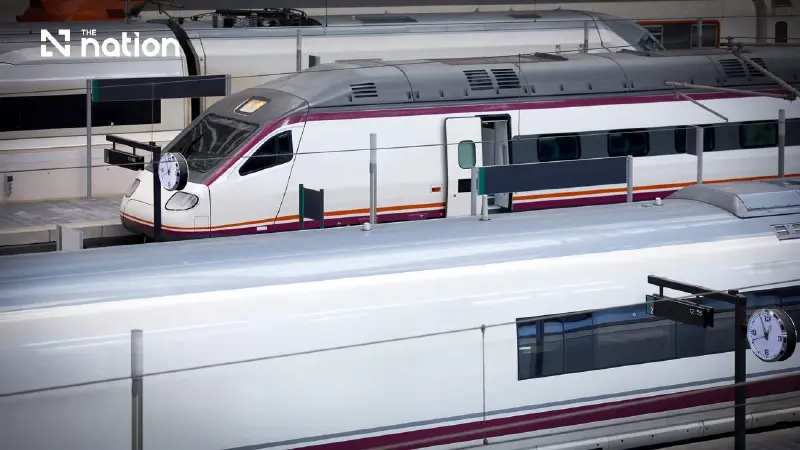


The 380-kilometre Bangkok–Phitsanulok section is being prepared for Cabinet consideration in 2027, with construction targeted to begin in January 2030.
- Thailand's Ministry of Transport plans to seek Cabinet approval for the Bangkok–Phitsanulok high-speed rail project as part of its 2027 work plan.
- This 380-kilometer section is the first phase of the larger Bangkok–Chiang Mai project, which is being developed in cooperation with Japan.
- The project's estimated investment is THB276 billion, and its environmental impact assessment (EIA) has already been approved.
- Construction is targeted to start in January 2030, with services planned to launch in January 2036.
Thailand is awaiting the launch of high-speed rail services, a new addition to the country’s infrastructure.
One project is currently under construction: the Thai–Chinese high-speed rail project’s Bangkok–Nakhon Ratchasima section.
The Cabinet approved the project on Tuesday (July 11, 2017).
The State Railway of Thailand (SRT) reports that construction is more than 55% complete, with services targeted to begin in 2031.
Meanwhile, the joint investment contract for Thailand’s second high-speed rail project, the High-Speed Rail Linking Three Airports (Don Mueang–Suvarnabhumi–U-Tapao), was signed on Thursday (October 24, 2019).
The project is now in its seventh year, but construction still cannot begin because negotiations to amend the joint investment contract remain unresolved.
A proposal to ‘terminate the joint investment contract’ is also likely to be submitted to the Eastern Economic Corridor Policy Committee, chaired by Prime Minister Anutin Charnvirakul, for consideration.
High-speed rail is therefore another mega-project that carries high expectations.
Its substantial investment requirements make it difficult to advance, while it also requires new technology that Thailand has not used before.
The Ministry of Transport has announced that its 2027 work plan includes preparations to seek Cabinet approval for a new high-speed rail project covering the Bangkok–Phitsanulok section.
The Bangkok–Phitsanulok section forms part of the Bangkok–Chiang Mai high-speed railway project.
Thailand’s Ministry of Transport and Japan’s Ministry of Land, Infrastructure, Transport and Tourism (MLIT) jointly signed a memorandum of understanding (MOU) on rail-system development between Thailand and Japan.

The project has a total length of 668 kilometres and is divided into:
- Phase 1: Bangkok–Phitsanulok, 380 kilometres, with investment of about THB276 billion.
- Phase 2: Phitsanulok–Chiang Mai, 288 kilometres, with investment of about THB232 billion.
For the Bangkok–Phitsanulok section, the environmental impact assessment (EIA) report has been approved by the National Environment Board, while the investment model remains under consideration.
The Ministry of Transport has included the section in its 2027 work plan as a continuing project being prepared for submission to the Cabinet, targeting the start of construction in January 2030 and the launch of services in January 2036.
