
Din Daeng registrations expose gaps in pink-card checks
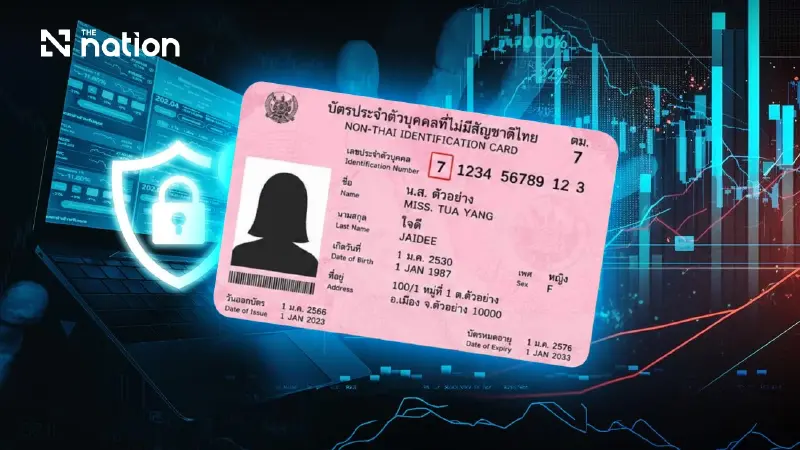


Din Daeng’s mass registrations show how false addresses and registry data could support pink cards, work permits and future personal status.
Mass registration of non-Thai children at a small number of rooms in Bangkok’s Din Daeng flats has exposed gaps in the checks used to protect Thailand’s civil-registration system and issue identification cards to people without Thai nationality.
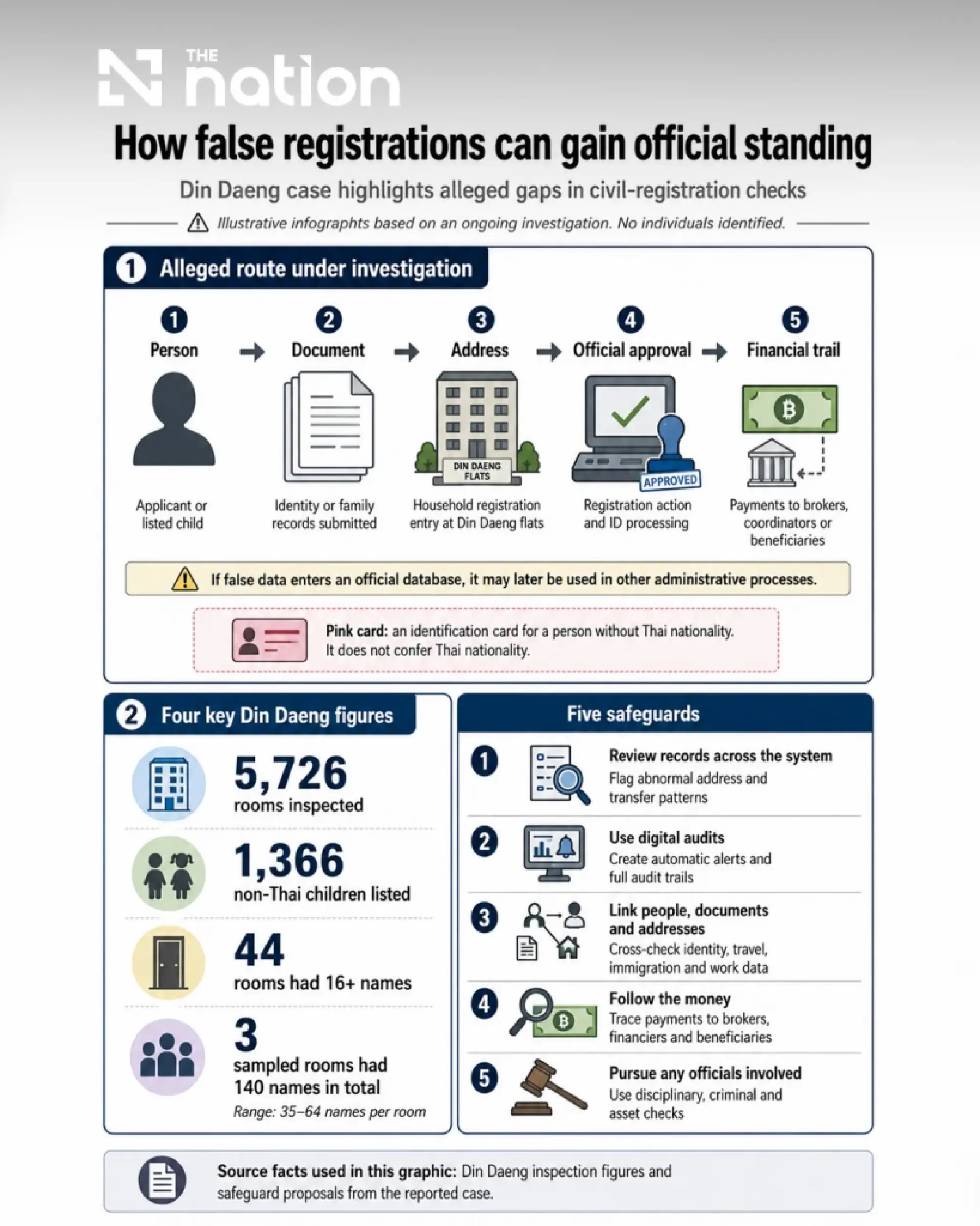
An inspection on Tuesday (August 18, 2026) covered 5,726 rooms and found at least 1,366 non-Thai children aged between five and 15 listed in household records. Forty-four rooms carried at least 16 names each, while three rooms examined in detail had between 35 and 64 names apiece, or 140 in total.
The operation resulted in the arrests of seven people, including three government officials, under court warrants. The wider investigation is now examining how registrations apparently inconsistent with actual occupancy passed through official checks and whether the resulting records were used to obtain identification cards for people without Thai nationality.

Operation “Clearing House in Central Bangkok” brought together the Interior Ministry through the Department of Provincial Administration and its DOPA N.I.C.E. task force, the Royal Thai Police, Bangkok Metropolitan Administration, the Office of Public Sector Anti-Corruption Commission, the Anti-Money Laundering Office and the Department of Special Investigation.
The inquiry extends beyond the revocation of cards allegedly issued on the basis of false information. Investigators are looking at brokers, people who arranged addresses, those who supplied or certified information, government personnel involved in registration procedures and those who may have benefited from the records.
How false data can acquire official standing
A pink card is not a Thai national identity card and does not confer Thai nationality. It is an identification document issued within the civil-registration system to a person who does not have Thai nationality.
The central concern is the reliability of the information used to obtain it. If an address, family relationship or supporting document was fabricated or improperly certified, a card issued from those records could give inaccurate information apparent legitimacy within government databases.
Once entered into an official system, the information could later be presented in processes involving employment, financial transactions, access to public services or welfare, and applications connected with personal status or nationality.
The card itself does not automatically grant citizenship or unrestricted access to such rights. The vulnerability lies in inaccurate information becoming the starting point for other administrative procedures.
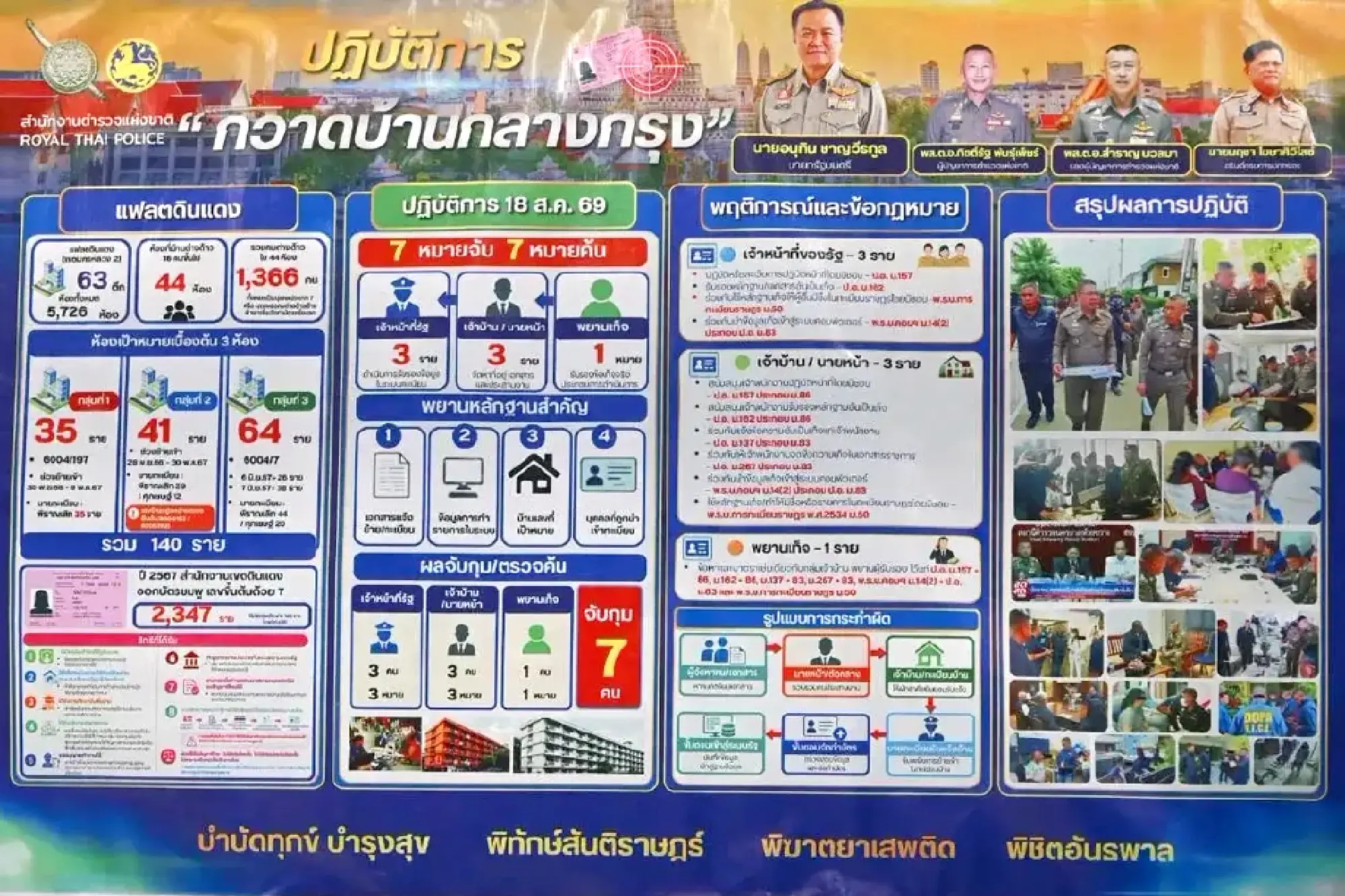

Brokers allegedly linked applicants to district records
Preliminary findings indicate a staged operation in which different participants allegedly handled separate parts of the process.
Myanmar brokers are suspected of collecting names and documents from foreign nationals before passing them to Thai intermediaries. The Thai brokers allegedly coordinated with people connected to district-office registration procedures to arrange address transfers and obtain identification documents improperly.
The suspected network therefore extends beyond individual applicants submitting false information. Investigators are examining possible roles played by recruiters, address providers, coordinators, document handlers and government officials who may have enabled the registrations to proceed.
Once an entry appears in a government database, other officials or agencies may treat it as valid unless the original address, relationship and evidence are checked again.

False-paternity cases expose the same weakness
The Din Daeng case has parallels with alleged false-paternity arrangements, widely referred to in Thailand as the “fake father” scheme.
Authorities have investigated cases in which Thai men allegedly acknowledged themselves as the fathers of children born to foreign mothers despite not being their biological fathers. Such acknowledgements could create family and birth-registration records that might later support applications involving status or legal rights.
The Interior Ministry has tightened acknowledgement-of-parentage procedures nationwide. When either parent is a foreign national, the foreign parent must appear in person before the registrar to reduce the risk of the process being used to create personal status improperly.
Bangkok has separately ordered its 50 district offices to examine birth-registration records and strengthen scrutiny of cases involving foreign mothers and Thai fathers following an alleged false-paternity case.
These cases demonstrate that civil registration is more than a record-keeping system. Its information forms the administrative basis for determining identity, family relationships, rights and personal status.
An underground market in registration status
Foreign nationals who enter and work in Thailand legally are not the issue. The concern is an underground market that allegedly turns civil-registration status into a commodity.
Services may include arranging an address, transferring a name into a household registration, preparing supporting documents and coordinating with people inside government offices.
Lawful management of migrant workers must therefore be distinguished from investigations into networks suspected of buying and selling access to personal status.
The Din Daeng case is not the first alleged registration scheme uncovered by authorities. The National Anti-Corruption Commission and the Department of Provincial Administration previously examined the preparation of registration records and the issuance of pink cards following suspected corruption and arrests of officials in several areas.
A case in Wang Noi district of Phra Nakhon Si Ayutthaya province involved unusually large numbers of foreign nationals allegedly being transferred into three household registrations before applying for cards. Investigators alleged that some names were transferred out shortly after the cards were issued.
Investigations have also uncovered alleged networks in Don Sak district of Surat Thani and Mae Sot district of Tak. The Don Sak inquiry involved brokers and registration personnel suspected of improperly arranging identification cards for Myanmar nationals without civil-registration status.
Five safeguards for the civil registry
The weaknesses identified in the cases point to five safeguards that could strengthen the registration system:
1. Review historical records across the system
Authorities should use civil-registration data to identify abnormal patterns, including houses or rooms carrying unusually large numbers of names, repeated transfers into and out of the same addresses within short periods, and officials processing volumes far above normal levels.
2. Introduce automatic digital audits
Registration systems should generate alerts when transactions depart significantly from established patterns.
An alert could be triggered when one official approves substantially more transfers involving foreign nationals than colleagues, or when groups of applications repeatedly connect the same former and new addresses.
Every important change should leave a digital audit trail showing who entered the information, the date and time of the transaction, the documents used and the person who authorised it. Investigators could then trace suspicious records directly to those who processed and approved them.
3. Connect people, documents and addresses
Civil-registration information should be cross-checked against databases covering personal identity, addresses, travel records, immigration status and work permits.
Linking the records would help ensure that each person has one verifiable identity and allow authorities to trace discrepancies across different government systems.
4. Follow payments through the network
Where money was allegedly collected for arranging addresses or documents, investigators should trace recipient accounts, brokers, financial backers and ultimate beneficiaries.
Enforcement should not stop with the person holding a suspect card if evidence indicates that others organised or profited from the process.
5. Pursue any officials involved
Disciplinary investigations should proceed alongside criminal cases when government personnel are suspected of wrongdoing.
Authorities should also examine assets and financial trails. Any unexplained wealth or property found to be connected with an offence should be dealt with under the relevant law.
Source: Bangkokbiznews
