
Senator urges Section 25 clearance over alleged 960-hectare Chiang Mai forest grab
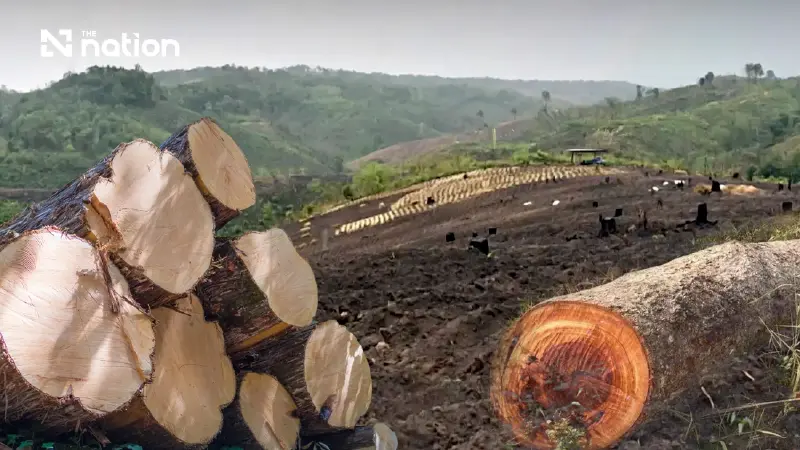


Chiang Mai residents allege ginger farms have cleared at least 960 hectares of restored forest, raising water pollution and official collusion concerns
- Senator Cheewapap Cheewatham is urging forestry authorities to take immediate action against the illegal clearing of at least 960 hectares of restored forest in Chiang Mai for ginger cultivation.
- The encroachment, brought to light by local residents, is allegedly contaminating local water supplies, including the Mae Thalop Dam, with potent herbicides and threatening the water source for tens of thousands of people.
- The senator has called for the use of Section 25 of the National Reserved Forest Act to remove crops and structures without a court order, and for an investigation into alleged official complicity and illicit payments.
Senate environment committee chairman Cheewapap Cheewatham has urged forestry authorities to take action against alleged encroachment in Chiang Mai after residents reported that ginger cultivation had destroyed at least 960 hectares of restored forest and threatened local water supplies.
Speaking on September 9, Cheewapap called on the Royal Forest Department and the Forest Industry Organisation (FIO) to invoke Section 25 of the National Reserved Forest Act to remove structures and crops from encroached land. He argued that the provision could be used without waiting for a court order.

His remarks followed a complaint presented at Parliament on September 8 by Chaowalit Srithanetsakun, a representative of people using water from Mae Thalop Dam in Chai Prakan district, accompanied by group adviser Ratsami Saennamwong and other representatives.
The group asked the Senate Committee on Natural Resources and Environment to inspect the area and investigate allegations of continuing forest clearance, chemical contamination, illicit payments and official complicity.

Residents allege contamination and inflated tractor charges
Chaowalit alleged that forest covering thousands of rai was being cleared daily. Although Central Investigation Bureau police had recently made arrests and pursued cases involving five plots, three in reserved forests and two in national parks, he said investors and alleged encroachers continued tending ginger crops.
He also alleged that highly potent herbicides were being used to suppress weeds and were contaminating water flowing into Mae Thalop Dam. Local communities rely on the reservoir to produce tap water and supply livestock.

Unlike maize cultivation, ginger farming requires deep ploughing, Chaowalit explained. He said each plot used three or four tractors, with machinery taken onto steep mountain slopes exceeding 30 degrees.
He alleged that Hmong farmers were charged between 6,500 and 8,000 baht per rai for tractor work, compared with normal rates of 2,000–2,500 baht. He described the inflated charges as a means of disguising illicit payments.
More than 30 tractors were moved out of the area before an official inspection, he added, questioning how those involved had known to remove them.
Chaowalit also questioned the response to a June 25 letter sent to a centre, which he said identified 93 alleged offenders occupying more than 80 hectares across FIO land, reserved forest and land under the National Land Policy Committee framework.

He alleged that no prosecutions followed. According to his account, the FIO filed a police record but stated that it did not yet wish to lodge a formal complaint seeking prosecution. It then requested the land’s return from Chai Prakan police for reforestation, although alleged encroachers continued cultivating it.
The water users’ group warned that environmental damage and contamination could affect tens of thousands of people across three districts, and urged the Senate committee to intervene.
Senator calls for land recovery and investigations
Cheewapap argued that the problem extended beyond isolated encroachment. He said forensic evidence identified organised ginger cultivation as a leading cause of watershed forest destruction in Chiang Mai, damaging tens of thousands of rai annually.
According to Cheewapap, satellite images showed heavy machinery, including excavators, opening more than 40 new clearings within a matter of weeks. He alleged that large trees were felled and buried before extensive areas were enclosed with barbed wire for a single season of ginger cultivation.
“It is tragic that the country’s water-retaining forests are being traded for this agricultural output,” he said.
He further alleged that highly potent insecticides were entering the Ping River, reaching the city and affecting communities downstream. He linked the destruction of watershed forests to drought and flooding.
Cheewapap criticised agencies he accused of allowing state land to be sublet for uses inconsistent with its permitted purpose. He urged them to stop relying solely on the filing of police complaints and to use Section 25 to remove structures and crops promptly, arguing that this would help halt both forest clearance and chemical contamination.
He maintained that such operations required little expenditure and said he had previously demonstrated the approach.
Cheewapap also called for a review of land management under the National Land Policy Committee framework. Authorities should make clear that state land cannot be sublet, recover plots where violations occur and pursue legal action, he said.
He urged decisive action over alleged illicit payments and called on the Department of Provincial Administration to establish whether local leaders had been complicit and take action under legislation he described as newly enacted.
Community recalls decades of forest restoration
Thiranan Chaloeywiman, another representative giving evidence, said the threatened forest had been restored through decades of community labour following an initiative inspired by Her Majesty Queen Sirikit The Queen Mother.

He recounted that in 1992, while travelling by helicopter towards Doi Ang Khang, Her Majesty saw extensive deforestation and bare mountains. She asked Khruba Duang Kham, the former abbot of Wat Pa Mai Daeng Phra Chao Phrom Maharat in Chai Prakan, to help restore the forest.
That request led to the “Water for Forests” project, Thiranan said. Pipes carried water down from the mountains, providing free supplies to nearly 20,000 households in exchange for a commitment to protect the forest.
Residents helped fight forest fires during the dry season. During the rainy season, volunteers, traders, members of the public and students joined planting activities.
Thiranan said the community had continued the work since 1992 out of loyalty to Her Majesty, transforming bare hills into dense forest. He alleged that at least 6,000 rai, equivalent to 960 hectares, had now been cleared for ginger cultivation.
“We have tried to protect the forest and fulfil our responsibilities throughout, but what is happening now is truly beyond the community’s ability to resist,” he said, appealing for assistance from the committee and state agencies.
Civil society representative Chaiwat Limlikitaksorn praised residents for speaking out but argued that some agencies’ interventions produced only temporary results.

He compared their actions to throwing a stone into a pond covered with duckweed: the surface briefly opens before closing again. Once officials leave, he alleged, investors from outside the area, including Phitsanulok and Phetchabun, return to cultivate encroached forest.
Chaiwat called for complaints under Section 157 of the Criminal Code against officials alleged to have been involved. He urged the Senate committee to inspect the area directly and summon officials from across the ministry to establish individual responsibility.
Residents continued sending him videos of alleged tree felling and forest burning every day, he added.
