
Nimbostratus clouds behind Bangkok's prolonged rain without thunder
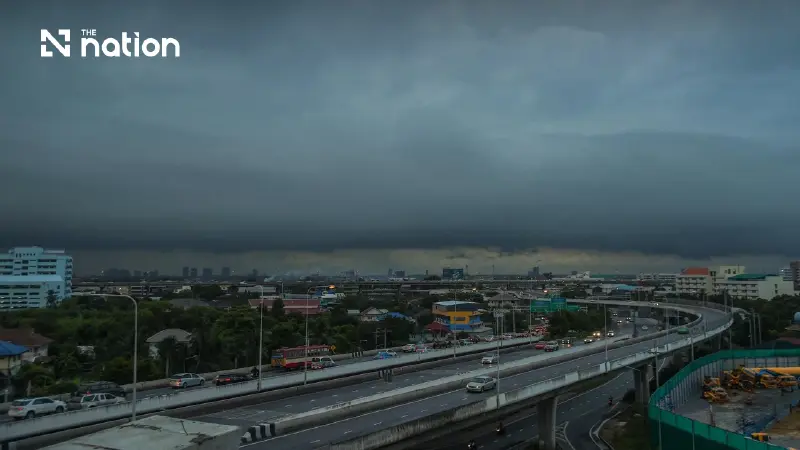


Bangkok's prolonged rain without thunder is linked to nimbostratus clouds in a low-pressure area, which can produce steady rainfall for hours.
- The prolonged rain in Bangkok, which lacks thunder, is caused by nimbostratus clouds within a low-pressure area.
- Nimbostratus clouds are characterised by a flat, dark appearance and produce steady, continuous rainfall rather than the thunderstorms associated with billowing storm clouds.
- The rain is sustained because the low-pressure system continuously draws moist air into the stable cloud structure, leading to persistent precipitation over a wide area.
Prolonged rain lasting through the day and night has contributed to flooding across nearly all parts of Bangkok, prompting questions over why the rain can continue for so long without thunder.
Dr Buncha Thanaboonsombat, director of the Materials Technology Knowledge Dissemination Division at the National Metal and Materials Technology Centre (MTEC), under the National Science and Technology Development Agency (NSTDA), has explained that the phenomenon is linked to nimbostratus clouds within a low-pressure area.
Buncha, who received the Science Communicator of the Year award in 2026 and founded Thailand's Cloud Lovers Club, explained that nimbostratus clouds have several distinctive characteristics.

What do nimbostratus clouds look like?
Their bases are generally flat, dark and opaque, often spreading across the sky and blocking sunlight.
Unlike typical storm clouds, their tops tend to appear relatively smooth rather than developing into prominent, billowing formations.
They are also commonly associated with steady rain rather than thunderstorms, meaning rainfall can continue without frequent thunder or intense lightning.

Why can the rain last so long?
One factor is the low-pressure area, which continuously draws moist air into the system and supplies moisture to the cloud base.
The cloud structure is also relatively stable, with air rising across a broad area rather than developing into separate storm cells. This allows rain to fall at a more consistent rate over a wide area.
Within the thick cloud layer, water droplets and ice crystals combine and eventually fall as persistent, steady rainfall.
Buncha noted that a uniformly grey sky accompanied by quiet, continuous rain is a typical sign of nimbostratus clouds overhead.
Under such conditions, the rain is more likely to ease once the low-pressure area weakens and the supply of moisture to the cloud system declines.
