
Bangkok governor urges long-term infrastructure plans for 300mm rain
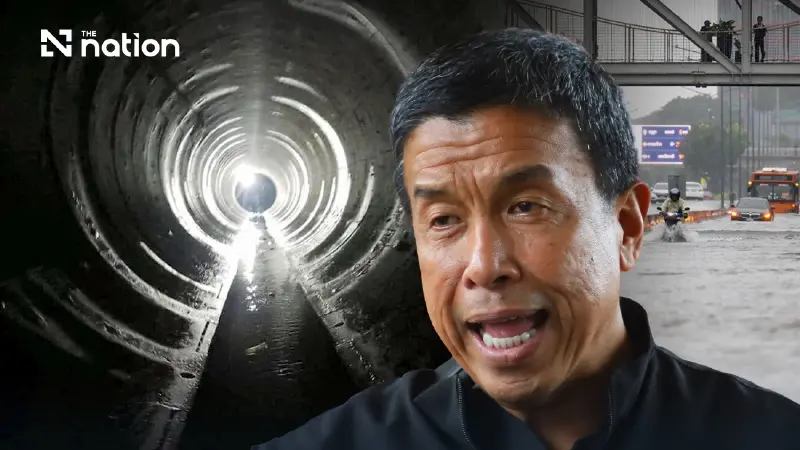


Chadchart says extreme rainfall could recur and calls for more drainage tunnels to channel floodwater directly into the Chao Phraya River.
- Bangkok Governor Chadchart Sittipunt has called for long-term infrastructure planning after 200-300mm of rainfall caused severe flooding, an event he warned could recur.
- The core of the proposed plan is to expand the network of drainage tunnels, or "water expressways," to bypass congested canals and speed up drainage directly into the Chao Phraya River.
- The governor stressed the need for joint planning and investment between the Bangkok Metropolitan Administration (BMA) and the national government on key projects, such as new drainage tunnels.
- A specific government-approved project includes a new tunnel to link the Prawet Burirom Canal with the Nong Bon retention basin to make fuller use of its water storage capacity.
Bangkok Governor Chadchart Sittipunt said the city needed to adapt its water management after several days of accumulated rainfall of 200–300 millimetres caused by a swirling low-pressure system and the south-westerly monsoon.
He was speaking at Government House on Monday (September 28, 2026), following a meeting with the government to review the flooding.
The Thai Meteorological Department had reported that average rainfall in Bangkok had fallen to about 60 millimetres, he added.
The easing rain would improve drainage, particularly in Min Buri and Lat Krabang.
To assist residents, the Bangkok Metropolitan Administration (BMA) has established command centres and food preparation centres at district offices to distribute meals to around 60,000–70,000 affected people.
The BMA will subsequently open applications for compensation based on actual damage.
Residents in disaster-hit areas have been asked to take photographs and retain evidence of damage to support their applications.
Chadchart described rainfall reaching 300 millimetres as a natural crisis that was difficult to predict because of uncertainties in weather forecasting.
Such an event could recur, whether later this year or in another 10 years.

The BMA and the government therefore needed to jointly plan long-term infrastructure capable of handling 300 millimetres of rainfall.
“The key to coping with extreme rainfall in the future is to extend the network of drainage tunnels, or water expressways, to cover more areas at risk. The aim is to reduce peak flows and speed up drainage from critically affected areas directly into the Chao Phraya River, bypassing congested canals. The BMA currently has several joint projects with the government, including a drainage tunnel to Khlong Chan, which will provide a lasting reduction in the impact and severity of flooding in Bang Kapi. Although construction takes time, this is an essential long-term investment,” Chadchart said.
Chadchart said drainage conditions in the main canals were steadily improving overall, particularly in Saen Saep Canal, helping to draw water away from Khlong Chan and surrounding areas and ease residents’ hardship.
Prawet Burirom Canal remained the most difficult to drain because it had to carry water from Lat Krabang to the Phra Khanong pumping station.
The canal’s many bends also slowed drainage.

He had discussed the issue with Deputy Prime Minister and Finance Minister Ekniti Nitithanprapas, requesting assistance from the Royal Irrigation Department and the Royal Thai Navy to deploy water-pushing machines in Prawet Burirom Canal.
These would help water flow more quickly towards the Phanom Sarakham and Phra Khanong sluice gates.
The BMA is operating its pumps at full capacity, with daily drainage stated at about 1,200 cubic metres per second.
Water levels in the main canals are expected to gradually fall within two to three days.
In communities where water has overtopped flood barriers, pumps are to be brought in urgently to drain the water, with an estimated timeframe of about seven days.
On water retention, the governor said the Nong Bon retention basin had a total capacity of about 5 million cubic metres and could still accommodate around 3 million cubic metres more.
However, channelling water into the basin remained difficult because it had to pass through the slow-draining Nong Bon Canal.
As a result, the basin currently receives water mainly from the Chaloem Phrakiat Road area.
To address the problem in the short and medium term, the government has approved a drainage tunnel linking Prawet Burirom Canal directly to the Nong Bon retention basin.
Preparations for construction are under way.
The tunnel will improve the basin’s ability to serve as a water retention area and make fuller use of its capacity.


