
Consumer council warns Bangkok draft plan cuts 5 water retention sites as objections close Nov 9
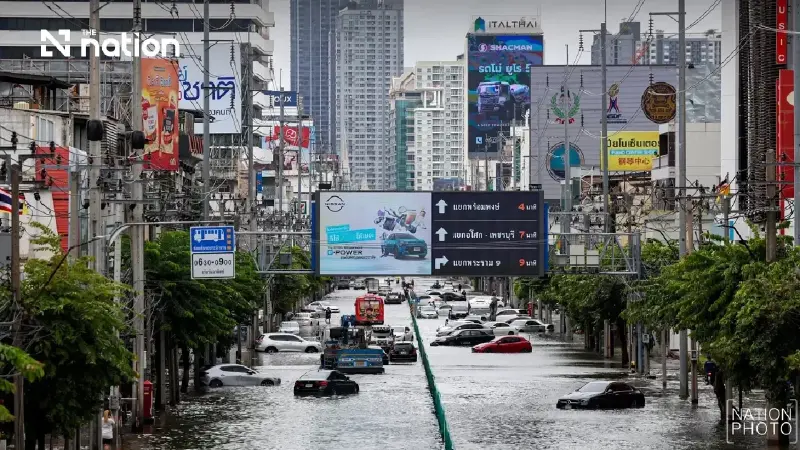


Bangkok’s draft plan would reduce floodwater storage areas, the consumer council warns, as upstream flows, accumulated rain and high tides add pressure
- The Thailand Consumers Council (TCC) warns that a new draft city plan for Bangkok proposes removing the floodwater-retention designation from five specific pond sites.
- The council argues that the plan, which also rezones larger conservation areas for denser housing, will significantly reduce the capital's natural ability to hold water and increase its vulnerability to flooding.
- Losing these retention areas would make Bangkok more dependent on engineered solutions like tunnels and pumps, which have proven to have limits during recent inundations.
- The public and affected parties have until November 9, 2026, to submit objections to the proposed changes in the draft plan.
The Thailand Consumers Council (TCC) has warned that Bangkok’s draft city plan could leave the capital more vulnerable to flooding by reducing water-retention areas while permitting denser residential development. The proposal includes the removal of floodwater-retention designations for five sites, with affected parties able to submit objections until November 9, 2026. Kongsak Sahasakmontri, a member of the TCC’s subcommittee on real estate and housing, said the longer-term consequences of the proposed land-use changes were even more worrying than the immediate flooding situation.
Kongsak warns of lost retention land in eastern and western Bangkok
Kongsak said Bangkok’s existing 2013 comprehensive plan designated land in the western part of the capital for rural and agricultural conservation, shown on zoning maps with green diagonal hatching. These areas also accommodated floodwater, functioning as retention basins, or “monkey cheeks”.
Under the proposed revision of Bangkok’s city plan, Kongsak said, those conservation designations would disappear entirely from the western side and be replaced by yellow and orange residential zones, allowing more housing estates and condominiums.
“The question is, if upstream water, rainfall and high tides arrive together one day, where will Bangkok find the space to hold that water?” Kongsak said.
Kongsak also warned of reductions in green-hatched conservation areas in eastern Bangkok, particularly Nong Chok, Min Buri, Khan Na Yao, Sai Mai and Lat Krabang. He said open land, existing water-retention areas and numerous retention projects were being removed from the plan or reassigned for denser housing, despite their low-lying locations and exposure to flooding.
Kongsak argued that losing these areas would force Bangkok to spend enormous sums on excavating and widening canals, constructing giant drainage tunnels and installing more pumps. Such infrastructure could alleviate flooding, he said, but recent inundation had demonstrated its limits when confronted with large volumes of water and exposed flaws in urban planning.
Kongsak said open spaces and permeable ground were gradually being replaced by homes and buildings developed for sale and profit, with an expectation that canals, tunnels and pumping systems could compensate.
“Today’s water conditions are already telling us that drainage systems have limits. If we remove even more land that used to hold water, future damage will be worse. This is what people need to understand before allowing a plan that benefits some groups but harms many others to go through,” Kongsak said.
Five floodwater-retention designations would be removed
The Bangkok Metropolitan Administration’s (BMA) published planning update identifies five pond sites whose floodwater-retention designations would be removed under the fourth revision of the comprehensive plan:
- Chuan Chuen Bang Khen housing estate pond
- Maniya housing estate pond
- Suan Siam pond
- Chuan Chuen Parkville housing estate pond
- K.C. Lake View housing estate pond
The BMA’s stated reason for removing the five designations is that they no longer reflect current conditions. The planning change concerns their designated function; it does not, by itself, establish that the ponds have physically disappeared.
The eastern Khu Bon water-retention basin had already been removed from Bangkok’s city plan.
Kongsak said increasingly dense development, alongside the loss of ponds, canals, open spaces and water-retention land, was making the capital ever more dependent on engineered drainage.
“In a city covered in concrete, with ponds filled in, fewer canals and less space to hold water, we are placing all our hopes in tunnels and pumps. The simple question is whether these systems can drain water fast enough when upstream flows, rainfall and high tides arrive together. We have probably already found the answer in what we have lived through over the past several days,” Kongsak said.
Kongsak urged Bangkok to treat the flooding as a warning before proceeding with the draft. Land-use decisions would determine not only where homes and buildings could be constructed, he said, but also how much space the capital would retain for floodwater over the coming decades.
Rising upstream flows make low-tide drainage critical
Water-management specialist Asst Prof Sitang Pilailar warned that Bangkok needed to accelerate drainage while sea levels allowed it, as more water moved downstream towards the capital. High tides from late September into early October could make drainage more difficult if water already in the city’s system had not been cleared.
Three overlapping pressures were identified on Bangkok and surrounding provinces: existing floodwater awaiting drainage, additional upstream flows and high tides pushing water back inland.
The Royal Irrigation Department had forecast on September 23 that flows at the C.2 monitoring station in Nakhon Sawan could reach about 1,800 cubic metres per second, according to Bangkok Biznews. The department’s September 26 report recorded an actual flow of 1,827 cubic metres per second.
Chao Phraya Dam was releasing 1,850 cubic metres per second on September 26, with releases increasing to 1,950 cubic metres per second on September 27 to accommodate rising upstream inflows.
Sitang also stressed that dam operations must follow engineering principles, particularly when reservoirs hold large volumes of water. Delaying releases solely to avoid short-term impacts could increase risks to dam safety, she warned.
Sitang said Bangkok should use low-tide periods to lower water levels in canals and drainage systems, creating capacity for further rainfall and the next wave of upstream water.
Bangkok plan objections close on November 9
The fourth revision of the Bangkok Comprehensive Plan remains in its 90-day public-display stage, running from August 10 to November 9, 2026.
Interested parties may submit requests to amend, change or revoke land-use provisions under Section 30 of the Town Planning Act 2019.
Kongsak said many residents still did not understand how the draft could affect flooding, traffic, building density, data centres, entertainment venues, potentially unlawful buildings and community quality of life.
“Most people still do not know what this city plan has to do with their lives. The maps and regulations have not been explained in a way that makes it easy to see who ultimately bears the consequences when a zoning colour changes, density increases or water-retention space is reduced,” Kongsak said.
The TCC’s real estate and housing subcommittee is preparing a campaign to help residents access and understand the draft before the objection period closes. The campaign would connect concerns about flooding and shrinking retention areas with more than 100 high-rise projects the council alleges are unlawful, the development of data centres and allegedly unlawful entertainment venues.
Kongsak said the campaign would also address increasingly dense development in which buildings of different types and sizes could be constructed close together, creating conflicts between neighbouring uses. The council wants residents to understand how these apparently separate problems are connected through decisions about Bangkok’s future land use.
