
Flood expert sees no 2011 repeat as 2026 Nakhon Sawan runoff totals 4.3bn m³
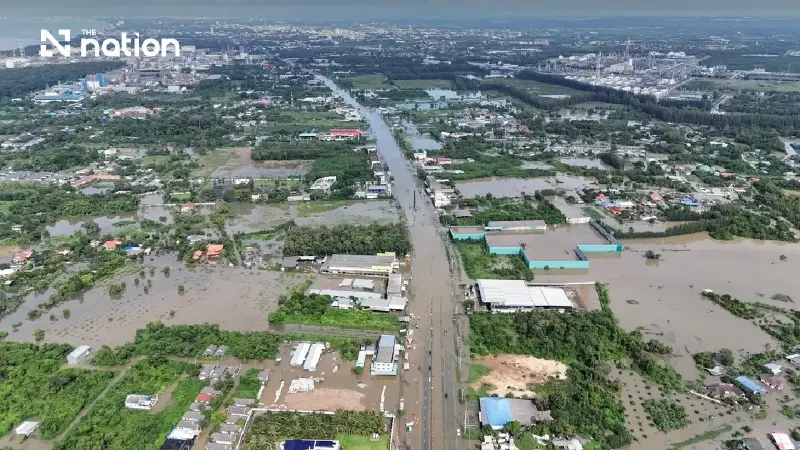


Seree Supratid’s flood model indicates little risk to inner Bangkok, while Ayutthaya and other central provinces face heavier flooding
- A flood expert predicts no repeat of the 2011 disaster, citing significantly lower accumulated water volume passing through Nakhon Sawan (4.3 billion cubic meters vs. 15 billion in 2011).
- The assessment is also based on substantially lower accumulated rainfall in the North and Central regions and a peak water flow rate far below 2011 levels.
- While inner Bangkok faces virtually no flood risk under the most likely scenario, significant impacts are still expected in neighboring provinces and low-lying districts of Ayutthaya.
- Due to the smaller water volume, the 2026 flooding is expected to last no more than one month, compared to the two-to-three-month duration of the 2011 event.
Assoc Prof Dr Seree Supratid, director of Rangsit University’s Climate Change and Disaster Center, said on Friday (October 2, 2026) that northern floodwater would not produce a repeat of Thailand’s 2011 flood disaster. Seree cited accumulated water passing through Nakhon Sawan of about 4.3 billion cubic metres, compared with 15 billion cubic metres in 2011. Seree’s most likely flood scenario indicated virtually no risk to inner Bangkok from the incoming river water. The assessment nevertheless identified continuing risks in neighbouring provinces and heavier impacts in parts of the Central region, particularly low-lying districts of Ayutthaya.
Seree, who is also vice-chairman of the National Disaster Warning Council Foundation, presented the assessment at a briefing on preparations for northern floodwater and the outlook for Bangkok and surrounding provinces. Rangsit University’s climate and disaster centre jointly organised the briefing with the foundation.
Northern rainfall and accumulated river volumes remain below 2011 levels
Seree put the accumulated floodwater passing through Nakhon Sawan at approximately 4–5 billion cubic metres, with the latest figure around 4.3 billion. The much larger cumulative volume of 15 billion cubic metres in 2011 was a central reason for his assessment that the current situation would not reach the same severity.
Rainfall accumulated in the North and Central region was also substantially lower than in 2011, according to Seree’s comparison:
|
Region |
Accumulated rainfall in 2011 |
Accumulated rainfall in 2026 |
|
North |
1,500mm |
About 1,200mm |
|
Central |
1,400mm |
About 1,000mm |
Seree cited 815 deaths and damage exceeding 1.4 trillion baht from the 2011 flood disaster. Comparable casualty and damage figures for 2026 had not yet been assessed, according to the account of his briefing.
Three flood scenarios show different risks for Bangkok and central provinces
Seree presented three scenarios based on the volume of water flowing through Nakhon Sawan, while stressing that a smaller overall volume did not mean every area would be safe.
|
Scenario |
Flow through Nakhon Sawan |
|
2011 flood reference case |
4,600 cubic metres per second |
|
Previously assessed worst case for 2026 |
3,000 cubic metres per second |
|
Most likely 2026 peak |
Approximately 2,500–2,600 cubic metres per second |
The simulation using a flow of 2,500 cubic metres per second through Nakhon Sawan showed virtually no flood risk or impact in inner Bangkok, Seree said. Under that scenario, Nonthaburi and northern Pathum Thani remained at risk of flooding.
Suphan Buri, Nakhon Pathom and Phra Nakhon Si Ayutthaya were among the areas facing the heaviest impacts in Seree’s assessment. Water levels were expected to worsen particularly in Ayutthaya’s low-lying districts of Sena, Bang Ban and Phak Hai.
Chao Phraya releases above 700 cubic metres per second affect Sena
Seree said flooding in parts of Sena district begins when releases from the Chao Phraya Dam exceed 700 cubic metres per second. At a discharge of 2,500 cubic metres per second, heavy flooding along the river becomes unavoidable, he said.
The Chao Phraya Dam can accommodate a flow of about 2,700 cubic metres per second, according to Seree. Releases reaching 3,000 cubic metres per second would constitute a severe crisis in his assessment.
Seree put the current peak flow through Nakhon Sawan at 2,600 cubic metres per second. That remained below the 3,000-cubic-metre-per-second worst-case scenario, indicating less severe damage than under that scenario.
Seree expects flooding to last no more than a month
Flooding in 2026 was expected to persist for no more than a month because the accumulated water volume was considerably smaller than in 2011, Seree said. The pace at which water recedes would depend on each province’s drainage measures and its use of pumps to remove water from low-lying areas.
Seree contrasted the current outlook with 2011, when inundation lasted two to three months and floodwater in the Rangsit University area reached depths of 2–3 metres.
Recent heavy rain had not flooded homes or buildings in the Rangsit University area, Seree said. Standing water awaiting drainage was limited to approximately 10–30cm following urgent coordination with Lak Hok subdistrict municipality to lower water levels.
Even that shallower flooding disrupted access, Seree noted: standing water around 30cm deep temporarily prevented travel out of the area for about three days.
