
Thailand prepares 4 flood scenarios for Oct 12–18 IMF–World Bank meetings
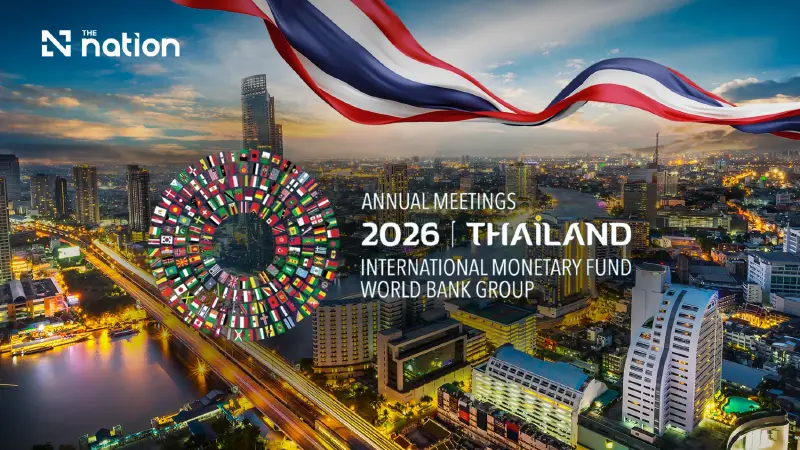


Thailand is preparing airport and immigration services for more than 10,000 delegates, with Anutin ordering measures to prevent travel disruption
- Thailand has established four contingency plans for potential flooding during the IMF-World Bank meetings, with responses escalating based on water levels.
- For minor flooding (15-25 cm), responses include accelerated drainage and switching electric car convoys to buses for safety, managed by a police command center.
- If water reaches 50 cm, making road travel difficult, a crisis team would take over and reroute delegates to the city's Skytrain and metro systems.
- The most extreme scenario, involving 3 meters of water entering the venue, would trigger a recommendation to cancel the meetings, with a final decision made jointly by top IMF, World Bank, and Thai officials.
Prime Minister Anutin Charnvirakul on October 5, 2026, ordered tighter airport and travel preparations for more than 10,000 people attending the International Monetary Fund (IMF)–World Bank Group Annual Meetings in Bangkok. Officials also reviewed four flood contingency scenarios, including transport changes and a procedure for deciding whether to cancel in an extreme emergency.
The 2026 IMF–World Bank annual meetings will take place at the Queen Sirikit National Convention Center on October 12–18, according to the World Bank’s published schedule. Thailand is hosting again after 35 years, offering an opportunity to present its development, challenges and economic transition alongside international discussions on economic and financial policy.
The IMF–World Bank meetings in Bangkok are expected to attract finance ministers, central bank governors, economists and civil society representatives, with a government briefing identifying participants from 191 countries.
Anutin chaired the national preparatory committee’s review at Government House, its third meeting of 2026, on October 5, a week before the IMF–World Bank event. Deputy Prime Minister and Finance Minister Ekniti Nitithanprapas and Deputy Prime Minister and Foreign Minister Sihasak Phuangketkeow also attended.
Anutin orders airport safeguards for more than 10,000 participants
Anutin instructed Airports of Thailand Plc and airlines to provide dedicated channels for all IMF–World Bank meeting participants and prevent a repeat of the previous week’s baggage-handling delays, check-in problems and flight cancellations. Many participants would also need domestic airline services, he said.
Anutin called for urgent action on visas and immigration, close supervision of airport services and coordination across agencies. He said Thailand should demonstrate its capabilities, make a favourable impression on visitors and strengthen global investors’ confidence.
Anutin described the IMF–World Bank participants as people who directly control financial decisions, with capital and the ability to support investment. Several countries had already decided to invest in Thailand, he said, citing the attendance of national leaders, finance ministers, central bank governors and investment institutions.
“This will certainly have an impact on Thailand’s economy,” Anutin said of the IMF–World Bank meetings.
Sihasak said nearly 400 world leaders and senior figures, mainly finance ministers and central bank governors, would attend the IMF–World Bank meetings, benefiting Thailand and its economy.
Sihasak also said Anutin would travel to Singapore on October 7 to meet business leaders at the Forbes Global CEO Conference, which would bring together 400 chief executives from around the world.
Bangkok flood scenarios set out transport changes and cancellation powers
The government’s four simulated Bangkok flood scenarios would trigger responses ranging from road drainage to alternative transport and, in the most severe case, a joint decision on cancelling the meetings. The arrangements from a Government House account of emergency planning for the Queen Sirikit National Convention Center.
The emergency command arrangements for the annual meetings have three levels:
1. Police command centre: The Royal Thai Police’s Single Command and Control Operation Center (CCOC) would handle emergencies inside and outside the venue affecting participants’ safety. The national police chief or a designated representative would serve as incident commander. Fiscal Policy Office director-general Vinit Visessuvanapoom, representing the host and serving as deputy chairman of the relevant subcommittee, would manage incidents jointly with operational units.
2. Meetings crisis team: The Meetings Secretariat Crisis Management Team (MSCMT) would decide matters affecting the schedule and logistics and assess major issues before referring them to senior management. The team comprises the World Bank and IMF meetings secretaries and representatives of the host country.
3. Top Management: The World Bank Group president, IMF managing director, Thai finance minister and Bank of Thailand governor would decide major matters, including cancellation or significant changes to the meeting format.
The four water thresholds discussed for the annual meetings were hypothetical planning scenarios:
1. 15 centimetres of water on roads: Decision-making would remain with the police command centre. Bangkok district directors would accelerate drainage and clear roads, while closed-circuit television and convoy-tracking systems would be checked to support movements involving more than 400 vehicles.
2. 25 centimetres, with no safe routes for electric cars: The police command centre would retain authority. The Fiscal Policy Office director-general would order all BMW electric-car convoys to switch to buses for traffic safety.
3. 50 centimetres, making road travel difficult: Authority would move to the meetings crisis team, which would switch delegates from car convoys to the Bangkok Mass Transit System (BTS) Skytrain and Mass Rapid Transit (MRT) metro services. Participants would use the MRT connection into the convention centre.
4. Three metres, with water entering Level G of the venue: The meetings crisis team would recommend cancellation for safety. The Finance Ministry’s permanent secretary would submit the matter to Top Management for discussions involving the World Bank Group president and IMF managing director, leading to a joint decision to end the meetings.
Anutin points to stronger exports and possible year-end stimulus
Anutin said improving exports supported his confidence in Thailand’s third-quarter economy in 2026, while the government remained ready to introduce further year-end stimulus as conditions required to meet its growth target.
Anutin described assessments by Moody’s, S&P Global Ratings and Fitch Ratings, the three major internationally recognised credit-rating agencies, as reflecting Thailand’s stability and a positive view of the country.
Anutin said third-quarter export values in 2026 were showing signs of improvement, agricultural exports had increased and he expected gross domestic product to rise. He said a fuller assessment across economic indicators would have to await figures from the National Economic and Social Development Council in two to three weeks.
Ekniti sets out three pillars for Thailand’s economic transition
Finance Minister Ekniti Nitithanprapas said Thailand needed to preserve stability, restructure its economy and invest for future growth under a three-part “STI” strategy. He outlined the approach at Thai Post’s 30th-anniversary forum, “Looking back, looking ahead and shaping Thailand’s future”.
Ekniti said a volatile, fragmented world with weakening rules required Thailand to build firm foundations while creating new opportunities through three pillars:
1. S: “Stabilize Today”: Ekniti said Thailand must address longstanding weaknesses, including slow economic growth associated with low investment since the 1997 financial crisis. Financial and fiscal stability must remain priorities to avoid the risks seen in major economies where bond yields rose as investor confidence weakened.
Ekniti argued that Thailand’s public debt relative to gross domestic product compared favourably with countries such as the United States and Japan, reflecting fiscal discipline. He cited a change in Thailand’s credit-rating outlook from negative to stable as evidence of that discipline.
Ekniti also called for action on household debt and small and medium-sized enterprises’ limited access to credit. Cooperation with the Bank of Thailand through the “Clear Debt Fast, Move Forward” programme, together with additional liquidity for smaller businesses, would help support the grassroots economy, he said.
2. T: “Transition Now”: Ekniti called for immediate economic and energy restructuring, saying Thailand’s dependence on imported oil and natural gas was equivalent to almost 10% of gross domestic product.
Ekniti said overseas conflicts and wars had damaged global energy infrastructure and driven up oil prices, contributing to Thailand’s current-account deficit in the second quarter of 2026 of 600 billion baht.
Ekniti urged faster adoption of clean energy and improvements to the electricity transmission network to reduce exposure to expensive oil and energy imports. The transition would also allow households to become electricity sellers as well as consumers, reducing expenditure and generating income, he said.
3. I: “Invest for Tomorrow”: Ekniti said stability and restructuring must be followed by investment in machinery, technology, modern infrastructure and people. Upskilling and reskilling workers would help Thailand prepare for an ageing society.
Ekniti said revised Board of Investment rules were intended to turn investment commitments into actual projects through Thailand FastPass and Thailand Skill Bridge. Foreign investors would be required to connect their supply chains with Thai small and medium-sized enterprises and transfer technology to Thai universities, including Suranaree University of Technology and Thammasat University, particularly in artificial intelligence and semiconductors, where Thailand serves as a manufacturing base.
