
Thai customs reports 9,670 tonnes of imported waste seized in 11 months
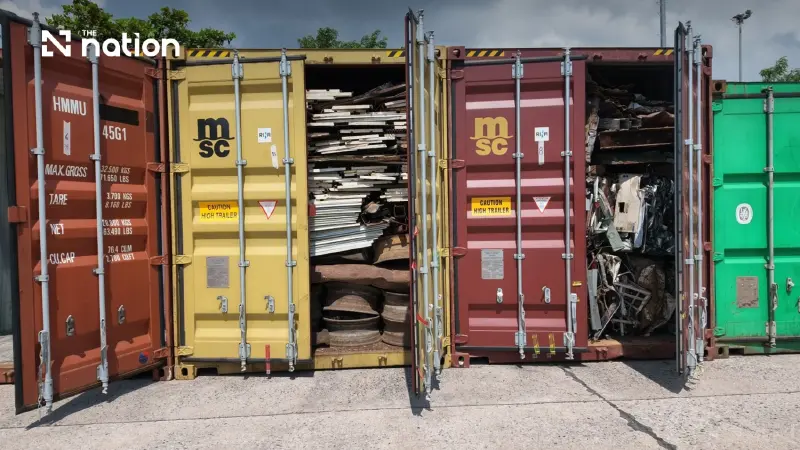


Customs figures cover 11 months of fiscal 2026, while checks at Laem Chabang and a wider inquiry target suspected illegal waste shipments.
- Thai customs seized 9,670 tonnes of imported waste, valued at over THB234.4 million, during an 11-month period from October 2025 to August 2026.
- The seized materials primarily consisted of hazardous substances, including 6,600 tonnes of hazardous waste, 2,700 tonnes of electronic waste (e-waste), and over 300 tonnes of plastic scrap.
- Illegal shipments were often concealed through false declarations, with some containers from the United States found to contain electronic waste disguised as aluminium scrap.
- An investigation into a transnational network is now underway, targeting 825 suspect containers linked to companies in the United States and Thailand.
Thailand faces a major environmental challenge after the Customs Department reported 187 environmental cases involving the seizure of 9.67 million kilograms of waste shipped into the country, approximately 9,670 tonnes, worth more than THB234.4 million.
The figures cover the first 11 months of fiscal 2026, from October 2025 to August 2026, and represent cumulative seizures from sustained efforts to stop hazardous waste reaching communities.
What was found in the seized shipments
Most of the waste seized posed a hidden threat to health and ecosystems.
It comprised about 6.6 million kilograms of hazardous waste, about 2.7 million kilograms of electronic waste (e-waste) and more than 300,000 kilograms of plastic scrap.
Without interception, these materials would cause extensive, long-term pollution in Thailand.
Opening containers at Laem Chabang
The latest round of intensified inspections began on Monday (September 14, 2026), when Natural Resources and Environment Minister Suchart Chomklin led a joint team from the Customs Department, the Pollution Control Department, the Department of Industrial Works and the Department of Special Investigation (DSI) to open and inspect suspect cargo containers at the Hutchison terminal at Laem Chabang Port in Chonburi.
The operation followed an alert from the Basel Action Network (BAN) to monitor 31 containers shipped from the United States.

‘Deception’ through false declarations and mixed cargo
Opening randomly selected containers for inspection revealed a sophisticated method of concealment.
Six containers from the United States had been falsely declared as aluminium scrap and unusable items, but were found to contain electronic circuit board scrap concealed among the cargo.
Inspections of containers from other countries, including Poland, the United Kingdom and New Zealand, found that the goods matched their declarations, with no contamination detected.
Transnational network inquiry covers 825 suspect containers
The government is widening the investigation to examine networks involved in the shipments, urgently checking an initial list of 825 suspect containers linked to seven exporting companies in the United States and 16 importing companies in Thailand.
Inspections have already found violations involving 151 containers.
The emphasis is on using evidence to pursue legal action fairly in each case.

Safeguards under the ‘Basel Convention’
The illegal imports constitute violations of the Hazardous Substance Act 1992 and the Basel Convention.
Amendments to the international rules, which took effect on Wednesday (January 1, 2025), require all transboundary movements of e-waste to receive prior informed consent (PIC) from the destination country.
The aim is to close loopholes that allow waste to be falsely declared as other goods.
Intercepting waste at ports is only the first stage.
The real challenges lie in the work that follows, including taking legal action against those responsible for offences throughout the supply chain, returning hazardous waste to its country of origin and linking databases across government agencies.
The data to be linked range from customs declarations and lists of business operators to information on the factories receiving the goods.
Thailand’s path to smart environmental management
Addressing the problem ultimately requires smart environmental management, including checks at the source, controls at the destination and sustained law enforcement, to protect public health and Thailand’s ecosystems.
These measures are needed to prevent the country becoming the ‘world’s dumping ground’ for unwanted waste.
