
Thailand puts 15 provinces on flood and landslide alert for Nov 18–22
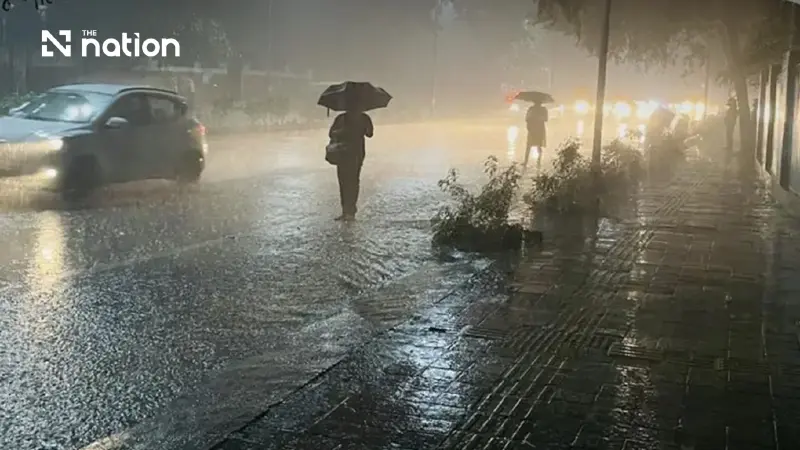


Thailand's disaster agency has put 15 central and southern provinces on alert for flash floods and landslides for November 18–22, with rescue teams ready.
- Fifteen provinces in Thailand's Central and Southern regions are on alert for floods and landslides from November 18 to 22.
- The warning was issued due to forecasts of heavy to very heavy rain caused by a strengthening northeast monsoon.
- Provincial authorities have been instructed to prepare emergency response teams, disaster-relief equipment, and evacuation shelters for affected communities.
Thailand's Department of Disaster Prevention and Mitigation (DDPM) has placed 15 provinces in the Central region and South on alert for flash floods, rapid run-off, landslides and waterlogging from November 18 to 22, as heavy to very heavy rain is expected across parts of southern Thailand.
Provincial authorities have been instructed to prepare emergency response teams, vehicles and disaster-relief equipment to assist affected communities around the clock.
DDPM director-general Nirat Pongsitthaworn, who also heads the Central Disaster Prevention and Mitigation Command, stated that the alert followed an assessment of weather conditions and flood risks, based partly on a warning issued by the Thai Meteorological Department (TMD).

Stronger northeast monsoon raises flood risks
The TMD expects persistent rain across southern Thailand, with heavy rainfall in many areas and isolated very heavy downpours.
A new moderate high-pressure system from China is expected to extend over upper Thailand and the South China Sea, strengthening the northeast monsoon over the Gulf of Thailand, southern Thailand and the Andaman Sea.
The conditions could increase the risk of flash floods and landslides, particularly in areas exposed to monsoon winds, on hillsides, near waterways and in low-lying communities.
Fifteen provinces placed on flood alert
The Central Disaster Prevention and Mitigation Command has identified 15 provinces requiring heightened monitoring and emergency preparations.
The alert covers Prachuap Khiri Khan in the Central region and 14 southern provinces: Chumphon, Surat Thani, Nakhon Si Thammarat, Phatthalung, Songkhla, Pattani, Yala, Narathiwat, Ranong, Phang Nga, Phuket, Krabi, Trang and Satun.
Emergency teams and evacuation shelters on standby
The central command has coordinated with governors in all 15 provinces and DDPM regional centres in Prachuap Khiri Khan (Region 4), Surat Thani (Region 11), Songkhla (Region 12) and Phuket (Region 18) to strengthen disaster preparedness.
Local authorities must closely monitor weather conditions, accumulated rainfall and water levels while ensuring that residents in vulnerable areas receive timely warnings.
If flooding is expected to worsen or spread, emergency personnel, heavy machinery and rescue vehicles must be positioned in high-risk locations to provide assistance 24 hours a day.
Officials have also been instructed to accelerate drainage and deploy water pumps in areas prone to repeated flooding, including locations where floodwater has yet to recede.
Safety measures will extend to natural tourist attractions, particularly caves, waterfalls and cave tunnels. Authorities must immediately close areas considered vulnerable to flash floods or other dangers and prohibit public access.
Meanwhile, provincial agencies must prepare temporary evacuation shelters in safe locations, with adequate supplies of food, drinking water, medicines and other necessities for residents who may need to leave their homes.

Residents advised to prepare emergency supplies
The DDPM has urged people living on hillsides, near waterways or in low-lying areas to closely follow official weather forecasts and emergency announcements.
Households should prepare emergency bags containing important documents, medicines, torches, spare batteries, dried food and drinking water.
Residents are also advised to move valuables, pets and vehicles to higher ground or safer locations before flooding occurs.
Electrical systems should be checked, and household power supplies must be switched off immediately if floodwater reaches electrical sockets or appliances.
People should avoid travelling or taking part in activities near fast-flowing waterways, caves and waterfalls during periods of heavy rain.
Emergency assistance available 24 hours a day
Residents affected by flooding or other natural disasters can request assistance by calling the DDPM's 24-hour emergency hotline on 1784. Reports can also be submitted through the department's official LINE account @1784DDPM.
