
Hormuz crisis revives Landbridge push with Ranong port lead
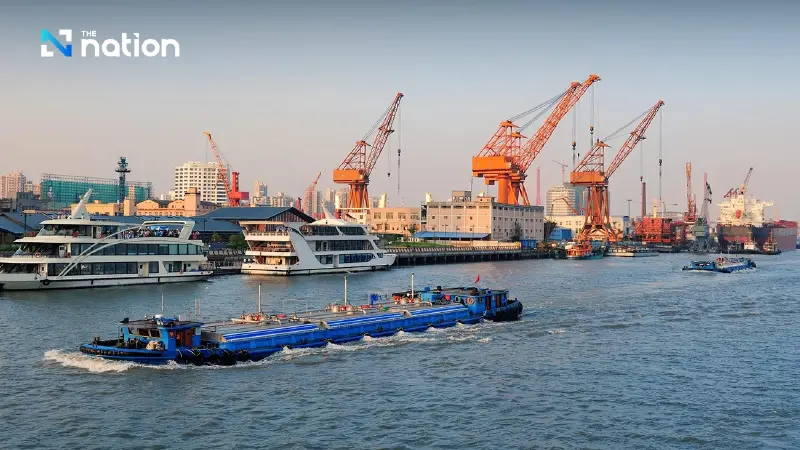


Thailand is reassessing the Landbridge project amid Middle East tensions, with Ranong deep-sea port emerging as a possible first-phase investment
Thailand’s Landbridge mega-project is once again being pushed to the forefront of national infrastructure policy, with the government reassessing its economic and geopolitical value amid growing instability in global shipping routes and energy supply chains.
The project, which aims to connect the Gulf of Thailand and the Andaman Sea through a major transport corridor across southern Thailand, has resurfaced repeatedly over the past two decades alongside proposals for the long-discussed Thai Canal project.
In 2001, the government of former prime minister Thaksin Shinawatra approved studies into the Kra Canal project, although no substantial progress followed. By 2005, the government had instead approved the Landbridge concept in principle.
Three years later, the administration of Samak Sundaravej approved a study by Dubai Port World into the Landbridge proposal, before the idea faded for nearly a decade. In 2018, the government of Gen Prayut Chan-o-cha revisited studies into the Thai Canal project.
The Landbridge proposal was later revived during Prayut’s second administration under then transport minister Saksayam Chidchob of the Bhumjaithai Party. The government of Srettha Thavisin subsequently approved the project in principle and began drafting legislation for a Southern Economic Corridor, or SEC. Dubai Port World also returned for renewed discussions with Thailand in 2023.
Now, under Prime Minister Anutin Charnvirakul, the project is being reconsidered against the backdrop of escalating geopolitical conflict in the Middle East and disruption around the Strait of Hormuz.
Government sources said the closure of the Strait of Hormuz has intensified global concern over maritime chokepoints, particularly the Strait of Malacca. Indonesian discussions over charging passage fees in the Malacca Strait, similar to Iranian toll collection in Hormuz, have also drawn attention.
Anutin has appointed a committee to study approaches for driving the Landbridge project forward, chaired by Deputy Prime Minister and Finance Minister Ekniti Nitithanprapas. The committee has been given 90 days to complete its review before the government decides on the next steps.
Ekniti said the study would reassess the project in light of changing global conditions and broaden its scope beyond earlier economic evaluations. He said the new review would include geopolitical tensions, war-related shipping disruption, environmental concerns, social impacts and local community acceptance.
The Office of the National Economic and Social Development Council, which falls under his supervision, will serve as secretary to the committee.
Deputy Transport Minister Siripong Angkasakulkiat said the review would also incorporate previous and updated studies conducted by the Office of Transport and Traffic Policy and Planning, or OTP, including work prepared by private consultants.
He noted that earlier discussions around the Landbridge had focused mainly on rail systems, while largely overlooking the potential role of oil and gas pipelines.
According to Siripong, pipeline infrastructure could significantly shorten transport times. Thailand currently has pipeline systems mainly serving the eastern region, but the Landbridge could allow similar infrastructure to be developed on the western side of the country.
He also said it would be possible to begin development gradually by prioritising certain components first, particularly through public-private partnership, or PPP, investment models involving both Thai and foreign investors.
“The government will not decide this alone,” Siripong said. “Consultants, investors and all stakeholders will take part in the study process, and we are listening to proposals from every side.”
Asked whether Thailand could eventually return to the Thai Canal concept if the Landbridge proved commercially unviable, Siripong said current studies clearly showed the Landbridge offered stronger economic returns.
He said the Landbridge would require investment of around ฿900 billion, while the Thai Canal project would cost roughly ฿2 trillion.
Studies have shown that the Landbridge delivers a higher financial internal rate of return, or FIRR, making it the more economically attractive option, he said.
“As things stand today, the Landbridge is far more worthwhile. The Thai Canal would only be considered as a last resort because it offers lower returns,” he said.
Government sources said the administration is now examining whether a phased investment model could make the project more achievable, given the enormous scale of the required capital even if the state does not directly fund construction.
One option under discussion is to prioritise investment in Ranong deep-sea port to strengthen Thailand’s western maritime gateway and create stronger trade links to India, Sri Lanka, the Middle East and Europe through the Andaman Sea.
Officials also believe the Ranong port could attract logistics operators transporting goods from southern China to destinations such as Myanmar, Bangladesh, India and Sri Lanka.
At the legal level, the government is also considering whether the Eastern Economic Corridor Act, or EEC Act, could temporarily be used to designate investment promotion zones in southern provinces before the proposed Southern Economic Corridor law is enacted.
The draft SEC bill has not yet been submitted to Cabinet, raising concerns that legal limitations could delay infrastructure investment in the South.
Under this alternative approach, investment projects, particularly large-scale infrastructure developments, could proceed without waiting for new SEC legislation to formally take effect.
Meanwhile, revised OTP studies have lowered the projected Landbridge investment cost to ฿990 billion from an earlier estimate of ฿1 trillion after adjustments to the project’s scale.
The revised plan divides development into multiple phases, beginning with Phase 1/1 between 2030 and 2031, valued at ฿617 billion, followed by Phase 1/2 between 2032 and 2034 worth ฿174 billion, and Phase 1/3 between 2035 and 2053 worth ฿205 billion.
Phase 2, covering 2054-2079, has not yet been costed and will depend on the outcome of the earlier stages.
OTP is currently studying a PPP Net Cost investment model involving a 50-year concession. The bidding process would follow a “One Port, Two Sides” concept, allowing a single operator to construct and manage the entire system under one contract.
Investors would need extensive experience in port operations and shipping lines, as well as strong financial capacity to support the project.
OTP director Jiraroj Sukolrat said geopolitical developments in the Middle East and potential toll collection in the Strait of Malacca had prompted the government to review the project’s investment value once again.
However, OTP’s studies continue to indicate that the Landbridge remains economically viable, with an economic internal rate of return, or EIRR, of 11.9% and a FIRR of 8.2%.
The project is also expected to create more than 200,000 jobs.
While the Finance Ministry conducts its 90-day review, OTP will continue parallel legal preparations because the Landbridge ultimately depends on the Southern Economic Corridor Act and the establishment of a dedicated SEC office to oversee investment in the South.
OTP expects the SEC bill to reach Cabinet within June before proceeding to parliamentary deliberation.
Officials said this route would likely deliver the fastest timeline for the Landbridge project, as attempts to rely on the EEC law instead could require further amendments and potentially take longer.
OTP also noted that its completed studies do not yet include oil pipeline infrastructure, focusing instead on deep-sea ports, dual-track railways and motorways. However, land has already been reserved within the project design to accommodate future oil pipeline development if policymakers decide to proceed.
Officials believe adding oil pipeline infrastructure would improve the project’s commercial value further while also strengthening long-term energy security in southern Thailand, which currently depends heavily on oil transported from eastern ports at relatively high logistics costs.
