
Thailand seeks THB3bn to revive tourism co-payment subsidy and boost domestic travel
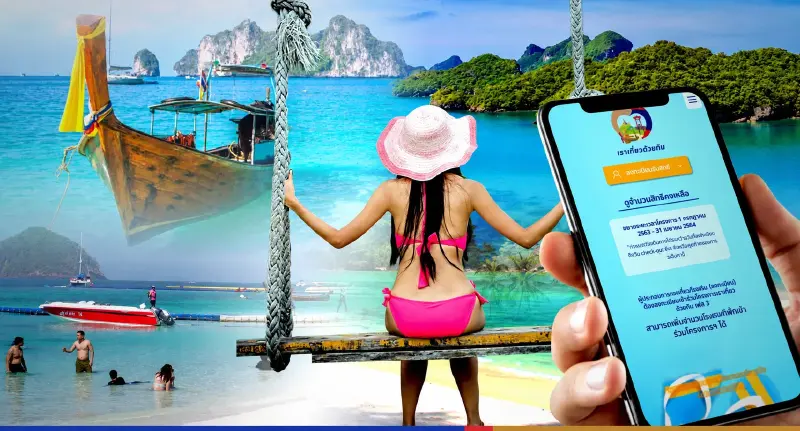


Tourism Ministry plans a THB3bn co-payment scheme, free domestic flights for foreign tourists and a revised tourist entry fee from 2027
- Thailand's Tourism and Sports Ministry is seeking at least THB 3 billion from the 2027 central budget to fund a co-payment scheme to boost domestic travel.
- The program aims to subsidize hotel stays and tourism services for domestic travellers, offering up to THB 3,000 per person for an initial 1 million entitlements.
- Bookings for the scheme are expected to open in the fourth quarter of 2026, and it will be managed through the existing Paotang mobile application.
Co-payment scheme returns to the table
Thailand’s Tourism and Sports Ministry is preparing to revive a state-backed tourism co-payment scheme as part of a wider push to stimulate travel in the second half of 2026.
Tourism and Sports Minister Surasak Phancharoenworakul said the ministry expects to seek at least THB3 billion from the 2027 central budget to support the programme, which would subsidise hotel stays and tourism services for domestic travellers.
Bookings are expected to open in the fourth quarter of 2026, with the scheme initially planned to offer at least 1 million entitlements. Based on the proposed budget, state support would be worth up to THB3,000 per entitlement.
The final co-payment ratio has not yet been settled. Officials are still considering whether the government and the public should split costs at 50:50 or 60:40.
Surasak said the funding request would not come from the government’s THB400-billion borrowing decree, but from the 2027 central budget. The ministry is also finalising the official name of the scheme, after earlier governments used names such as “We Travel Together” and “Thai Travel Co-payment” for previous domestic-tourism stimulus programmes.

Paotang app to remain the main platform
Deputy Prime Minister and Commerce Minister Suphajee Suthumpun, who supervises the Tourism and Sports Ministry, has asked officials to design a system that is easy to use and efficient for the public.
Surasak said there would be no new application under his policy. Instead, the scheme would continue to use the Paotang app, which he said is stable, widely known and already familiar to users.

Free domestic flights proposed for foreign visitors
Beyond the co-payment plan, the ministry also wants to push other stimulus measures for central-budget funding.
One proposal is “Buy International, Free Thailand Domestic Flights”, which would offer free domestic air tickets to foreign tourists who buy international flights into Thailand.
The idea has been waiting in the pipeline since the previous government and is intended to encourage international visitors to travel beyond their entry city and spend more across domestic destinations.
Another proposal is “Thailand Summer Blast”, under which the government would support charter flights and work more closely with airlines to bring in travellers.


Tourist arrival fee may rise to THB300-500
Surasak also gave an update on the long-discussed Travel Fee, widely known in Thai as the “landing fee” or “tourist arrival levy”, which would be collected from foreign tourists and paid into the Thailand Tourism Promotion Fund.
The idea has been under discussion for seven to eight years, dating back to the period when Phiphat Ratchakitprakarn served as tourism and sports minister.
The latest proposal could see the fee for foreign tourists arriving by air adjusted to THB300-500 per person per trip, compared with the earlier rate of THB300. The ministry expects collection to begin in early 2027, after talks with airlines on the collection method are completed and the insurance-premium details are finalised.
The plan follows earlier efforts to revive the tourist entry fee, with the proceeds intended to support visitor care, tourism development and insurance coverage for foreign tourists. Previous versions of the policy had centred on a 300-baht levy, while later discussions indicated the charge could exceed that level.

Tourism fund aimed at sustainability
Surasak said Thailand needs the arrival fee because the revenue would support long-term tourism sustainability.
He said many major tourism cities now require budgets to manage natural and public resources, handle waste, improve roads in worn-down tourist areas and provide care for visitors.
Part of the revenue would be used to buy insurance coverage for foreign tourists, helping reduce the government’s annual burden of THB300-400 million in medical expenses for foreign visitors that cannot otherwise be reimbursed.
The insurance would provide additional coverage separate from any insurance purchased by tourists themselves.

Air ticket collection preferred
The ministry wants the fee to be collected through air tickets and is still in talks with airlines on how that could work.
If the fee is collected through tickets, Thai passport holders who pay when buying air tickets would receive an immediate refund, as fund rules clearly prohibit the collection of the fee from Thai nationals.
If no agreement can be reached with airlines, the ministry would collect the fee directly from foreign tourists through the Thailand Digital Arrival Card, or TDAC, the digital entry system for foreign travellers entering Thailand.
Tourism and culture merger moves forward
Surasak said the plan to restructure two ministries by separating tourism from sport and merging it with the Culture Ministry would be a positive move.
Under the proposed structure, tourism would be placed under a new Ministry of Culture and Tourism, while sport would be handled by a dedicated Ministry of Sports.
He said bringing tourism and culture together would make work easier and allow Thailand’s cultural assets to better support tourism development.
The restructuring is expected to be completed by the end of 2026, in line with the timeline set by the Office of the Public Sector Development Commission.
Draft structure expected by July
Work on the draft structure has made significant progress, with officials now discussing details on missions, agencies and workforce allocation for the two ministries.
The draft is expected to be completed by July before being submitted to the Cabinet for in-principle approval. It would then proceed to parliamentary consideration under the legal process.
The new tourism side would include key agencies such as the Department of Tourism, the Tourism Authority of Thailand, the Designated Areas for Sustainable Tourism Administration and the Tourist Police Bureau.
The sports side would include the Department of Physical Education, the Sports Authority of Thailand and Thailand National Sports University.
For overlapping missions, particularly those under the Office of the Permanent Secretary, responsibilities and personnel would be separated according to suitability and expertise to ensure the most effective implementation.
Foreign arrival target likely to be raised
Surasak said the Tourism Authority of Thailand is preparing to raise its 2026 foreign-arrival target from the previous forecast of 33 million visitors.
The review follows signs that tensions between the United States and Iran are easing, helping restore traveller confidence.
From January 1 to June 20, Thailand received 15.45 million foreign tourists, down 2.78% from the same period last year. Although the figure remained negative, the decline was smaller than expected.
Surasak said the impact of the Middle East conflict had been less severe than initially feared. With the situation beginning to stabilise, the ministry believes Thailand’s foreign-tourist target can be lifted.
Visa rules shift towards quality tourism
The government is also moving to focus more on visitor quality and spending, rather than simply chasing arrival numbers.
The Cabinet has approved the cancellation of the 60-day visa-free measure, known as P.60, for tourists from 93 countries and territories, with entry rules to return to the previous criteria for each country.
For some target markets, such as India, the government will consider a new 15-day visa-free measure, or P.15, instead of the previous visa-on-arrival requirement.
The Foreign Ministry will also consider granting a standard 30-day visa-free stay, or P.30, to all European Union member countries, while non-EU countries will be considered individually.
The visa adjustment follows Cabinet approval to scrap the 60-day exemption for 93 countries and territories, with most travellers expected to return to shorter stay periods under earlier rules.
Surasak acknowledged that ending the 60-day visa-free measure may reduce immigration numbers, but said Thailand would gain more genuine tourists.
He added that the economic value of tourism in 2026 is expected to be close to last year’s level, but will not jump back to the 2019 level, when total tourism revenue reached THB3 trillion.
He said a full return to that level is not realistic under current global economic conditions, although the energy situation has improved and helped ease some concerns.
“If we can maintain total tourism revenue this year at the same level as last year, that would already be very good under the current global economic situation,” Surasak said.
