Thailand’s Cabinet gives ministries three months to justify regional offices and submit one-year plans for mergers, transfers or digital services
The Thai Cabinet has ordered a review of 3,708 regional state offices and has frozen the creation of new central-government field offices in the provinces.
Ministries have three months to justify the continued operation of these offices, with potential outcomes including closure, merger, or transfer of responsibilities.
The review aims to reduce overlapping structures, lower long-term government expenditure, and improve public services.
Restructuring plans will promote the consolidation of offices under a "One Roof" model and the greater use of digital technology to replace physical branches.
Thailand’s Cabinet has frozen the creation of new central-government field offices in the provinces and ordered ministries to review existing regional structures, with 3,708 units singled out for scrutiny.
The decision does not automatically close all 3,708 units.
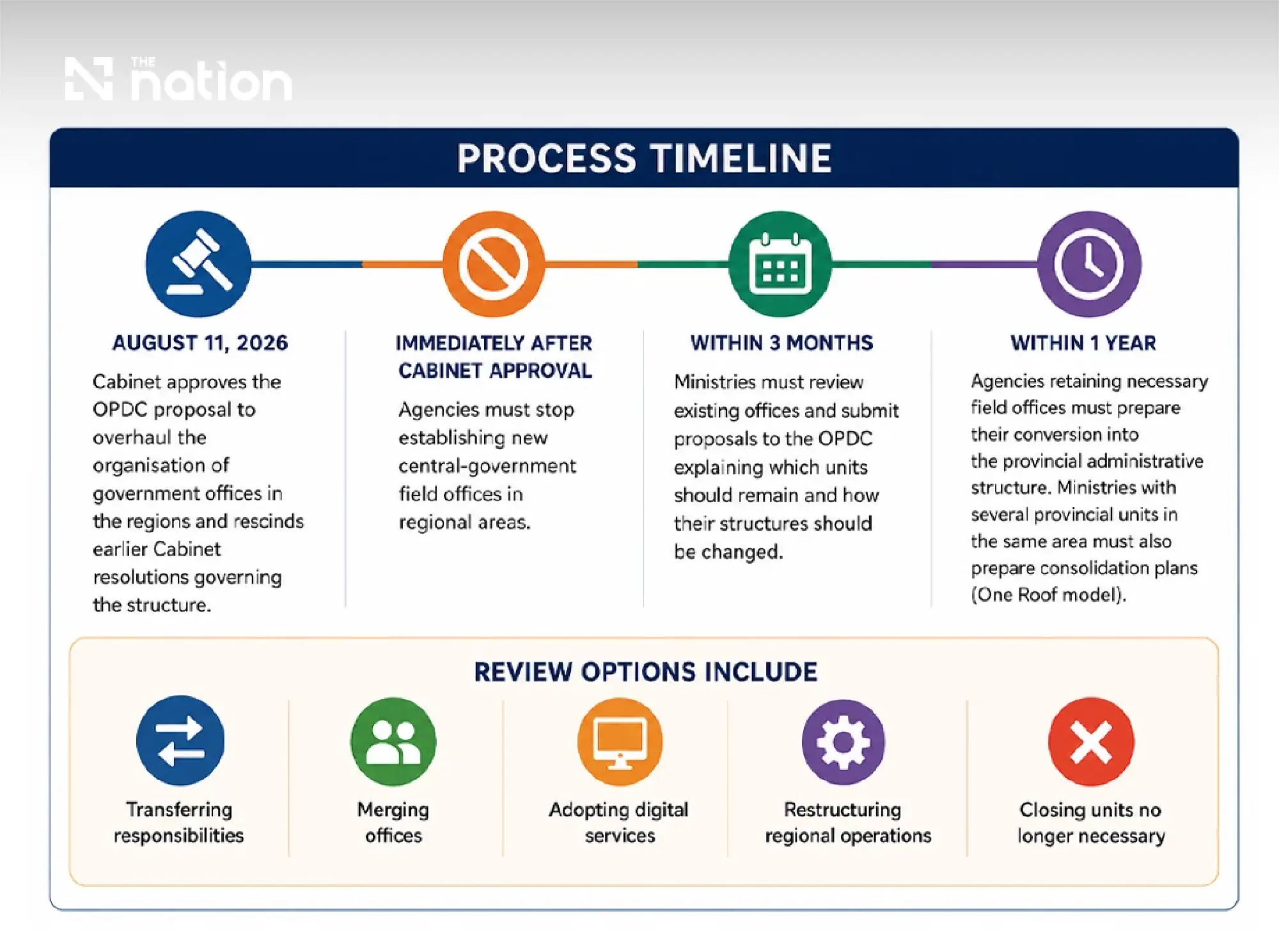
Ministries have three months to justify their continued operation and propose closures, mergers, transfers of responsibilities, greater use of digital services or conversion into the provincial administrative structure.
Offices that remain necessary must be covered by restructuring plans spanning one year.
Provincial units belonging to the same ministry may also be consolidated under a single agency through the government’s “One Roof” model.
The Cabinet approved the measures on Tuesday (August 11, 2026), accepting a proposal from the Public Sector Development Commission to rescind Cabinet resolutions dated April 4, 2017, and September 18, 2007.
The government said the previous arrangements did not fully correspond with the State Administration Act B.E. 2534 (1991), which divides state administration into central, provincial and local systems.
The changes are intended to reduce overlapping structures, lower long-term expenditure and improve public services.
Deputy Prime Minister Pakorn Nilprapunt, who chairs the Public Sector Development Commission, said central departments had established branches in provinces that duplicated some responsibilities of provincial governors, although the category of central administration operating in the regions was not provided for under the Act.
Pakorn said personnel affected by restructuring could seek transfers back to central offices or join a voluntary early-retirement programme.
Online platforms and computer systems could replace some services currently provided through physical branches.
Under the Cabinet resolution, government agencies must:
Stop establishing new central-government field offices in the provinces and review whether existing offices remain necessary. Agencies must consider transferring duties to local administrative organisations or other sectors and using digital technology instead. Any necessary office must be covered by a one-year proposal to convert it into part of the provincial administration, submitted to the Office of the Public Sector Development Commission (OPDC) within three months.
Review existing provincial administrative units and consolidate offices belonging to the same ministry in the same area under a single agency through the One Roof model. One-year consolidation proposals must also reach the OPDC within three months.
Suspend proposals for further structural changes until the OPDC has completed its consideration of the ministries’ submissions.
Consult the OPDC before establishing units under laws that authorise ministers to issue ministerial regulations or notifications. The OPDC’s opinion must accompany the matter when it is submitted to the Cabinet.
Seek the OPDC’s opinion before holding public consultations on new draft laws that would establish government offices or agencies in the provinces.
Regional system comprises 10,010 units
OPDC figures showed that Thailand had 10,010 division-level government units operating in the regions as of June 2026, up from 9,990 before 2017.
The total comprised:
2,496 provincial-level administrative units
5,321 district-level administrative units
2,193 central-government field offices
The figures exclude the Defence Ministry, the Education Ministry and the Royal Thai Police, which are governed by specific legislation.
The increase involved seven agencies: the Office of the National Water Resources, the Budget Bureau, the Customs Department, the Department of Mineral Resources, the Department of Marine and Coastal Resources, the Office of the Permanent Secretary for Justice and the Department of Skill Development.
The OPDC identified 3,708 units established under ministerial regulations or other laws without undergoing the review process set by the previous Cabinet framework.
They account for about one-third of the 10,010 regional units.
Examples include regional treasury offices, highway districts, rural highway districts and customs checkpoints.
Thailand also has 7,842 local administrative organisations.
The regional government workforce comprises 438,470 civil servants, government employees and permanent employees, excluding local-government personnel and Bangkok Metropolitan Administration staff.
The OPDC concluded that the number and variety of offices had produced overlapping responsibilities, confused members of the public and businesses seeking government services, slowed local problem-solving and required extensive resources.
The One Roof model would place units belonging to the same ministry in a particular area under one administrative body.
Provincial commerce offices were cited as an example of this approach.
The government also wants agencies to expand e-services for work that can be completed online, reducing the long-term need for additional offices and personnel.
Customs awaits details of proposed changes
Customs Department director-general Phantong Loykulnanta said to Krungthep Turakij that he had not yet received the detailed resolution but expected the review to affect numerous agencies rather than Customs alone.
He said each position, staffing allocation and provincial office would require careful consideration before the department could explain why particular customs units remained necessary.
“We have not yet received the details. We need to examine the staffing levels, positions and provinces involved,” Phantong said.
Should the review find some customs checkpoints unnecessary, the department could redistribute staff and use technology to maintain or improve operational efficiency.
“Any office that is not needed could be closed and its staff reassigned. We will also consider whether technology can help,” he said.
The Customs Department will determine its response after receiving complete information from the agencies responsible for the review.