
Thai Senate weighs Anutin’s THB400bn energy loan decree
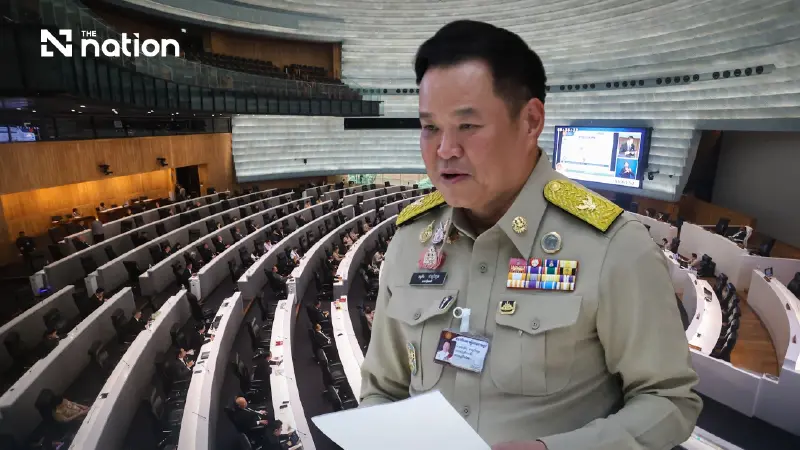


Anutin defended emergency borrowing before senators, saying ordinary budget channels lacked the speed and scale to tackle the energy crisis.
Prime Minister Anutin Charnvirakul defended the government’s use of emergency powers before the Senate on Monday (August 31, 2026), urging senators to approve a decree authorising the Finance Ministry to borrow up to THB400 billion.
Anutin, who also serves as interior minister, presented the borrowing as an unavoidable response to the energy crisis and a way to accelerate Thailand’s transition away from imported fossil fuels.
The decree was listed as urgent business at a special Senate sitting that began at 9am. Gen Kriangkrai Srirak, First Vice-President of the Senate, chaired the meeting.

Anutin told senators that normal budgetary and legislative mechanisms could not provide sufficient funding with the speed and flexibility required. He described the borrowing as the government’s last resort after attempts to manage the crisis through existing fiscal resources.
The Cabinet approved the enactment of the Emergency Decree Authorising the Ministry of Finance to Borrow Money to Address the Impact of the Energy Crisis and Support the Country’s Energy Transition B.E. 2569 (2026) on May 5. It was published in the Royal Gazette and took effect on May 9.
The Constitutional Court ruled on July 9 that the decree met the requirements of Section 172, paragraph one, of the Constitution. The provision permits an emergency decree when the Cabinet considers it necessary to protect the country’s economic security and when an unavoidable emergency requires urgent action.
Such a decree must subsequently be submitted to Parliament for consideration without delay.
Anutin argues crisis meets emergency threshold

Anutin set out seven grounds for using an emergency decree, focusing on the scale of the global energy shock, Thailand’s dependence on imported fuel, uncertainty over the conflict, insufficient fiscal resources and the need to strengthen long-term energy security.
He described the conflict in the Middle East in early 2026 as producing a global energy crisis unlike any since the end of the Second World War.
Earlier oil-supply disruptions had involved restrictions on production and exports, he said, but had not caused comparable destruction of oil and gas fields, refineries, gas-processing facilities and energy terminals or the closure of major shipping routes.
The latest conflict had damaged energy infrastructure and disrupted maritime transport, particularly through the Strait of Hormuz, bringing production and shipments from major Middle Eastern energy sources almost to a halt, according to Anutin.

Global demand had remained largely unchanged, pushing oil prices sharply higher, while producers elsewhere could not replace all the supplies lost from the Middle East, he said.
Thailand imports nearly half of its oil from the region and still relies heavily on fossil fuels for manufacturing, agriculture, transport, distribution and services. The shift towards renewable and alternative energy remained limited, leaving the economy exposed to shortages and price volatility.
Anutin said higher fossil-fuel costs were spreading through the economy, increasing the prices of food, goods, services and transport. Agricultural costs were also rising, including the price of fertiliser and other petroleum-linked inputs.
Households were facing higher living costs while their incomes remained unchanged, weakening purchasing power. Businesses, meanwhile, were confronting higher operating costs and greater risks to production and employment.
The simultaneous pressure on household income and business costs increased the danger of an economic slowdown accompanied by high inflation, or stagflation, he said.
Anutin also warned that no one could predict when the Middle East conflict would end. Even after the fighting stopped, restoring oil and gas production and exports could take several years, and operations might never return fully to their previous state.
Continued dependence on imported fossil fuels would therefore leave Thailand and its supply chains exposed to further energy shocks, he said.
Government says existing funds are insufficient

Anutin told senators that the annual budget and other fiscal instruments could not meet the government’s urgent financing requirements.
The fiscal 2026 central budget set aside THB99 billion for emergencies and contingencies. Part of the allocation had already been used for flood and disaster relief in several areas, unrest along the Thai-Cambodian border and other national security expenditure.
The remaining central budget was therefore insufficient to cover the costs arising from the energy crisis, he said.
The government also faced about THB140 billion in additional urgent spending requirements. Anutin said that even when the remaining budget was combined with THB50 billion in reserve funds under Section 45 of the Budgetary Procedures Act, the total would still fall short.
About 72% of the fiscal 2026 budget had already been spent after more than two quarters of the financial year.
A budget-transfer bill would require procedures that might take too long, while preparing a supplementary budget would take at least two months.
The remaining borrowing capacity available to finance the budget deficit under the Public Debt Management Act B.E. 2548 (2005), as amended, stood at only about THB17 billion, which Anutin said was inadequate for measures to assist those affected by the energy crisis.
Although the government had used other fiscal measures, he said, none offered sufficient scale, speed and flexibility.
Pursuing the borrowing through an ordinary Act of Parliament would not be fast enough and could allow the economic damage to become harder to reverse, prolonging the crisis and increasing systemic risks.
Loan divided between relief and energy transition
Anutin presented the decree as having one central goal, two objectives and three methods.
The goal is to safeguard Thailand’s economic security during an unavoidable emergency requiring urgent action.
Its two objectives are to assist people, farmers and businesses affected by the Middle East crisis and to reduce fossil-fuel consumption as quickly and extensively as possible by promoting renewable and alternative energy produced in Thailand.
The three methods are:
- reducing living and occupational costs for people, farmers and businesses;
- supporting government agencies, businesses, communities and individuals in switching to domestically produced renewable and alternative energy; and
- developing skills and innovation to support the restructuring of Thailand’s energy system.
Anutin said greater use of domestic renewable and alternative energy would reduce dependence on imported fossil fuels and strengthen both energy and economic security.
Skills development and innovation would need to proceed alongside that transition so that workers and businesses could adapt to the restructuring of the energy sector, he added.
The government also viewed the shift as consistent with the global move towards cleaner energy in response to increasingly severe climate change.
Of the proposed borrowing, THB200 billion would be allocated to assistance for people, farmers and businesses affected by the crisis.
The remaining THB200 billion would be used to improve energy efficiency, accelerate the transition towards renewable and alternative energy and support energy-related skills and innovation.
With Cabinet approval, the Finance Ministry would be permitted to borrow money or issue debt instruments. Loan agreements or debt issuance would have to be completed by September 30, 2027.
Anutin promises screening and debt controls
Anutin insisted that the borrowing would remain within Thailand’s fiscal-discipline framework.
The government expected the public debt-to-GDP ratio to remain below 70% and would prepare a systematic borrowing and repayment plan to control financing costs and spread risk.
Projects seeking money under the decree would have to undergo screening and meet several conditions.
Each project must correspond with the decree’s objectives, demonstrate urgent necessity and value for money, avoid duplication with the annual budget or other funding sources and be ready for immediate implementation.
Anutin concluded by asking senators to approve the decree, describing the energy crisis as a serious and unavoidable emergency requiring urgent action to protect economic security.
He thanked Senate members for their comments, recommendations and concerns during the debate, saying the government would take them into account.
The government would also comply fully with relevant laws and regulations to ensure that expenditure financed by the borrowing delivered the greatest possible benefit to the public, he said.
