
Ekniti closes parliamentary debate and defends energy loan decree
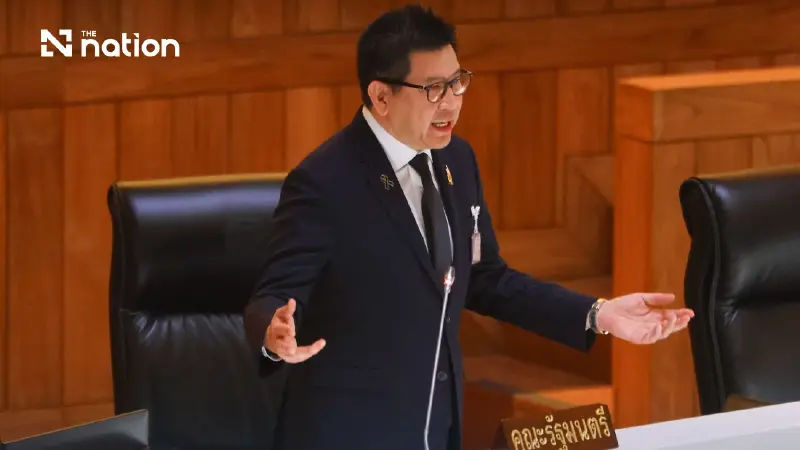


Ekniti Nitithanprapas says the emergency borrowing decree will protect households, support the energy transition and strengthen Thailand’s economy.
- Finance Minister Ekniti Nitithanprapas defended the emergency loan decree as a necessary measure to combat a severe energy crisis, which he stated has hit Thailand's economy in three waves: rising energy prices, increased living costs, and contracting purchasing power.
- The decree has two primary objectives: providing immediate relief to citizens and workers affected by the crisis, and financing a long-term energy transition to make the economy more resilient and less dependent on imported fuels.
- Ekniti addressed concerns by assuring that borrowing will be done gradually and only as needed, with a transparent screening process for all projects to ensure funds are spent effectively and for public benefit.
- He argued that reducing dependence on imported energy by developing home-grown fuels is a more sustainable solution than temporary subsidies, comparing it to fixing a leaking roof rather than just catching the drips.
Deputy Prime Minister and Finance Minister Ekniti Nitithanprapas closed the parliamentary debate on the government’s emergency borrowing decree at 8.06pm on Wednesday (August 26), insisting that the measure was necessary to address the energy crisis and strengthen Thailand’s economy for the future.
The decree authorises the Finance Ministry to borrow funds to mitigate the effects of the energy crisis and support the country’s energy transition.
Ekniti said the government had listened carefully to views from all sides during the debate. Some opinions differed, others were broadly aligned, while several points may have arisen from misunderstandings.
The central question, he said, was whether the energy crisis was sufficiently severe to justify the decree. A majority of the Constitutional Court had already determined that the situation constituted a threat to economic security.
Economy hit by three waves of pressure
Ekniti said second-quarter economic data confirmed that Thailand was facing a genuine crisis rather than merely a policy concern.
The first wave came from energy prices. Global diesel prices rose by about 60%, and although the government used the Oil Fuel Fund to ease the impact, domestic prices still increased by approximately 30%.
The second wave affected living costs and production expenses. Inflation moved from negative territory in the first quarter to almost 3%, while average costs rose by around 10%.
The third wave was a contraction in purchasing power. Consumption declined in the second quarter compared with the first, and allowing the situation to continue could eventually affect employment and force businesses to close.
“These figures demonstrate that, without a rapid government response, the crisis could leave lasting scars on the Thai economy, causing businesses to close and people to lose their jobs,” Ekniti said.
“Economic security is therefore not an abstract expression. It can be demonstrated through facts.”
Energy imports expose economic vulnerability
Responding to arguments that the energy transition was a long-term matter that could be pursued gradually, Ekniti pointed to Thailand’s current account, which recorded a deficit of nearly 600 billion baht in the second quarter.
He said the deficit reflected the country’s vulnerability arising from its heavy dependence on imported oil and natural gas.
Ekniti compared Thailand to a house with a leaking roof. Whenever it rained, the government had to place buckets underneath and repeatedly provide relief to those affected.
Reducing excise tax or subsidising energy prices would ultimately create additional borrowing requirements, he said. A less expensive long-term solution would be to repair the roof by reducing the country’s dependence on imported energy.
Decree has immediate and long-term objectives
The emergency decree therefore has two objectives.
The first is to support people affected by the current crisis, including state welfare cardholders, middle-income consumers, lower-income people, transport workers, delivery riders and motorcycle taxi drivers.
The second is to finance the energy transition and make Thailand’s economy more resilient.
Ekniti said all sides agreed that every baht must be spent effectively and transparently.
The government had therefore made transparency a central principle in its project-screening process. Every proposal must demonstrate that it genuinely benefits the public, provides value for money, can be publicly disclosed and complies with the decree’s objectives.
No ready-made projects reflects caution
Ekniti said the absence of completed projects waiting for immediate approval was not a weakness but evidence of caution.
It would be more concerning if the government simply recycled and repackaged old projects for rapid submission, he said.
The decree has narrowly defined objectives covering relief for people affected by the crisis, reduced dependence on imported energy and the development of new skills for Thai workers.
The government also wants to increase the use of home-grown fuels, including biodiesel made from palm oil and ethanol produced from sugarcane and cassava.
This would allow the benefits to reach Thai farmers and the wider public instead of leaving the economy dependent on imported energy.
Borrowing to be carried out only as needed
Ekniti also sought to correct what he described as a misunderstanding that the government would borrow the full amount immediately, leave the money unused and incur interest expenses.
He said the government would borrow gradually and only when necessary.
Thailand continued to maintain fiscal discipline, he added, while credit-rating agencies remained confident in the country and its borrowing costs were still relatively low.
“The government under Prime Minister Anutin Charnvirakul wants to support people and the economy today while moving towards clean energy, energy that can be produced by Thai people, and investment for the future,” Ekniti said.
“The aim is to ensure that Thailand emerges from this crisis stronger than before.”
House approves emergency borrowing decree by 285 votes
Following the debate, the House of Representatives voted to approve the emergency borrowing decree, allowing it to remain in force as law. The measure received 285 votes in favour, with 141 MPs voting against and 52 abstaining.
