
Deep State Scenario:'Change of PM' as legal warfare pressures Thaksin
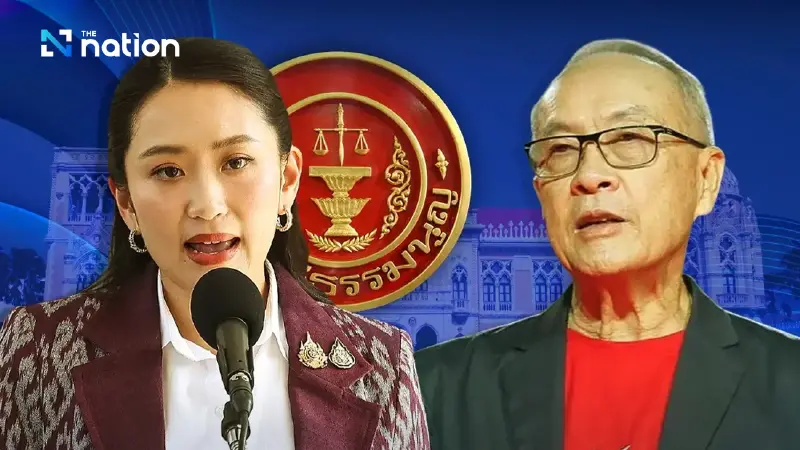


In the scenario where Prime Minister Paetongtarn Shinawatra can not continue due to the voice recording controversy with Hun Sen, a new deal may emerge to replace the Prime Minister. If it's not Chaikasem Nitisiri, the Pheu Thai Party candidate, Thailand's political scene could witness the return of a former leader to the Prime Minister’s chair.
The ruling coalition was immediately shaken after the Constitutional Court unanimously agreed to hear the petition filed by Mongkol Surasajja, President of the Senate, on behalf of 36 senators.
They requested the Court to rule on the status of Prime Minister Paetongtarn Shinawatra regarding a controversial voice recording of a conversation with Cambodian Senate President Hun Sen about the Thailand-Cambodia border situation, which could potentially breach Articles 170(1),(4) and 160(4) and (5) of the Constitution.
The Constitutional Court judges voted 7-2 to suspend Paetongtarn from her duties as Prime Minister until a final ruling is made.
The suspension of Paetongtarn's duties before the new cabinet members take their oath on July 3, 2025, undeniably damages her political credibility.
This development echoes the same allegations made against former Prime Minister Srettha Thavisin, who was removed from office following a Constitutional Court ruling with a 5-4 vote, citing concerns over integrity and serious breaches of ethical standards.
Unlike Srettha, who was not ordered to suspend his duties, the "30th Prime Minister" ultimately lost his seat after the Constitutional Court's final decision.
In Sreththa's case, the Court accepted the petition on May 23, 2024 and ruled on his removal on August 14, 2024, taking nearly three months to process the case.
Though the circumstances of Paetongtarn's case differ in terms of factual proceedings, the legal "weapon" to unseat her revolves around accusations of a breach of "ethical standards"—the same charge that led to Srettha's downfall.

Public law experts view this as a political manoeuvre that employs "abstract" interpretations, leaving room for ambiguity and making it difficult to definitively determine whether the actions are right or wrong, black or white.
It is undeniable that after the 2023 election, the “deep state” apparatus continues to influence Thailand’s political direction, largely through the Senate and constitutionally mandated institutions such as the Constitutional Court.
This can be seen from the transition of power from Srettha to Paetongtarn in 2024, which was still undermined by the actions of the Senate, following the specific provisions of the 2017 Constitution.
However, the power to dissolve the House of Representatives, while passed to the Deputy Prime Minister who assumes the role of acting Prime Minister in the event the “Prime Minister” is unable to perform their duties, has sparked legal debate.
Public law experts interpret that the acting Prime Minister holds full authority under the law, enabling them to make cabinet reshuffles, govern the country, and bring a new cabinet for the oath of office, as prescribed by Article 161 of the Constitution. This authority is considered absolute, as granted by the Constitution.
This means that Suriya Jungrungreangkit, as acting Prime Minister, has the power to bring new ministers to take the oath of office. Similarly, if the power to dissolve the House passes to Phumtham Wechayachai, the Deputy Prime Minister and Minister of the Interior, he would also have the authority to dissolve the House if Paetongtarn is unable to perform her duties.
Looking at the stance of each political party in parliament, only the People’s Party has clearly expressed its position, calling for the dissolution of the House.
On the other hand, Bhumjaithai Party has started voicing through Chada Thaiseth, the Uthai Thani MP, that dissolving the House is the solution to the political crisis. In a way, the Bhumjaithai Party is not disadvantaged by this, as it has already secured its position during the period it controlled the Ministry of the Interior.
The coalition government, led by the Pheu Thai Party, is not yet ready for the dissolution of the House, as it has not yet fully gained control over the Ministry of the Interior, which is crucial for advancing its policies.
Other coalition parties, which together command over 260 seats, are also not yet prepared for an election.
There has been an analysis of potential political scenarios in the future, particularly in the event that Paetongtarn is forced to step down as Prime Minister following a Constitutional Court ruling. It is possible that the Pheu Thai's “spiritual leader” may not immediately resort to the power mechanism of dissolving the House of Representatives, but instead may opt for replacing the Prime Minister with a new candidate.
Although the Pheu Thai Party still has the option of Chaikasem Nitisiri as a potential Prime Minister candidate, health issues had previously raised concerns. However, Chaikasem recently acknowledged that he would not be the one to become Prime Minister, and that the party would need to manage the situation and find someone else to take the position.
He stated, “If they appoint me as Prime Minister, it’s possible, but they may look at someone else. I may act as caretaker if needed, but if someone else is more agreeable and able to issue commands, they could use them. I’m fine either way, I’ll just smile and not argue.”
In addition, the personal legal cases of the big boss (Thaksin Shinawatra), including the Police General Hospital case and the Article 112 charges, are beginning to move toward consideration. This is further compounded by the growing external pressure, such as the protests, which demand that Paetongtarn no longer hold the position of Prime Minister.
If a change in leadership is necessary, the list of Prime Minister candidates currently available for consideration by the House of Representatives includes Chaikasem from Pheu Thai Party, Anutin Charnvirakul from Bhumjaithai Party, Pirapan Salirathavibhaga and Gen Prayut Chan-o-cha from United Thai Nation and Jurin Laksanawisit from the Democrat Party.
The possibility of the Pheu Thai Party selecting Chaikasem seems low due to the current political climate. The enduring influence of the “deep state” continues to pressure the Pheu Thai Party’s leadership, making it difficult to resort to the easy tactic of dissolving the House of Representatives as in the past.
Importantly, if the House is dissolved, all parties face a significant risk of losing in the upcoming election, but this also presents an opportunity for the People’s Party.
The shift from Paetongtarn to a new Prime Minister candidate could occur eventually, particularly as disunity within the coalition government leads to negotiations during cabinet reshuffling.
At present, there is speculation about the possible endgame for the Pheu Thai government. If Paetongtarn cannot continue as Prime Minister, could a deal be struck to bring back a former leader, perhaps “Uncle” (from the previous government)? This could occur under circumstances where the “red shirt” leadership is compelled to accept the situation, driven by pressure from the “deep state” network.
