
Acting PM cannot dissolve House of Representatives, says top legal adviser
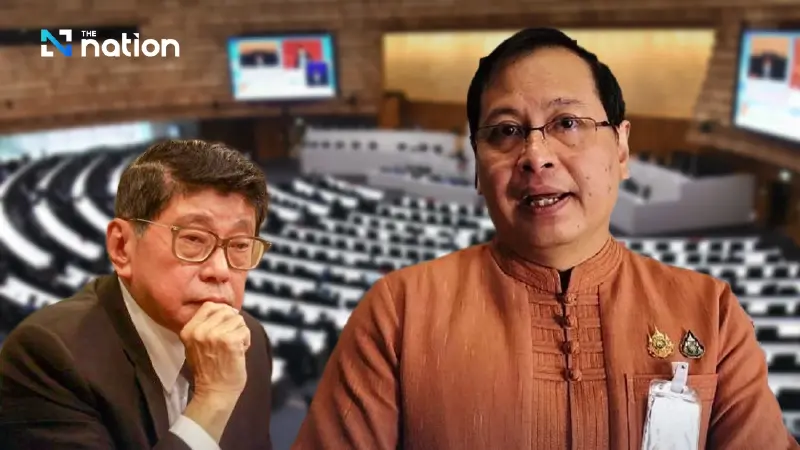


Pakorn Nilprapunt, Secretary-General of the Council of State, reaffirmed on Monday (July 7, 2025) that under Thailand’s democratic system, only the prime minister holds the constitutional authority to propose Cabinet appointments or to dissolve the House of Representatives.
In a Facebook post under the name “Alex Pakorn,” he reiterated that this principle is consistent with democratic traditions in countries following the Westminster-style parliamentary system, where the “principle of confidence” forms the foundation of executive power.
“In Thailand, the appointment of a prime minister follows the clear principle of parliamentary confidence,” Pakorn wrote. “It is the Speaker of the House who informs the monarch that the House has passed a resolution expressing confidence in a particular individual to serve as prime minister, after which the King appoints that person accordingly.”
He also pointed out that royal appointments of ministers are explicitly based on the prime minister’s nomination.
“The royal command appointing ministers always states that the prime minister has respectfully submitted the names of individuals deemed worthy of public trust to serve in the Cabinet,” he explained.
Pakorn added that the process reflects a chain of delegated trust: Parliament places its confidence in the prime minister, and the monarch appoints ministers upon the prime minister’s advice.
Pakorn further clarified that a deputy prime minister acting as caretaker cannot legally exercise the prime minister’s authority to appoint or remove ministers. This is because a deputy, even while serving as acting prime minister, is still merely a minister who has been entrusted with temporary duties by the prime minister—not someone who has received direct confidence from the House to lead the executive branch.
He stressed that such a caretaker does not have the constitutional mandate to initiate a Cabinet reshuffle or propose the dismissal of other ministers, as they were not elected or confirmed by Parliament to lead the government.
More critically, an acting prime minister cannot recommend the dissolution of the House if the substantive prime minister is still in office. Dissolving Parliament, Pakorn stated, is a power reserved exclusively for a sitting prime minister who holds the confidence of the House.
“The authority to seek royal approval for ministerial appointments or to recommend the dissolution of the House lies solely with the prime minister,” he wrote, “as only they have been formally entrusted by Parliament to head the executive branch.”
If the prime minister vacates office—regardless of the cause—the entire Cabinet is considered to have collectively resigned. In such a case, Pakorn noted, the Constitution requires that steps be taken to form a new Cabinet.
“This implies that the House must take action to appoint a new prime minister and establish a new administration,” he concluded.
On July 2, 2025, Former Deputy Prime Minister and ex-Cabinet Secretary-General Visanu Krue-ngam stated that there are two schools of thought regarding whether an acting prime minister has the authority to dissolve Parliament. He believes the answer is yes.
“This issue has long been the subject of legal debate,” Visanu said in an interview with Nation TV. “One view holds that a caretaker prime minister can exercise all the powers of a full prime minister. The opposing view insists that certain powers—such as dissolving the House—are exclusive to the sitting prime minister.”
He added: “I lean toward the interpretation that the acting prime minister can dissolve the House. Ultimately, it depends on whether His Majesty the King will countersign the royal decree. If the decree is presented and the royal signature is given, then no one can claim the Constitution has been violated.”

Deputy Prime Minister and Interior Minister Phumtham Wechayachai, who is currently serving as acting prime minister, addressed questions regarding a special Cabinet meeting on July 3, 2025, in which the Prime Minister’s Secretariat raised the issue of the acting PM’s authority.
Phumtham clarified that the discussion was merely an internal delegation of duties and that the views shared by the Secretary-General of the Council of State were advisory, not part of the official Cabinet resolution.
“The Council of State’s opinion should be listened to, but it is not conclusive,” he said. “Several experts, including Visanu, have offered differing views. These are perspectives worth considering, but this is not an issue the government needs to decide on now. The exercise of any such powers would depend entirely on the political context.”
He further added: “Now is not the time to wonder whether we will stay or go. What we must focus on is how to do our job effectively. We shouldn’t dwell on hypothetical problems. We should be asking how to move forward on the real issues that matter.”

Minister attached to the Prime Minister’s Office Chusak Sirinil confirmed that the issue of whether an acting prime minister holds the authority to dissolve Parliament was discussed during the special Cabinet meeting on 3 July, but noted that it was merely an informal exchange of views and no official record was made.
Chusak said the matter remains unresolved, as even legal experts hold differing opinions on the constitutional interpretation.
When asked for his personal view, he declined to elaborate, saying simply: “I prefer not to express my opinion at this time.”
He emphasised that the government is open to hearing input from all sides, but any decision must be grounded in clear legal principles.
“As of now, there is no definitive conclusion on this issue,” Chusak stated.
