
Japan to test deep-sea extraction of rare-earth mud
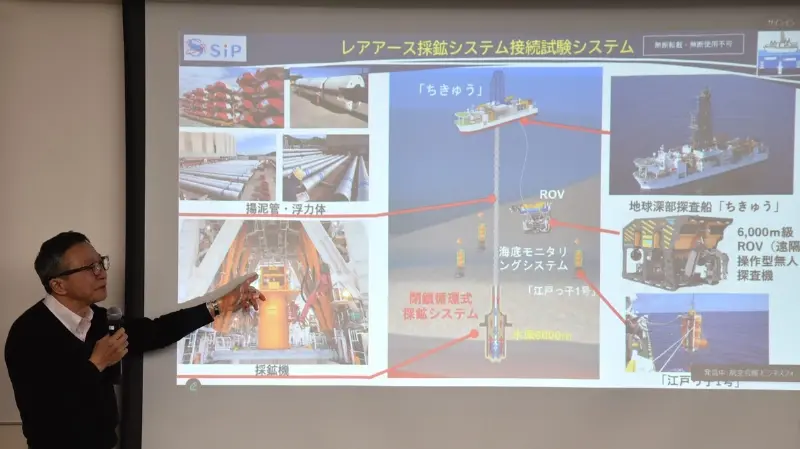


Japan Agency for Marine-Earth Science and Technology said Tuesday (December 23) that it will conduct a test to excavate the deep seabed off Minamitorishima, a remote Tokyo island, and collect clay-like sediment rich in rare earths.
- Japan is set to conduct the world's first deep-sea extraction test for rare-earth mud at a depth of approximately 6,000 meters.
- The test will use the research vessel Chikyu to lower a pipe and excavator that will pump the mineral-rich sediment to the surface.
- The targeted mud contains valuable minerals like neodymium and dysprosium, which are used in high-performance magnets for motors.
- If the test is successful, a pilot mining program will be conducted in 2027 to assess the commercial profitability of the extraction.
The test, to be conducted from mid-January to early February next year by the Japanese deep-sea scientific research vessel Chikyu, is set to be the first of its kind in the world, reaching depths of about 6,000 meters, according to JAMSTEC.
Known as rare-earth mud, the sediment contains significant amounts of minerals such as neodymium and dysprosium, which are used in high-performance magnets for motors and power generators.
The extraction test will be part of a maritime security-related project of the Cabinet Office.
If successful, the agency will conduct a pilot mining program in February 2027 to assess its profitability.
A long pipe is set to be extended from the Chikyu to the seabed and connected with a cylindrical excavator device.
Water will circulate inside the contraption to carry the drilled sediment on board the vessel.
This method is designed to prevent sediment from spreading across the ocean.
The agency will monitor the marine environment to assess any impact on the surrounding ecosystem.
Rare-earth mud is distributed across the ocean floor as a thin layer and cannot be excavated deeply like coal.
When mining on a commercial basis in the future, excavators will likely have to change extraction sites frequently.

[Copyright The Jiji Press, Ltd.]
