
People’s Party says it still does not trust Pheu Thai or Bhumjaithai


The People’s Party held its MP meeting to decide on the direction of its vote for the new prime minister, but no conclusion was reached. Another meeting is scheduled for 2 September.
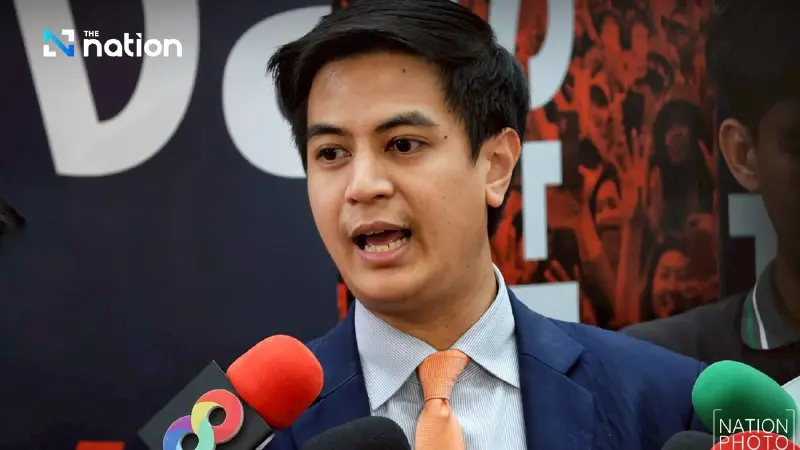
Parit Wacharasindhu, a list-MP of the People’s Party (PPLE), spoke to reporters after a special meeting of the party’s MPs at the Future Forward Building, the PPLE headquarters, on Monday (September 1). The meeting was convened to reach a conclusion on how the party would vote in the upcoming selection of a new prime minister.
He said over 90 MPs attended the meeting, accounting for about 90% of the party’s members, while some were absent due to prior commitments. According to Parit, the discussions reflected a wide range of opinions, with many MPs expressing their views with considerable concern.
The meeting resolved to reconvene on Tuesday (September 2) to allow further input and to consolidate MPs’ opinions alongside those of other sections of the party.
Parit noted that two issues stood out clearly during the discussions:
The party continues to maintain its original stance that the best solution for the country is to hold a new general election as soon as possible.
The party has consistently called for the dissolution of the House since the emergence of the leaked audio clip scandal. However, figures in positions of power, including Prime Minister Paetongtarn Shinawatra and Deputy Prime Minister Phumtham Wechayachai, have not responded.

“Today we reaffirm that dissolving the House is what the country needs. If the caretaker prime minister has the power to dissolve Parliament, it would be fully in line with our party’s stance. We are ready for a general election. If the caretaker prime minister does not dissolve the House and no bloc can secure a parliamentary majority, then the process of selecting a new prime minister must be used to pave the way for dissolution and fresh elections as quickly as possible,” he said.
He acknowledged the anxiety felt by both MPs and the public if dissolution does not happen and Parliament instead proceeds with choosing a new prime minister. “At present, no bloc commands a majority. If the PPLE abstains from voting, there are two serious concerns,” he explained.
“Currently, neither the red camp nor the blue camp has more than half the seats. If the two sides reunite, there is concern they could form a majority government that would likely serve out the remaining two years of the parliamentary term. This would contradict our stance that the country needs elections as soon as possible.”
“If the red and blue camps do not reunite, there is the risk of power shifting to forces outside the democratic framework, which would not bode well for Thai politics.”
When asked whether the People’s Party would reach a decision on 2 September, Parit replied that it was still too early to say. He explained that the party normally holds its weekly MP meeting on Tuesdays, and expected that more MPs would be present to contribute their views then.

On whether the party would wait until the very last day of the prime ministerial vote to make its decision, he said this remained uncertain as the parliamentary schedule had not yet been set.
Asked if the party needed to consult with the Pheu Thai and Bhumjaithai parties further to clarify conditions, he said no. “We consider that the two parties have already accepted our conditions.”
Parit also addressed claims from the Bhumjaithai Party that the PPLE was preparing to form an agreement with them. “That is a question for Bhumjaithai,” he said. “We will not join any government. Whoever claims to have more than half the votes, that result does not come from the PPLE.”
When asked if the party would issue a formal resolution on how its MPs would vote, Parit stressed that this was an internal process. “The executive committee must take responsibility for the decision, and it must reflect the views of all sectors of the party,” he said.
When asked whether the People’s Party only wanted the dissolution of Parliament, Parit replied: “If the government cannot respond to the needs of the people, then Parliament must proceed with electing a new prime minister to pave the way for a fresh general election. We have never set a timeframe as a condition. If the caretaker prime minister wishes to dissolve the House, then do it immediately.”
Responding to a question about the sincerity of Pheu Thai and Bhumjaithai, the PPLE spokesman said many had wondered how a minority government could be held to its promises. “There are two important factors. First, mechanisms must be designed so that we, as opposition leader, have tools to hold a minority government to account. If it breaks its promises, we can immediately trigger a no-confidence debate.
“Second, when it comes to trust, we do not fully trust either party. Our task is to assess the risks based on evidence and behaviour. Whichever option carries less risk is the one we must consider. We make decisions with reason, not with resentment.”
When asked whether this meant past conflicts would be completely set aside, Parit clarified: “We do not forget, but we will not let emotions dictate our judgment.”
Parit added that both he and his fellow People’s Party MPs were mindful that their position was made possible by the 14 million citizens who voted for them. “We have pledged never to betray that trust by doing anything against our principles,” he said.
