
Old guard returns as Democrats fight for survival in 2026 election
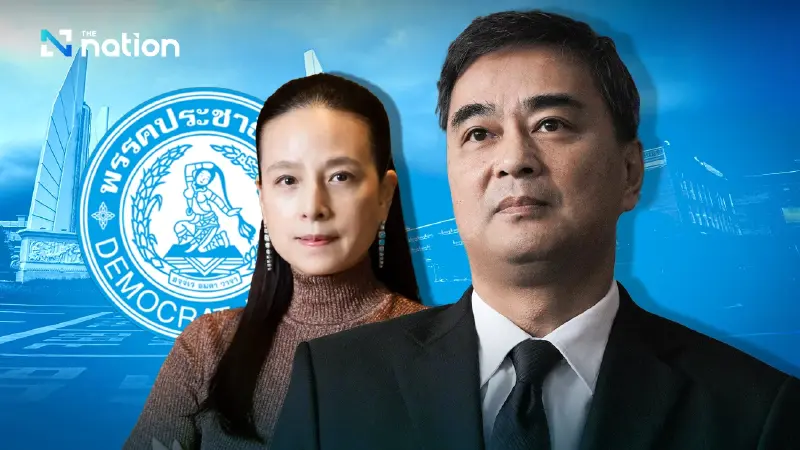


Chuan Leekpai is backing Abhisit Vejjajiva’s return as Democrat Party leader to rescue the party from crisis, amid efforts to bring Nualphan “Madam Pang” Lamsam into a key role. A confidential poll shows that an Abhisit–Madam Pang pairing would significantly boost the party’s popularity.
A major comeback is brewing within Thailand’s oldest political party, the Democrat Party, as it enters a full-fledged revival mode to fight what many describe as a “battle for survival” in the 2026 general election.
The clearest signal yet is the likely return of Abhisit Vejjajiva, Thailand’s 27th prime minister, whose comeback now seems almost certain, but on one condition: that he assumes the position of party leader, succeeding Chalermchai Sri-on.
If that happens, Abhisit will automatically become the Democrats’ prime ministerial candidate. Within the party, few figures can match his stature or leadership credentials, making him the natural choice to rally both veterans and supporters who had drifted away.
Several prominent members who had been preparing to defect to the Bhumjaithai Party reportedly paused their moves after learning that Chuan Leekpai, the party’s elder statesman, is personally spearheading efforts to reorganise the party, with Abhisit seen as his new beacon of hope.
The Secretary-General Seat: A Power Struggle
The position of party secretary-general, long considered the engine of the party’s internal operations and political manoeuvres, has always attracted those with strong ambition and political grit.
Among those eyeing the post is Chaichana Dejdecho, who is said to be seeking an upgrade in status as part of the upcoming shake-up. Intense behind-the-scenes bargaining is reportedly under way.
Many Democrats dream of seeing Nualphan “Madam Pang” Lamsam take on a major role in the party, particularly as secretary-general. However, insiders say that if she were to enter politics, her eyes would be set on the party leadership itself. Yet, with Abhisit positioned as the leader, Madam Pang has no desire to challenge him for the top spot.
At present, the party is awaiting her response on whether she is willing to help steer the Democrats’ revival, and in what capacity. Her decision is expected to significantly influence the party’s direction, though the secretary-general post is unlikely to be hers.
A “political dream team” for revival
A confidential poll conducted internally revealed that the pairing of Abhisit and Madam Pang has boosted the Democrats’ popularity considerably, especially as support for conservative rivals Palang Pracharath and United Thai Nation continues to decline.
This has raised hopes that the blue party might reclaim its traditional stronghold in Bangkok, a territory it once dominated. Bhumjaithai, meanwhile, has shown little appetite for contesting the capital, viewing it as unfavourable ground.
For Pheu Thai, the Bangkok race has always been challenging, and with the simmering Thailand-Cambodia tensions involving Hun Sen, public sentiment could turn volatile. In Bangkok’s unpredictable political climate, voters can shift allegiances overnight.
The southern battleground
Meanwhile, the southern region, once the Democrat Party’s political stronghold, is becoming an increasingly difficult battleground. After suffering major losses to rivals in recent elections, the Democrats now face an all-out offensive from Bhumjaithai and Klatham, turning the South into one of the fiercest political war zones in the country.
Behind the scenes, reports of high-stakes political deals have surfaced across several provinces in the Deep South, deals so costly and complex that they blend political science and economics into a single power game aimed at keeping political influence intact.
The question now is how the Democrats will reorganise their strategy to compete with Bhumjaithai and Klatham in an election that is increasingly fought with money as the main weapon. The party’s traditional formula of “polished image and clean reputation” may no longer fit the realities of southern politics today.
This time, however, Abhisit appears better prepared. He has reportedly assembled a preliminary policy and executive team under his prospective leadership.
All eyes are now on the Democrat Party’s general assembly on October 18, where the key test awaits: Will Abhisit show up with his core team, and can he truly lead the Democrats back to life?
It will be a defining moment for both Abhisit and the Democrat Party, as they fight to prove their continued relevance in Thailand’s shifting political landscape.
