
EC consults BoT, invokes Article 32 to seek data on suspicious cash withdrawals
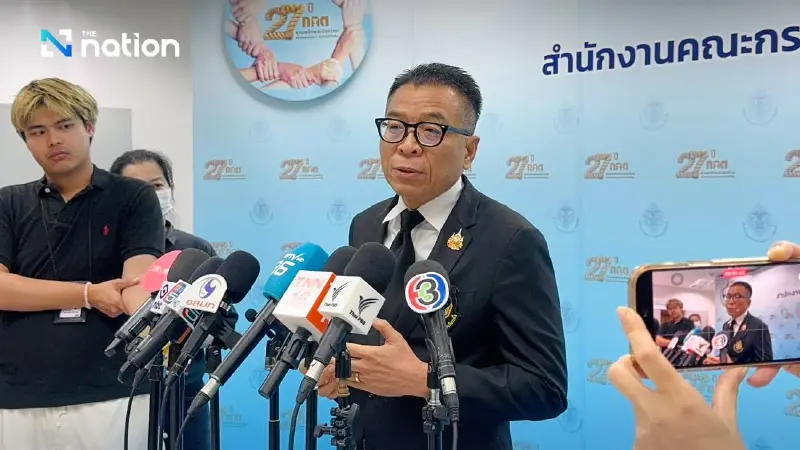


The Election Commission has invoked Article 32 of the EC Act to request transaction data from the Bank of Thailand after more than 250 million baht was reportedly withdrawn and exchanged into 100- and 500-baht notes, raising suspicions it could be linked to election-law violations.
EC consults with BoT, resolves to invoke EC Act
The secretary-general of the Election Commission met and consulted with the central bank governor following reports of suspicious cash withdrawals and resolved to invoke the EC Act to demand data from the Bank of Thailand.
EC secretary-general Sawaeng Boonmee sought a meeting and discussion with Bank of Thailand governor Vitai Ratanakorn to consult him on how to obtain data on cash withdrawals of more than 250 million baht in 100-baht and 500-baht notes.
After the discussion, the EC held a meeting and resolved to invoke Article 32 of the EC Act to ask the BoT to submit data on the cash withdrawals at commercial banks for the EC to investigate whether the cash was used for vote buying, Sawaeng said.
On the same day: EC invokes Section 32 powers
On January 29, 2026, Sawaeng revealed that the EC had decided to invoke its powers under Section 32 of the Organic Act on the Election Commission to formally request data from the Bank of Thailand regarding the large, unusual withdrawals. The data will aid in ensuring the election process remains fair, transparent, and legally compliant.
Sawaeng explained, “I presented this issue to the EC meeting, focusing on the large-scale cash withdrawals reported during the election period, which have raised suspicions due to the unusually large amounts withdrawn and the specific denominations, such as 500 and 100 baht notes. This warrants further investigation to determine if the funds were withdrawn for any illegal electoral or political party activities.”

In a bid to ensure a thorough and evidence-backed process, the EC meeting agreed to exercise its legal powers to request relevant documents and information from the BoT. The Deputy Secretary-General of the EC, along with investigators, will personally collect the information from the BoT on January 30, 2026.
EC plans MOU with BoT to enhance cooperation
Furthermore, Sawaeng revealed that in the future, the EC plans to create a memorandum of understanding (MOU) with the Bank of Thailand to establish a more systematic mechanism for requesting and exchanging financial transaction data. This is intended to enhance efficiency in monitoring and preventing actions that could involve electoral fraud or the illegal use of political party funds in the future.
Legal authority under Section 32
Under Section 32 of the Organic Act on the Election Commission, the EC is authorized to request relevant agencies to investigate and report financial data if there is reasonable evidence or suspicion of violations of election laws or political party regulations. The EC can ask the Anti-Money Laundering Office (AMLO) to report financial transactions or request banks and financial institutions to disclose information on money transfers and withdrawals made by political parties, party officials, or candidates as needed.
