
Labour groups mark Women’s Day with march to Government House, vigil for war victims
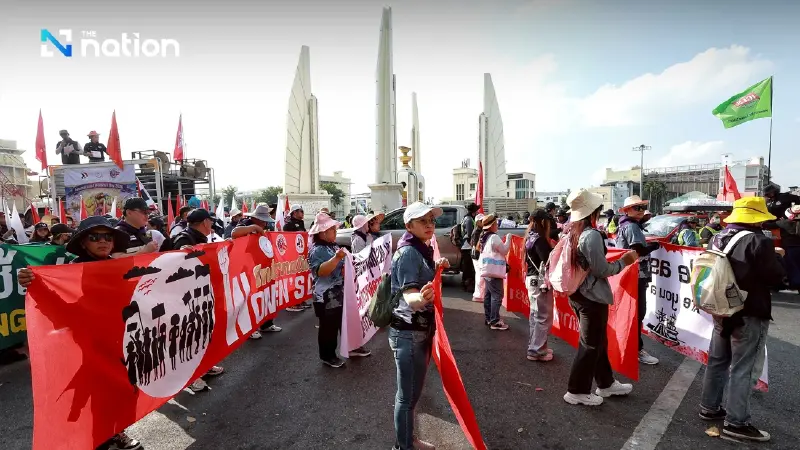


Thai labour networks marked International Women’s Day by marching from Democracy Monument to Government House, while holding a flower-laying vigil outside the UN building for those killed in the Iran-US war.
Thai labour networks marked International Women’s Day on Sunday (March 8) by gathering at Democracy Monument before marching to Government House, where they staged activities calling for women’s rights, children’s rights and broader social justice.
The demonstration was organised by the State Enterprises Workers’ Relations Confederation (SERC), the Thai Labour Solidarity Committee (TLSC) and allied groups.
Protesters stage vigil outside UN before heading to Government House
As the procession moved along Ratchadamnoen Road, demonstrators stopped outside the United Nations building to hold a flower-laying vigil for those killed in the war between Iran and the United States.

After the mourning ceremony, the group continued to the area opposite Gate 5 of Government House, where protesters staged political satire performances and activities highlighting pregnancy rights and children’s rights. Government House officials later came out to receive a petition from representatives of the labour groups.
Labour networks link women’s rights with peace and social justice
The rally coincided with International Women’s Day, observed annually on March 8, which commemorates women’s struggle for equal rights, fair wages and better working conditions.

The occasion traces its origins to protests by female workers in New York in the late 19th and early 20th centuries, and was later advanced internationally by Clara Zetkin, who proposed the establishment of International Women’s Day in 1910. The United Nations formally recognised the day in 1975.
The movement has long been associated with the principle of the “three eights” — eight hours of work, eight hours of learning and eight hours of rest — as well as the wider campaign for equality between women and men.

International Women’s Day is now observed as a time to celebrate women’s achievements, remember the struggle for equality and support women’s rights in all areas of society. Its symbolic colours are purple, white and green, while the yellow mimosa is often regarded as the occasion’s flower.

