
Thai EC votes on Sept 14 to refer 26 senators to Supreme Court
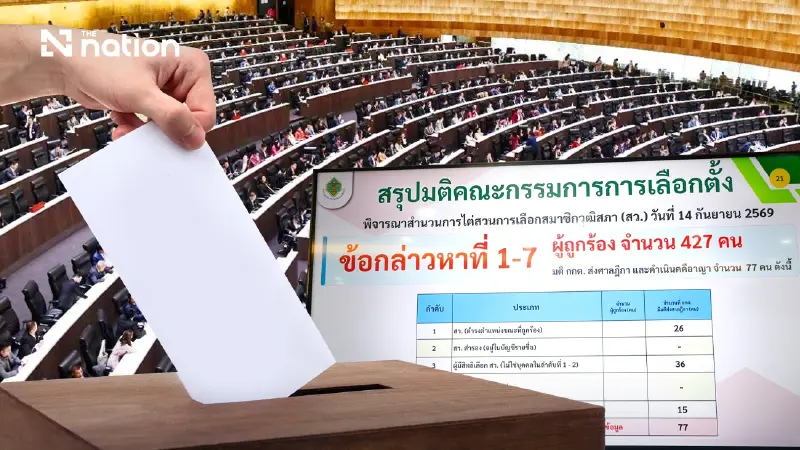


Thailand’s Election Commission found no grounds to proceed under two allegations of political assistance in the 2024 Senate election case.
- Thailand’s Election Commission voted on September 14, 2026, to refer 26 serving senators to the Supreme Court over alleged breaches of candidate-introduction rules.
- The commission found no grounds to proceed against anyone under two allegations concerning political assistance to Senate candidates.
- The Election Commission reached its decision after considering opposing recommendations from an investigation panel and an adjudication subcommittee.
Thailand’s Election Commission (EC) voted on Monday (September 14, 2026) to refer 26 serving senators to the Supreme Court’s Election Cases Division over alleged breaches of rules governing how candidates introduce themselves during the Senate selection process. The decision was announced at a press conference at the commission’s headquarters.
The EC considered seven allegations involving 427 people and announced that 113 people should be referred to the Supreme Court under allegations three to seven. The 26 serving senators were included in the referral decision under allegation three, concerning candidate-introduction rules.
EC rejects allegations of political assistance to candidates
The EC found no grounds to proceed against anyone under allegations one and two, which concerned political figures helping candidates secure Senate seats and candidates consenting to receive such assistance.
The EC’s decision means no political party office-holders, party executives or members of parliament (MPs) are being referred under those two allegations. The referrals under the other allegations are for the Supreme Court’s consideration.
EC examines seven categories of alleged election offences

The EC considered the following seven allegations under the Organic Act on the Acquisition of Senators:
- Political assistance to candidates: Political party executives, party office-holders, MPs, local councillors, local administrators or other political office-holders allegedly helped candidates secure election as senators, under Section 76, paragraph one.
- Candidates’ consent to political assistance: Candidates allegedly agreed to receive assistance from political figures or party office-holders to secure election as senators, under Section 76, paragraph two.
- Breaches of candidate-introduction rules: Candidates allegedly failed to comply with procedures or conditions prescribed by the EC for introducing themselves, under Sections 36 and 70.
- Benefits offered to influence voting: Property or other benefits were allegedly procured, given, offered, promised or prepared to induce votes, under Section 77(1).
- Hospitality offered as an inducement: Hospitality was allegedly provided, or promised, to influence candidates or those entitled to vote in the Senate selection process, under Section 77(3).
- Benefits sought in return for candidacy: Individuals allegedly solicited, received or agreed to receive property or other benefits in return for standing as candidates, under Section 79.
- Benefits sought in return for votes: Eligible voters allegedly solicited, received or agreed to accept property or other benefits in return for selecting, or not selecting, a particular person, under Section 81.
The statutory provisions distinguish political assistance, candidate introductions and different forms of alleged inducement. The EC’s decision to pursue cases under allegations three to seven does not establish that every person being referred faces all five allegations.
Investigation panels reached opposing recommendations
The EC Office began investigating the case in 2024, after the Senate election, through Central Investigation and Inquiry Committee No. 26. The panel included representatives of the EC Office and the Department of Special Investigation (DSI).
After an inquiry lasting about two years, Committee No. 26 recommended proceedings against 229 people in connection with the seven categories of alleged offences.
The 229 people identified in the earlier inquiry comprised 138 serving senators; 21 ministers, MPs and Bhumjaithai Party executives; 20 people described as belonging to the Bhumjaithai network; and 50 people on the Senate reserve list or other Senate candidates.
Committee No. 26 forwarded its case file to the EC secretary-general for submission to the full commission. During Ittiporn Boonpracong’s tenure as EC chairman, he appointed Adjudication Subcommittee No. 36 to screen and consider the case.
Reports emerging in early 2026 said Subcommittee No. 36 had voted five to two to recommend dismissing all complaints against the 229 people, concluding that they had not committed the alleged offences.
The full Election Commission subsequently received the opinions and resolutions of both Committee No. 26 and Subcommittee No. 36. The commission met every Monday from early June 2026 to consider the case, concluding that review on August 31 before voting on September 14.
EC announces decision after Senate sitting ends

EC chairman Narong Klunwarin and deputy secretary-general Acting Sub-Lt Phasakorn Siriphakayaporn delivered the announcement at the commission’s headquarters at 3.48pm on September 14. The briefing had originally been scheduled for 3pm and began after the Senate sitting had adjourned at 3.12pm.
Election Commissioner Narong Rakroi and two deputy EC secretary-generals, Khanchit Charoen-in and Kriengkrai Parndokmai, were seated at the front of the briefing area while waiting to follow the announcement.
