
Former UK PM Calls for End to Anti-Fossil Fuel Slogans, Urging Practical Coexistence of Gas, Nuclear, and Renewables
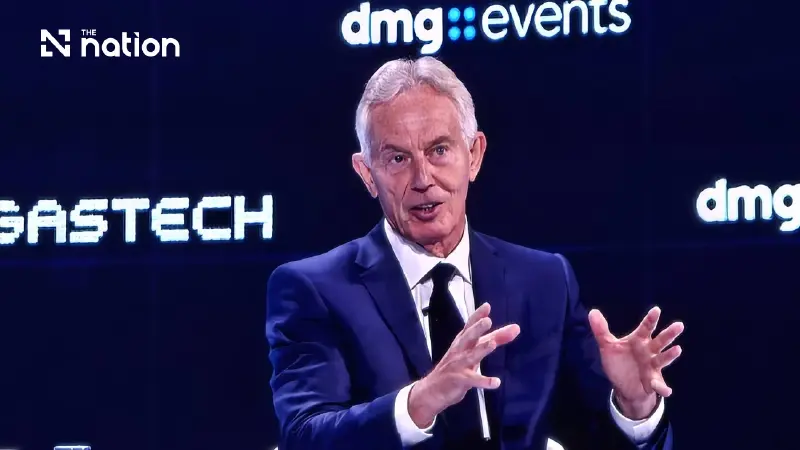


At Gastech Bangkok, Blair urges leaders to abandon ideological energy debates and pursue a pragmatic mix of gas, nuclear and renewables
- Former UK Prime Minister Tony Blair calls for an end to ideological "slogans" in the energy debate, urging a pragmatic and balanced policy.
- He advocates for an energy mix where gas, nuclear, and renewables coexist, viewing gas as a necessary transitional fuel to achieve a greener future.
- Blair asserts that energy security has become as critical to a nation's security as defense, especially in light of recent geopolitical events.
- He supports a revival of nuclear power, describing much of the past campaigning against it as "misguided" and calling for evidence-based decision-making.
At Gastech Bangkok, Blair urges leaders to abandon ideological energy debates and pursue a pragmatic mix of gas, nuclear and renewables.
Former UK Prime Minister Tony Blair told delegates at Gastech in Bangkok on Monday (September 14) that governments must abandon the "slogans" of the fossil fuel debate and instead pursue a pragmatic, balanced energy policy that allows gas, nuclear and renewables to coexist.
Speaking in a session titled The New Politics of Energy and Power, Blair, now executive chairman of the Tony Blair Institute for Global Change, was interviewed by moderator John Defterios, a board member of Sustainable Energy for All and former CNN emerging markets editor.
"You can't put the two against each other," Blair said of fossil fuels and clean energy. "You're going to need a balanced energy policy for the future, and you're going to need transitional energy in order to get to a cleaner and greener future."
He argued that energy security now sits alongside defence as a core pillar of national security.
"When you look at your energy policy as a country today, I think it's right up there with defence on how you think about your country's security in the broadest sense," he said, adding that his institute, which works in roughly 45 countries, had observed almost every government re-examining its energy strategy since Russia's invasion of Ukraine and the war involving Iran.
Developing economies and the AI energy surge
Blair was pressed on whether the rush to power artificial intelligence could leave developing economies behind. Defterios cited International Energy Agency projections that AI-driven electricity demand could triple by 2035 and noted concerns in parts of Africa about basic energy access rather than AI itself.
Blair said the three largest emitters — China, the United States and India, together responsible for more than half of global emissions — were all pursuing the same formula: cheap energy, electrification and a balance of fossil fuels and renewables.
Developing nations, he argued, cannot be asked to curb their growth to atone for emissions created by wealthier countries.
"I can't, as a former prime minister of a developed country, go to the... president of a developing nation and say, even though the developed world has created this issue, we expect you to limit your development. That's never going to work," he said.
He pointed to technology as the likeliest route to reconciling rising demand with climate goals, including smarter grid management and household solar schemes such as one being trialled by Thailand's government, alongside a revival of interest in nuclear power.
A reappraisal of nuclear power
Blair said his institute's research suggested global emissions would be markedly lower today had nuclear expansion not stalled after Three Mile Island and Chernobyl and after more recent accidents involving older-generation reactors.
He described much of the campaigning against nuclear power as "pretty much misguided" and said policymaking should be handed to those "looking at the evidence and not looking at the slogans."
Gas, in particular, remains indispensable in the near term, he said.
"It's just a big mistake to end up in a situation where decision-makers feel they're doing something that is regressive when they're using fossil fuel necessary for their country's development."

AI's "revolution in intelligence itself"
Turning to artificial intelligence, Blair described the current wave of development as comparable in scale to the industrial revolution, but categorically different in kind.
"This is a revolution in intelligence itself, and therefore it has a whole area of complete unpredictability," he said.
He was asked about a turbulent fortnight in AI safety discourse, including the resignation of Anthropic researcher Jacob Coxon, who said he quit because colleagues in the industry privately fear advanced AI could pose an existential threat within a decade — concerns subsequently echoed publicly by Anthropic co-founder Dario Amodei.
Blair said such anxieties were legitimate but argued history showed that "human anxiety never disinvents what human ingenuity has invented." The answer, he said, lies in binding international agreement rather than unilateral restraint.
"I don't see how you do that unless that's part of an agreement between America and China and the other major powers in the technology field," he said, warning that safeguards adopted by one country only would leave it at a disadvantage.
Strait tensions and the Iran standoff
Discussion turned to the Strait of Hormuz, where tensions with Iran have disrupted shipping, and which Blair called one of the "trip points" of the global economy — in his view even more consequential for trade than the Strait of Malacca, itself the subject of a recent pledge by Indonesian, Malaysian and Singaporean leaders to keep open.
Blair said Iran's regime needed to accept that a blockade of the strait "is not going to be acceptable... not just to their region but the international community," and pointed to Iran's own economic distress, with inflation near 70 per cent and a forecast economic contraction of six to seven per cent this year, as reasons for it to seek a settlement.
Ukraine, Russia and the Western alliance
On Russia's war in Ukraine and a recent strike near a train reportedly carrying European security officials, Blair said Vladimir Putin's warnings on nuclear escalation should be "taken seriously", while voicing hope for a negotiated peace that lets Ukrainians "pursue the future in the way that they want".
He said the transatlantic relationship, though strained at times, remained intact because of enduring mutual interest and argued that shocks of recent years were prompting nations everywhere to reassess their alliances and, in turn, their energy dependencies.
"Policy first, politics second"
Asked how leaders can resist short-termism given global public debt now averaging above 100 per cent of GDP in developed economies, Blair returned to a philosophy he said had guided his own time in office.
"Policy first, politics second," he said. "Work out what you think the right answer is as a leader, and then fashion your politics around that."
He warned that the reverse approach — shaping policy to fit the "political prevailing wind of the day" — had proven disastrous for Western governments, whether on energy, technology or the economy.
"Start from reality," Blair said. "Don't start from what your political activists are trying to push you to do, or what screaming headlines are saying day by day. Think long-term. Work out what you think is right, and have the courage to say it."
Gastech runs in Bangkok from 14 to 17 September.
