
Trump call puts FIFA in World Cup storm as Belgium fumes over Balogun ban
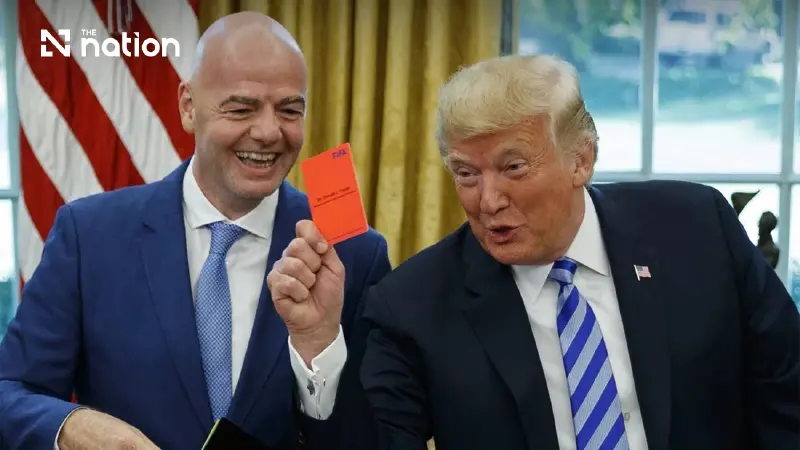


FIFA suspended Folarin Balogun’s red-card ban after Donald Trump urged Gianni Infantino to review the case, angering Belgium
FIFA has thrown the World Cup into one of its biggest controversies of the tournament after suspending Folarin Balogun’s automatic red-card ban, clearing the United States striker to face Belgium in the last 16 following a personal appeal from US President Donald Trump.
Balogun had been expected to miss Monday’s knockout tie in Seattle after being sent off during the United States’ 2-0 win over Bosnia and Herzegovina in the round of 32. Instead, FIFA has allowed him to play, while keeping the red card on his record.
The decision has shifted attention away from team tactics and into a wider debate over political influence, FIFA’s disciplinary independence and whether the governing body has applied its own rules consistently.
A source briefed on the matter said Trump had called FIFA president Gianni Infantino to ask for the sending-off to be reviewed. FIFA later announced that the implementation of Balogun’s match suspension had been suspended for a one-year probationary period under Article 27 of the FIFA Disciplinary Code.
FIFA suspends ban but keeps red card
FIFA’s decision does not wipe out the red card. Instead, it delays enforcement of the one-match suspension, meaning Balogun can face Belgium but remains under disciplinary watch for the next year.
Under Article 27, FIFA’s judicial body may fully or partly suspend the implementation of a disciplinary measure and place the sanctioned person on probation for between one and four years. If a similar offence is committed during that period, the suspended sanction can be revived and enforced alongside any new penalty.
FIFA said Balogun’s suspension would be reinstated if he committed another offence of a similar nature and gravity during the probationary period. The governing body did not respond to Reuters requests for further explanation about the reasoning behind the ruling or details of Trump’s conversation with Infantino.
Red-card incident sparks appeal
Balogun, 25, had scored his third goal of the tournament in the win over Bosnia and Herzegovina before being dismissed in the second half after a VAR review. The red card was issued following a challenge on Tarik Muharemovic.
US coach Mauricio Pochettino had argued from the start that the incident should not have led to a red card. After FIFA’s ruling, he welcomed Balogun’s reprieve and said the United States had already suffered enough by playing with 10 men for more than half an hour against Bosnia.
Pochettino also said he had not been involved in the appeal process and stressed that politics should not be mixed with sporting decisions, even as he defended FIFA’s final ruling as fair.
Trump praises FIFA decision
Trump celebrated the decision on Truth Social, thanking FIFA for correcting what he called a “great injustice”. The White House also marked the news with a “USA-USA-USA” post on X.
US Soccer accepted FIFA’s decision, while American players said they learned of the development through social media on their way to training. Captain Christian Pulisic said the squad was initially surprised, before welcoming the news that Balogun would be available.
Balogun’s return is a major boost for the co-hosts. He has been among the United States’ most important players at the tournament, while Pulisic has had limited game time because of injury.
Belgium challenges FIFA’s logic
Belgium reacted sharply. The Royal Belgian Football Association said it was “astonished” by FIFA’s decision and was examining all potential options.
The RBFA accepted that Article 27 gives FIFA’s Disciplinary Committee power to suspend enforcement of a sanction. However, it pointed to Article 66.4 of the FIFA Disciplinary Code, which it said provides that a sending-off automatically results in suspension for the next match.
Belgium also cited Article 10.5 of the FIFA World Cup 2026 Competition Regulations. That rule states that if a player or team official is sent off through a direct red card or a second caution, they will automatically be suspended from their team’s next match, with further sanctions also possible.
That tension between Article 27 and the tournament’s automatic-suspension rule is now at the centre of the dispute. For Belgium, the issue is not only Balogun’s availability, but whether FIFA has created confusion around how World Cup disciplinary rules are applied.
Previous cases add to debate
FIFA and the US camp argue that suspended sanctions are not without precedent. Portugal captain Cristiano Ronaldo was able to play in the early stages of the World Cup after FIFA suspended the final two matches of a three-game ban imposed following a red card in qualifying.
But not all players have received similar leniency. Qatar midfielder Assim Madibo was handed a five-match ban after a red card for a challenge that seriously injured Canada midfielder Ismael Kone during the tournament.
Those comparisons have deepened the argument over consistency, especially because Balogun’s case involves not only a disciplinary review but also reported intervention from the US president.
Controversy may outlast the match
The United States’ tie against Belgium was already one of the most closely watched fixtures of the last 16. Balogun’s reprieve has now made it a test of FIFA’s credibility as much as a contest for a quarter-final place.
For the US, the ruling restores their leading attacking option at a crucial moment. For Belgium, it raises questions about fairness and the integrity of the competition. For FIFA, it creates a debate that may linger long after the final whistle.
Whatever happens in Seattle, the case has become a defining World Cup flashpoint — one that brings together football law, political pressure and the uneasy question of who gets the final say when the rules collide.
