
Millions mourn Bangladesh’s first female prime minister Khaleda Zia
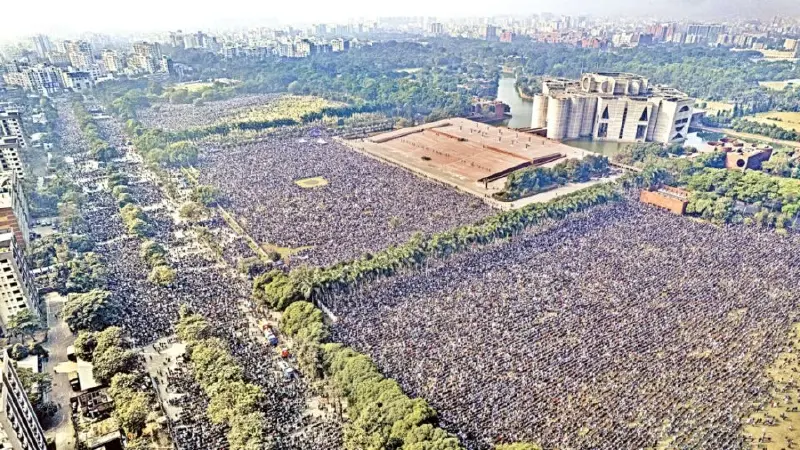


For someone who had devoted a lifetime to being one of Bangladesh's strongest advocates of democracy, a lawmaker who had never lost a single election, her final moments above ground were the finest show of the people's mandate.
The entire city stood in solemn tribute to Bangladesh’s first female prime minister on Wednesday (December 31).
From Agargaon in the north to Shahbagh in the south, mourners filled thoroughfares and alleyways to say goodbye to BNP chairperson Khaleda Zia.
State honour brought gun salutes, floral wreaths, and a guard of honour, but the truest farewell came from people standing kilometres away, their palms outstretched to the heavens.
People across the country joined their counterparts in Dhaka, united in collective grief.
For someone who had devoted a lifetime to being one of Bangladesh’s strongest advocates of democracy, a lawmaker who had never lost a single election, her final moments above ground were the finest show of the people’s mandate.
The gathering for her namaz-e-janaza at the South Plaza of the Jatiya Sangsad Bhaban began around 7am, with BNP leaders and activists arriving from across Dhaka and other districts.
From early morning, people from all walks of life continued to pour in, some travelling by bus, truck, train, private car, motorcycle or whatever mode of transport they could find, while others walked on foot, turning the entire area into an ocean of mourners.

They spilled over onto the alleyways connected to Manik Mia Avenue and then spread to Sobhanbagh, Farmgate, and by the time the janaza began, the tailback of the bereaved stretched to Shahbagh. Elderly citizens, women, and young people were present, many visibly emotional as they waited for hours to pay their final respects.
A flag-draped hearse brought her to the South Plaza around 11.46am, where she lay in state until the funeral began.
The crowd was not limited to the streets alone. People were seen standing on the elevated expressway and on the rooftops of nearby buildings to catch a glimpse of the proceedings.
Microphones had been installed across the venue and surrounding areas, where recitations from the Holy Quran were ongoing.
“She was not only the leader of a party, but a leader of the people irrespective of political backgrounds,” said one mourner standing near the Asad Gate.
Law enforcers and volunteers were deployed across the area to manage the crowd and ensure smooth movement. Traffic on surrounding roads came to a standstill, while authorities urged people to remain calm and follow instructions to avoid chaos.
When BNP acting chairman Tarique Rahman, just before the prayers began, addressed the crowds who came to pay their last respects to his mother, it was as a son, not a statesman.
There were no words of politics, no talk about Khaleda’s authorship in the story of Bangladesh, nor any reference to the gross injustices she faced.
He simply asked for forgiveness on her behalf, as her mother.
“I am Tarique Rahman, the eldest son of the late Khaleda Zia,” he said, dropping all political hats before a crowd that already recognised him as the chief of the largest political party contesting the upcoming national election.
Mufti Abdul Malek, khatib of the Baitul Mukarram National Mosque, led the namaz-e-janaza, which was attended by the Chief Adviser Professor Muhammad Yunus, Chief Justice Zubayer Rahman Chowdhury, BNP Secretary General Mirza Fakhrul Islam Alamgir, Bangladesh Jamaat-e-Islami Ameer Dr Shafiqur Rahman, the chiefs of the three services, National Citizen Party Convener Nahid Islam and others.
The body of Khaleda Zia, who had breathed her last around 6am on Wednesday, was brought out of the Evercare Hospital at 8.53am to be taken to her final resting place.
Her body was first taken to Tarique’s residence, House 196 on Gulshan Avenue, a home she visited at last, only in death, as his return to Bangladesh on December 25 came when she lay critically ill in hospital, never to rise again.
There, a grief-stricken Tarique sat alone on a chair inside, reciting verses from the Holy Quran for his mother.
Following the namaz-e-janaza, which ended at 3.05pm, Khaleda’s hearse carried her to her final abode beside her husband, martyred president Ziaur Rahman.
With Tarique descending into her grave to receive her body, she was buried around 4.30pm.
Family and party members stretched a grave-sized flag over her burial ground.
With his gaze lowered, Tarique scooped handfuls of soil and gently poured them over his mother.
A guard of honour fired three volleys into the air, and the bugle sounded the Last Post, signalling that Khaleda’s duty was done and she could finally rest in peace.
Khaleda was widowed at the age of 36 when Ziaur Rahman was assassinated. On Wednesday, the two were finally reunited 44 years later.
Sajjad Hossain
Zyma Islam
The Daily Star
Asia News Network
