
New government faces MOU 43 dilemma as Cambodia pushes JBC talks
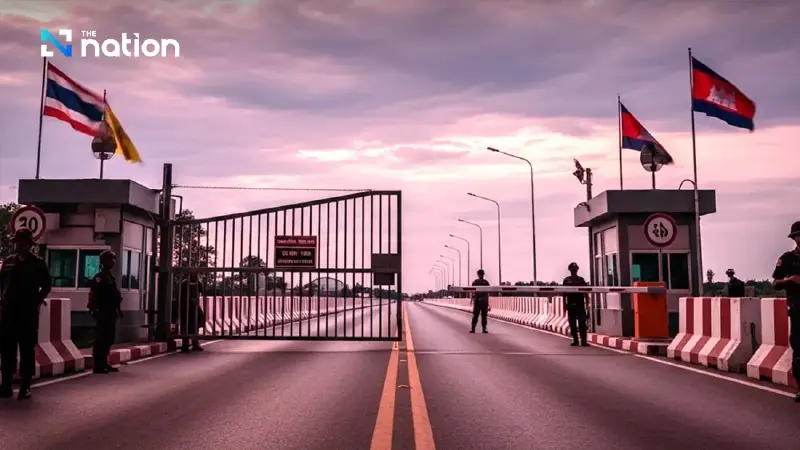


Thailand’s next government faces a high-stakes choice on MOU 43 as Cambodia pushes JBC talks and pressure grows to reopen Thai–Cambodian border crossings after a fragile ceasefire.
Although the Thai–Cambodian border has been free of gunfire for several days after the 72-hour ceasefire period, the situation remains fragile—especially given Cambodian Prime Minister Hun Manet’s stance that a ceasefire does not mean surrender.
Meanwhile, his father, Hun Sen, has declared he will not accept any changes to the Thai–Cambodian border areas resulting from the clashes. He has called for a meeting of the Thai–Cambodian Joint Boundary Commission (JBC) to press ahead with boundary surveys under the MOU 43 framework in January 2026 in Siem Reap, Cambodia.
Against the backdrop of Thai politics—now heading towards the February 8, 2026 election, with no clarity on who will become prime minister or form the next government—Thailand’s future approach to MOU 43 has become a key test.
Whether the new administration chooses to proceed with it, review and amend it, or cancel it outright will depend on policy decisions that remain uncertain.
After parliament was dissolved, a proposed referendum on cancelling the Thailand–Cambodia MOU 43–44 was struck down, on the grounds that it would bind a future cabinet under Section 169(1) of the Constitution of the Kingdom of Thailand. This has become a turning point for the Thai–Cambodian border situation.
Much now depends on the new government’s decision-making. It must be acknowledged that the border clashes have damaged bilateral relations in ways that will be difficult to restore.
Another clear signal is that, in the outcomes of meetings of the Thailand–Cambodia General Border Committee (GBC) following both ceasefire agreements, the issues Thailand raised and pressed with Cambodia never once included MOU 43.
Before parliament was dissolved, the Royal Thai Army had queried and urged the government to consider whether MOU 43 could still be applied to the current situation. With the environment and broader context having changed, adjustments—or entirely new tools—might be required.
If Thailand continues to adhere to MOU 43, it will be difficult, because the agreement requires both countries to withdraw from areas claimed by both sides and to leave them vacant—without construction or alterations—until the border line is clearly determined.
Before the clashes, Cambodia had violated MOU 43 by encroaching into disputed areas along the border based on the 1:200,000 map it recognises. After the fighting, Thai troops retook all claimed areas based on Thailand’s 1:50,000 map.
Notably, in a letter Cambodian Defence Minister Tea Seiha sent to Thai Defence Minister Natthaphon Narkphanit before the ceasefire was signed, one point proposed that Cambodian civilians and Cambodian troops return to their previous positions—an offer Thailand rejected.
This suggests Hun Sen is calling for a JBC meeting in the hope of using MOU 43 provisions to force Thai troops to withdraw from all disputed areas so that boundary surveys can proceed.
However, Thai public sentiment is currently running high on nationalism and anger. If the government chooses to keep MOU 43, resistance is likely to be unavoidable—because it would be seen as rendering futile the extensive resources devoted to defending sovereignty, as well as the injuries, disabilities and deaths among soldiers, along with casualties among civilians.
On the other hand, cancelling MOU 43 would disrupt the continuity of the boundary survey and map-making process, which has already made tangible progress.
This includes the certification of 45 boundary markers, leaving 29 still disputed—particularly the use of Lidar technology to identify watershed lines, which Cambodia has now accepted after long refusing.
But if Thailand sought to revise MOU 43 to reflect a changed situation and context, it would require agreement from both countries.
Cambodia is unlikely to accept revisions, as it is currently at a disadvantage. At the same time, for Thailand, this will remain a political flashpoint that the next government must weigh carefully and comprehensively to find the best way forward.
The next major issue—no less significant than MOU 43—is restoring Thailand–Cambodia relations. This is tied to a trilateral meeting involving China, Cambodia and Thailand in Yunnan on December 28–29, 2025, between Chinese Foreign Minister Wang Yi, Thailand’s Foreign Minister Sihasak Phuangketkeow, and Cambodia’s Foreign Minister Prak Sokhonn.
After the two countries reached a ceasefire, the Chinese Embassy in Thailand issued a news statement on the trilateral talks, outlining five areas where Thailand and Cambodia would intensify efforts:
- communication
- building understanding and taking step-by-step actions to strengthen the ceasefire
- restoring cross-border exchanges
- rebuilding political trust, and
- revitalising relations and maintaining regional peace
The key point is Item 3—restoring cross-border exchanges—which effectively implies reopening border checkpoints along the Thai–Cambodian frontier. These have been sealed since mid-2025 due to tensions and sovereignty encroachment concerns.
Yet Thailand still does not know who the next prime minister will be, what the new government will look like, or whether its domestic, security and foreign policies will align with the army’s direction and strategy.
Hun Manet and Hun Sen’s repeated declarations that they will not surrender and will not accept changes in border areas resulting from the clashes may primarily be political messaging for domestic gain.
Thailand’s next round of threats will require the prime minister and new government, the military, the Foreign Ministry and relevant security agencies to assess an increasingly complex situation.
At the same time, external pressure is building from those affected by the continued closure of the Thai–Cambodian border crossings—tightening around Thailand step by step.
Data from the National Bank of Cambodia (NBC) and the Council for the Development of Cambodia (CDC) on foreign investment in Cambodia across various industries lists the shares as follows:
- China 49.82%
- Vietnam 8.11%
- South Korea 5–6%
- Japan 4–5%
- Singapore 3.83%
- Malaysia 2–3%
- Thailand 1–3%
- Canada 8.6%
- United Kingdom 1–2%
- United States 1–1.5%
This is the urgent challenge facing the “new prime minister and new government”: they must carry forward the ceasefire mission and steer the border towards peace—amid the lingering question of whether Cambodia has truly ceased to be an adversary.
