
Foreign Ministry monitors Hun Manet's international moves and border document requests
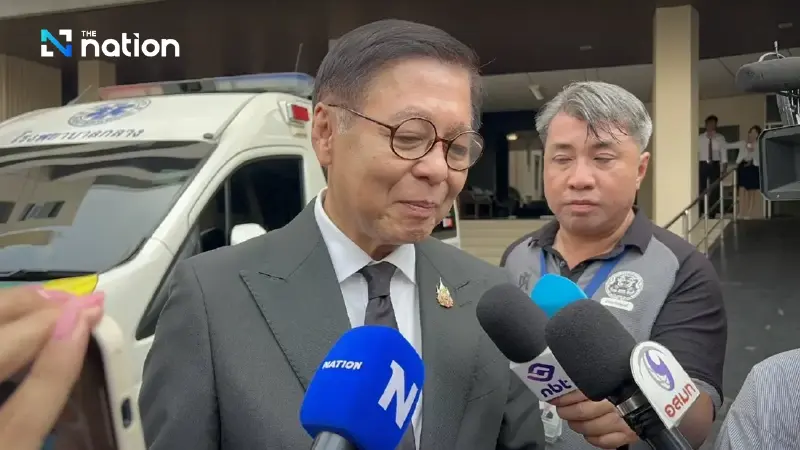


Thailand’s Foreign Ministry is closely watching Cambodian PM Hun Manet’s international visits and his request for historical Thai-Cambodian border documents from France.
Thailand’s Foreign Ministry Monitors Hun Manet’s International Moves
The Thai Foreign Ministry is closely monitoring the international activities of Cambodian Prime Minister Hun Manet, particularly his efforts to address the Thai-Cambodian border situation. The Ministry is also reviewing his request to French President Emmanuel Macron for historical documents related to the border.
This was confirmed by Foreign Minister Sihasak Phuangketkeow during an interview with reporters at Government House on Tuesday, February 17, 2026, at 11:28 AM.
Foreign Ministry Responds to Hun Manet’s International Engagements
Minister Sihasak emphasized that the Ministry is closely following reports on Hun Manet’s international visits, including his meetings with former U.S. President Donald Trump.
While Thailand did not participate in the recent Peace Council meeting, Sihasak noted that the decision on such matters would be up to the new government. He acknowledged that Hun Manet’s diplomatic engagements are likely focused on strengthening bilateral relations, and Thailand is carefully monitoring the situation.
Request for Thai-Cambodian Border Documents
Minister Sihasak also addressed Hun Manet’s request for historical and technical documents related to the Thai-Cambodian border from France. He confirmed that the Thai Foreign Ministry has inquired with France regarding these documents, explaining that Cambodia has the right to request such information.
He reassured the public that the Ministry would continue to monitor the situation and respond as needed.
Historical Context of the Thai-Cambodian Border Issue
Cambodia was under French colonial rule for 90 years, from 1863 to 1953. During World War II, Japan occupied Cambodia, allowing the French administration to remain until the war’s conclusion. Cambodia gained full sovereignty in 1953 following a movement led by King Norodom Sihanouk, marking the end of French colonial rule.
MOU 44 Cancellation and New Regulations
Regarding the nationalist movement's call for the cancellation of MOU 44, Minister Sihasak explained that the Memorandum of Understanding (MOU) can only be cancelled after being presented to the new cabinet. Further discussions with the Prime Minister and the National Security Council (NSC) will be required before moving forward.
Sihasak highlighted that the cancellation may require the drafting of new regulations, citing international law as the framework for negotiations. He mentioned the case of disputed territories with Malaysia, where no MOU exists but international law governs the process.
Potential Negotiations on a New Agreement
When asked if both countries would need to agree on a new agreement, Sihasak indicated that an agreement could be reached if both parties are in agreement. However, if they disagree, negotiations based on international law may be necessary. Preparations for the cancellation of MOU 44 are already underway.
Border Fires and National Security Council Discussions
On the issue of fires along the Thai-Cambodian border, Sihasak urged local authorities to investigate the cause. The Ministry stands ready to take action if necessary.
Lastly, when questioned about the Prime Minister’s upcoming National Security Council (NSC) meeting regarding border issues, Sihasak confirmed that the meeting would cover a variety of topics, including the Thai-Myanmar border situation. He stated that it was an appropriate time to discuss these issues, especially while waiting for the new government’s formation.
