
Durian Wars: Vietnam Set to Overtake Thailand in Chinese Market Within Three Years
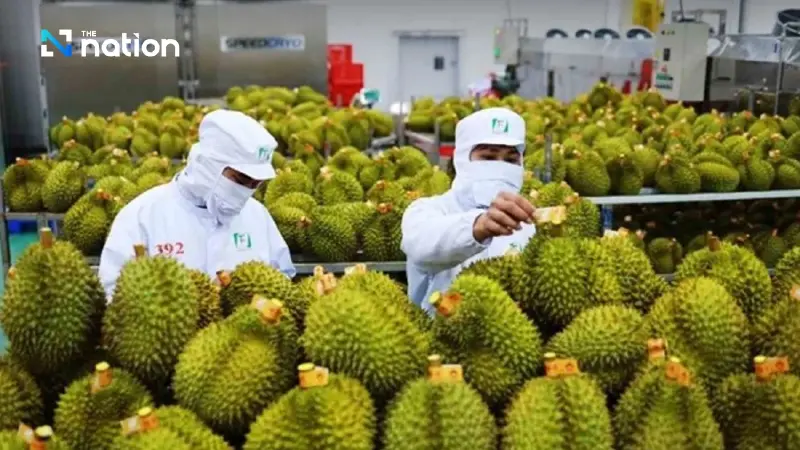


Vietnam's market share in China's durian sector leaps from zero to 40% in just three years, threatening Thailand’s decades-long regional supremacy
- Vietnam's market share in China's durian sector has surged from zero to over 40% in just three years since starting formal exports in 2020.
- This rapid growth directly threatens Thailand's decades-long supremacy as the primary durian supplier to the Chinese market.
- By 2024, Vietnam's durian exports to China reached a value of $3 billion, highlighting the significant scale of its challenge.
- Competition in the Chinese durian market is set to intensify further as Malaysia has also recently been authorized to export fresh durians.
Vietnam's market share in China's durian sector leaps from zero to 40% in just three years, threatening Thailand’s decades-long regional supremacy.
The ASEAN–China trade corridor is undergoing a tectonic shift as Vietnam rapidly closes the gap on Thailand’s once-impenetrable durian monopoly.
In a report detailing the latest analysis from HSBC, Witchuda Chitchan reveals that the economic bond between the two regions is reaching record highs, driven by a surge in Chinese Foreign Direct Investment (FDI) and a booming appetite for agricultural commodities.
According to Yun Liu, ASEAN Economist at HSBC Global Research, bilateral trade between ASEAN and China hit $984 billion in 2024.
ASEAN has now held the position of China’s top trading partner for five consecutive years, with 2026 expected to see further record-breaking volumes.
The ‘King of Fruit’ Contested
While electronics and electrical goods (E&E) account for 30% of this trade, it is the durian market that has become the most ferocious battleground.
Thailand has dominated Chinese imports since 2005, but Chitchan’s report highlights a dramatic disruption by Hanoi.

Vietnam’s Surge: After commencing formal exports to China in 2020, Vietnam’s durian exports reached $3 billion in 2024. In just three years, its market share in China soared from 0% to over 40%.
Malaysian Entry: Competition is set to intensify further following Malaysia's recent authorisation to export fresh durians to China as of August last year.
FDI: The ‘China Plus One’ Strategy
The ongoing trade tensions between Washington and Beijing have cemented ASEAN's status as a primary destination for the "China Plus One" strategy.
The ASEAN-6 nations now attract 14.5% of global FDI, with a significant portion originating from China.
The report by Witchuda Chitchan details how China has tailored its investments to suit local strengths:
Thailand: Re-emerging as an Electric Vehicle (EV) powerhouse, with major manufacturing bases established by BYD, Great Wall Motor, and SAIC.
Indonesia: Attracting nickel-smelting and battery giants like CATL and Tsingshan.
Vietnam: Solidifying its role as a global centre for consumer electronics assembly.

Looking Ahead: Policy Uncertainty and Elections
As the world watches the implications of a second Trump administration in the US, HSBC suggests that while tariff risks remain, the momentum of Chinese investment in Southeast Asia is unlikely to stall.
In Thailand, FDI applications have surged to nearly 7% of GDP, with 40% of approved 2025 investments coming from China—largely in the digital, metal, and electronic sectors.
However, the analysis warns of potential headwinds, including the upcoming General Election in February 2026 and lingering regional border tensions.
HSBC concludes that the long-term success for ASEAN lies not just in being a temporary alternative to China, but in its ability to permanently capture a larger share of the global market through these newfound industrial ties.
