
Finance and BOT signal recovery as Ekniti sets four-year investment roadmap



At the 'Thailand Economic Drives 2026' seminar, government and financial leaders unveiled a 4-year investment roadmap to tackle structural issues and ensure sustainable growth amid emerging global crises.
- Thailand's 2026 economic strategy is designed to counter three identified major threats: geopolitical and geo-economic conflicts, natural disasters, and domestic weaknesses such as high household debt and an aging population.
- The government is implementing a "Big Wins" strategy centered on driving investment in three core areas: infrastructure and the green economy, human resources, and legislative reform.
- A key focus is on mega-investments in clean energy and infrastructure to attract foreign investment, with plans to use Direct Power Purchase Agreements (Direct PPA) and public-private partnerships to reduce the public debt burden.
- The plan also includes reforming education with digital technology and AI, and streamlining laws (an "Omnibus Law") to ease obstacles for foreign investment and high-skilled labor, such as reviewing visa conditions and land laws.
PostToday hosted the "Thailand Economic Drives 2026" seminar on February 24, 2026, to project the country's economic direction and strategy.
Ekniti Nitithanprapas, Deputy Prime Minister and Minister of Finance, delivered a keynote speech on the topic "Weathering the 2026 Storm."
He stated that the government accelerated the "Quick Big Win" policy to recover the economy in the short term, causing the Q4 economy, which the National Economic and Social Development Council (NESDC) projected at a mere 0.3%, to jump to 2.5%.
Consequently, the Thai economy has escaped the rut and is out of the ICU, but this does not mean it can remain in this state, as three major storms are brewing in 2026:
- Geopolitical and Geo-economic Storm: Superpowers are using political conflicts to link with the economy.
- Natural Disaster and Calamity Storm: Last year, the government spent tens of billions of baht to compensate for floods, and this year it may face droughts.
- Domestic Weakness Storm: This is a consequence of private consumption being pressured by household debt and an ageing population, coupled with domestic politics that used to be unstable, and a prolonged lack of private investment.


3 Areas of Investment to Drive Thailand's Sustainable Growth
Therefore, to break through these crises, the government is preparing to drive the economy with a 4-year "Big Wins" strategy, targeting 3 areas of investment policies to ensure sustainable growth for the Thai economy, consisting of:
- Investment in Infrastructure and the Green Economy: Thailand must push for mega-investments, particularly in clean energy, which is a crucial foundation of the modern world. The government is preparing to move forward with Direct Power Purchase Agreements (Direct PPA) and raise funds through infrastructure mutual funds to reduce the burden of public debt accumulation.
Furthermore, amidst geopolitical conflicts, Thailand's neutral stance and clean energy infrastructure make it a magnet for investment, with over THB1.8 trillion pending approval from the BOI.
If the unlocking of laws is accelerated, it is expected that FDI this year will surge to THB970 billion, growing by nearly 20%.
Meanwhile, for public investment, local governments will be supported to invest in disaster prevention through a co-payment budget scheme with the central government.
This also includes attracting the private sector to co-invest in the form of PPP, so the government does not have to bear a heavy debt burden.
- Investment in People or Human Resources: Targeting education reform using digital technology and Artificial Intelligence (AI).
Additionally, the private sector will be brought in to co-drive this through the "Skill Bridge" project, which provides tax incentives for companies that help design human development curricula, coupled with the condition of hiring students to work.
- Investment in Legislation: This is considered a key to unlocking obstacles, such as reviewing visa conditions and the 90-day reporting requirement for High-Skill Labour, as well as land laws that pose obstacles. The government is preparing to issue an Omnibus Law on investment to help Fast Track all aspects and serve as a transformative law for the country, including the full implementation of the BOI Fast Pass system.
"The 3 things we will do are invest, invest, and invest. As mentioned above, these things will strongly attract foreign investment and make Thailand strong again. We will not be the sick man of Asia, but will become the strong man of Asia."

BOT Expects "GDP" to Increase to 1.9%
Vitai Ratanakorn, Governor of the Bank of Thailand (BOT), stated that, looking at the broad picture under the topic "Thais Looking at Thais," there are still many structural problems.
However, he believes there is still hope for the Thai economy.
Looking at the economic figures in Q4/2025, which grew better than expected, the GDP growth forecast for this year might be adjusted upward from the previously expected 1.5% to 1.9%.
However, looking at the current picture of the Thai economy, it is at a point of continuous low growth, having dropped from 8% to only about 1.9% this year.
"Looking at Thailand's Potential GDP, it is at 2.7%. But the key challenge is to push the projected GDP of 1.9% up to reach the potential level of 2.7%. Therefore, the important thing must come from structural reform to expand the potential to 3.5% or 4%. Reaching that level requires new investments and enhancing competitiveness."
Nevertheless, the main problem with the current Thai economy is low-level growth.
This partly stems from structural problems accumulated over a long time, including the household debt problem.
Although it recently decreased to 86-87% of GDP from 92% due to GDP growth, the actual monetary debt amount remains high at THB16 trillion and has not significantly decreased.
What is even more concerning is the quality of bad debt, or deteriorating debt quality.
It is found that the proportion of non-performing loans (NPLs) and problems arising from debt quality are continuously rising.
Moreover, there is a problem with continuous negative loan growth; the overall picture has been negative for 6 quarters, and in the SME group, it has been negative for 14 consecutive quarters.
In addition to debt problems, Thailand has other obstacles, such as grey capital problems, scammer gangs, declining competitiveness, etc.
Therefore, the BOT must adjust its role from primarily using the policy interest rate as the main tool for maintaining financial stability to helping solve structural problems more directly.
Accelerating the Resolution of 5 Structural Problems
The first measures the BOT has already implemented are solving the NPL problem with balances under THB100,000 to assist the first group of 1.1 million debtors from commercial banks.
The second measure is solving the negative SME loan problem caused by excessively high credit risk costs.
A THB100 billion fund has been established to help absorb risks and generate new loans for SMEs.
After this, other assistance programs will be rolled out in the next 2-3 months.
The third measure is supervising gold trading transactions via applications to manage the value of the baht.
It stipulates that gold trading via apps exceeding THB20 million per day must be reported to the central bank, and exceeding THB50 million per day requires permission.
Also, actual physical gold withdrawals exceeding 2 kilograms must be reported to prevent money laundering and tax evasion.
The fourth measure is cracking down on grey capital and mule accounts through the money transfer system and digital channels.
Strict orders will be issued to supervise e-Money businesses.
By early March, the BOT will issue a notification requiring cash withdrawals and deposits exceeding THB5 million to be verified.
If necessary in the future, the ceiling for cash withdrawals and deposits may be lowered to THB3 million.
It is expected that the cash withdrawal and deposit notification will be announced within 2 weeks.
The final issue, which is a structural problem, is revising financial institution fees.
Currently, it is found that there is diversity without clear standards; some transactions charge much more than the cost.
The central bank is therefore working with commercial banks to set fair fee standards.
There are about 10-15 fees currently under consideration.
Will Not Return to the Way It Was
Dr Kobsak Pootrakool, Senior Executive Vice President of Bangkok Bank and representative of the Thai Bankers' Association, stated that after this, the world will not return to its former normal state and is entering a "new phase" that is more challenging than before.
From global volatility of trade wars to geopolitical conflicts, and risks from capital market bubbles stemming from Trump's policies.
Turning to the Thai economy, the symptoms are like an "old person" lacking energy.
The Thai economy will expand at a low level for another 3-4 years, forecasted at only 1.5-2.0% per year.
Because Thailand cannot grow like neighbors such as Malaysia or the Philippines.
It's not that economic stimulus is insufficient, but because we are suffering from an ageing disease.
The existing technology being used is outdated.
Short-term measures may not provide a permanent fix.
Furthermore, in the money market, if we dig deep into loans, we find that in the past, the commercial banking system's loans have never experienced continuous negative growth unless there was a crisis.
Therefore, these are concerning pictures.
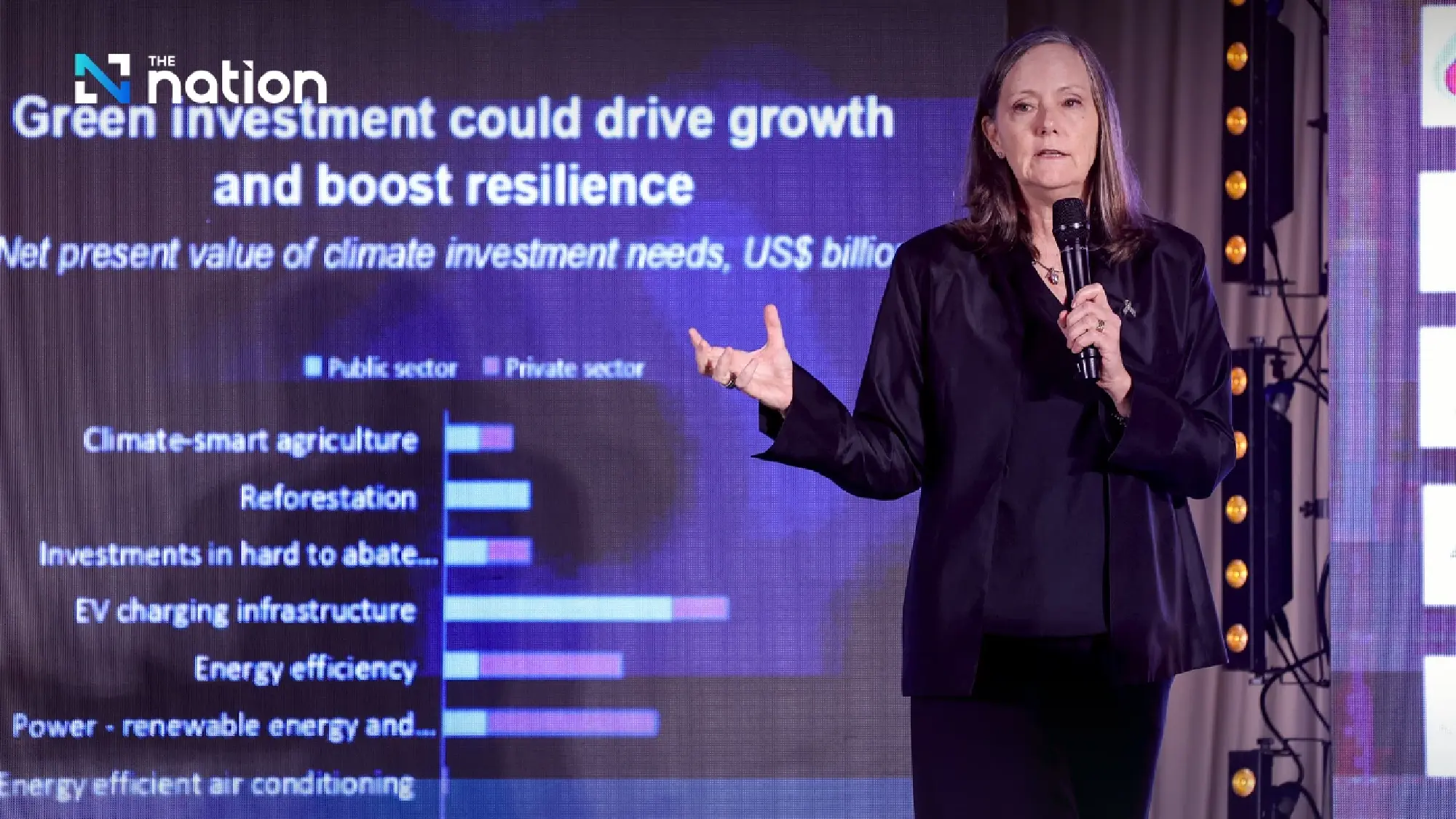

World Bank Warns Trump's Taxes Pose High Risk
Melinda Good, World Bank Country Director for Thailand and Myanmar, revealed that last year, we anticipated the storms the world had to face would be severe and cause heavy damage.
But in reality, the global economy handled it better than expected, growing at 2.7% due to accelerated goods exports.
But the problems Thailand must face persistently come from many directions, especially the storm of uncertainty from US tax policies, which are expected to affect Thailand, which relies primarily on exports.
At this time, policy uncertainty is like a tax, which limits investment and the flow of money.
Therefore, setting up retaliatory tariff walls or collecting more expensive trade fees might not be the answer.
Countries must show openness to build confidence for investors.
If Thailand considers relaxing and reducing trade costs within the ASEAN group by 15%, it could help increase the country's income by about 2%.
"Amid geopolitical issues, many countries think it might be time for us to put up our guard and build defensive lines against each other. But Thailand could utilise the conflict here to attract appropriate investments. Therefore, Thailand's strategy is not to retreat, but to be even more open than before."
