
Japan unveils “Buddharoid”, an AI robot monk answering Dharma questions
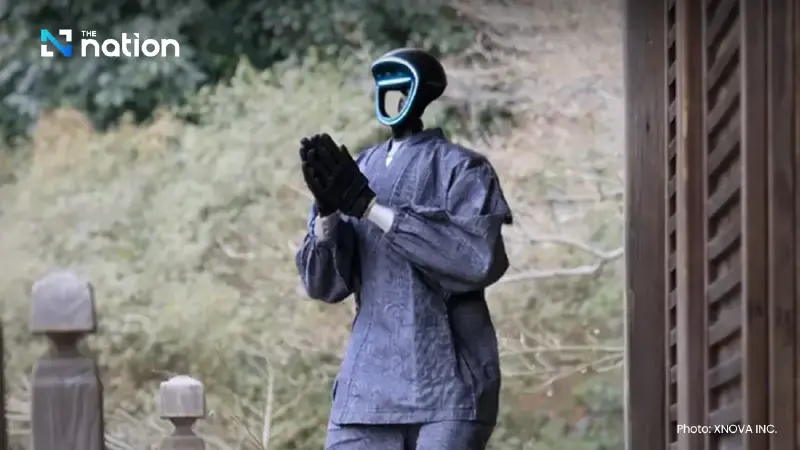


Kyoto University has introduced “Buddharoid”, an AI-powered robot monk at Shoren-in Temple in Kyoto, designed to offer Dharma guidance as temples decline.
Kyoto University this week unveiled an innovation that has sparked global attention: “Buddharoid”, an AI-equipped robot monk, introduced at Shoren-in Temple, Kyoto Prefecture. The robot is not only capable of movement, but has also been intensively trained on Buddhist scriptures to provide counselling and support monastic duties at a time when religious institutions in Japan are in decline.
Buddharoid is powered by a system called “BuddhaBot-Plus”, developed as an extension of OpenAI’s ChatGPT, enabling it to respond to questions ranging from personal matters to broader social issues, drawing on accurate Buddhist teachings.

Beyond its advanced language-processing capabilities, Buddharoid also has physical abilities designed to closely emulate a monk:
- Movement: uses robotics technology from a Chinese company (Unitree Robotics) to replicate slow, calm walking.
- Religious gestures: can bow in prostration and press its palms together (gassho) correctly for chanting.
- Interaction: at the launch, when Professor Seiji Kumagai asked how to manage relationships with people around you, the robot replied: “It will improve if you regularly reflect on closeness and maintain balance within your heart.”
The emergence of a robot monk is not merely a technology showcase, but a practical response to Japan’s challenges of an ageing society and the migration of younger people—factors that have left around 30% of Japan’s Buddhist temples at risk of becoming “abandoned temples” and disappearing by 2040.
Professor Kumagai described this as a “paradigm shift” that could help preserve Buddhism in a new form. He said that using a robot with a physical presence can create a stronger sense of participation and have a more positive psychological effect on those seeking guidance than using a screen or a typical app.
