
UN Security Council split as US and Israel defend Iran strikes
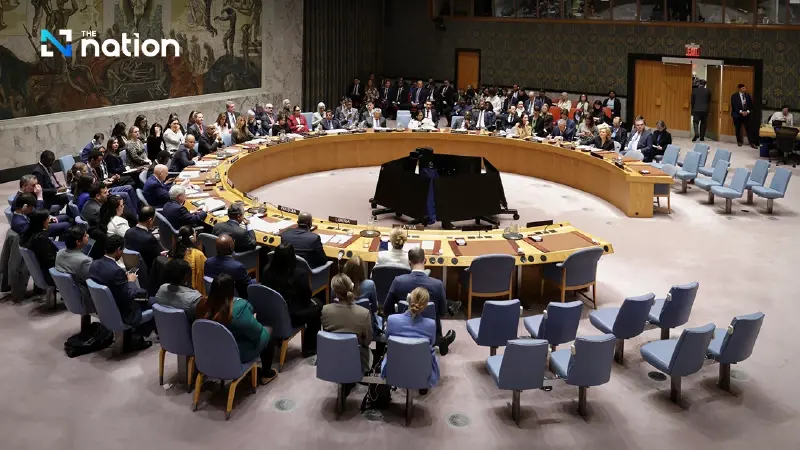


The UN Security Council held an emergency meeting on February 28, 2026, after US-Israeli strikes on Iran and Tehran’s retaliation across the region, but sharp divisions left the Council unable to agree on any joint action.
- At an emergency UN Security Council meeting, the United States and Israel defended their joint strikes on Iran as lawful and necessary self-defense to prevent a nuclear and existential threat.
- The Council was deeply divided, with Russia and China condemning the strikes as illegal, while Iran's ambassador labeled them "war crimes" and claimed its own retaliatory attacks were justified.
- UN Secretary-General António Guterres condemned attacks by all sides, warning of a wider regional conflict and urging an immediate cessation of hostilities and a return to diplomacy.
- Due to the stark divisions between members, the Council failed to produce a unified response or agreement, ending the session in a deadlock.
The UN Security Council convened an emergency session late on February 28, 2026, as fighting between the United States, Israel and Iran intensified and spread across the Middle East. The meeting was requested by Russia and China, with France, Bahrain and Colombia also supporting the call, and was chaired by the United Kingdom, which held the Council presidency for February.
The emergency meeting took place amid reports of large-scale strikes inside Iran followed by Iranian missile and drone attacks across the region. In opening remarks, UN Secretary-General António Guterres warned that the crisis risked triggering “a chain of events that nobody can control”, urging all sides to halt attacks and return to diplomacy.
Guterres: “Everything must be done” to stop escalation
Guterres told ambassadors the Security Council was facing a “grave threat” to international peace and security, condemning both the US-Israeli strikes on Iran and Iran’s retaliatory attacks on neighbouring states. In a statement cited by Reuters, he called for “an immediate cessation of hostilities and de-escalation”, warning that failure to do so could lead to wider conflict with severe consequences for civilians and regional stability.
Multiple accounts of his briefing emphasised the UN Charter’s prohibition on the use of force and the need to protect civilians. PassBlue reported that Guterres said airstrikes hit a girls’ school in Minab, killing at least 85 people and injuring many others, and that another school in Tehran was also reportedly struck—while he cautioned he could not confirm all reports, including claims about the fate of Iran’s Supreme Leader.
US: strikes were “lawful actions” to prevent nuclear threat
US Ambassador Mike Waltz argued Washington’s actions were legal and necessary, framing the operation as self-defence and a response to what the US described as a long-running threat from Iran. According to AP, Waltz told the Council: “Iran cannot have a nuclear weapon,” calling that principle a matter of global security and insisting the United States was taking “lawful actions.”
A detailed summary published by the Better World Campaign quoted Waltz arguing that the core responsibility of any government is protecting its people, and repeated President Donald Trump’s message to Iranians that “the hour of your freedom is at hand.” The same account quoted him saying “peace is preserved through strength” and warning that inaction carries a higher cost.
Israel: “last resort” to stop an “immediate threat”
Israel’s UN Ambassador Danny Danon defended the joint operation as a preventative move against what Israel described as an existential danger. Ahead of the meeting, Danon told reporters Iran’s nuclear and missile programmes and proxy activity had driven escalation and that Israel and the United States were acting to prevent an “irreversible and immediate threat.”
Israeli messaging at the UN focused heavily on deterrence and pre-emption, arguing that allowing Iran to advance its capabilities would pose unacceptable risks to Israel’s security.
Iran: “war crime” claim and self-defence under Article 51
Iran’s UN Ambassador Amir Saeid Iravani accused the United States and Israel of committing grave violations of international law, describing the strikes as “war crimes” and citing civilian casualties. AP reported that Iravani told the Council that “hundreds of civilians” were killed and wounded in the attacks.
The exchange escalated sharply at the end of the meeting. In AP’s account, Iravani asked to speak again to issue a warning to the US envoy: “I advise the representative of the United States to be polite.” Waltz responded by accusing Iran’s leadership of repression and violence.
Iran also argued that its retaliatory actions were lawful self-defence under Article 51 of the UN Charter—an argument echoed by several speakers who framed the debate around competing claims of legality and proportionality.
UK: “played no role”, but condemned Iranian strikes across the region
UK Chargé d’Affaires James Kariuki, chairing the meeting as Council president, said Britain “played no role in the strikes against Iran,” but condemned Iran’s retaliatory attacks across multiple countries. In a published UK government transcript, Kariuki cited attacks on civilian targets and infrastructure—including a hotel in Dubai, Kuwait’s civilian airport, and targets in Bahrain—and said UK forces were conducting defensive operations to protect people and partners.
Kariuki also reiterated that Iran “must never be allowed to develop a nuclear weapon” and said only diplomacy could sustainably address the crisis, urging Iran to refrain from further strikes to open a path back to negotiations.
Pakistan: alarm at “regional conflagration”, calls for restraint and talks
Pakistan’s UN Ambassador Asim Iftikhar Ahmad struck a balancing tone—condemning the initial attacks on Iran while also condemning Iran’s strikes on Gulf states hosting US assets. Pakistan’s Dawn newspaper quoted Ahmad saying: “Pakistan condemns the initiation of unwarranted attacks against the Islamic Republic of Iran, in violation of international law,” while also condemning attacks on Saudi Arabia, Bahrain, Jordan, Kuwait, Qatar and the UAE.
In a separate report, The Express Tribune quoted Ahmad warning that the US-Israeli attacks could undermine the security of the entire region “with far-reaching consequences,” adding: “We are deeply alarmed at the risk of regional conflagration.” The same account said he praised Oman’s role in facilitating dialogue and urged all sides to halt escalation and urgently resume diplomacy.
Colombia: “human life” first, warns against force replacing law
Colombia’s UN Ambassador Leonor Zalabata Torres urged the Council to centre civilian protection and the primacy of international law. A commentary published by Al Jazeera’s Liberties site reported that Zalabata Torres warned civilians are the first victims when “force replaces law,” condemning unilateral military actions that contravene the UN Charter.
Analysts also noted Colombia’s legal framing stood out in a chamber where many members avoided directly condemning the US and Israel. Chatham House said Colombia was among the few to emphasise the prohibition on the use of force in its presentation.
No Council outcome, and a fraught March agenda ahead
Despite repeated calls for de-escalation, the Council remained deeply divided, with Russia and China condemning the strikes and the United States and Israel defending them as lawful. Reuters reported Russia intended to demand an end to what it described as “illegal and escalatory actions” and a shift back to a political and diplomatic settlement—positions the United States rejected.
PassBlue reported that most Council members fell short of explicitly condemning the United States and Israel, underscoring the political limits on any unified response.
Diplomatic tensions are expected to carry into March, when the United States assumes the rotating Security Council presidency. A “What’s In Blue” update by Security Council Report said Council members were unable to agree on the provisional programme of work, reportedly because China and Russia objected to including a briefing related to the 1737 Iran sanctions committee in the March plan.
