
Seoul students publish black hole thermodynamics research
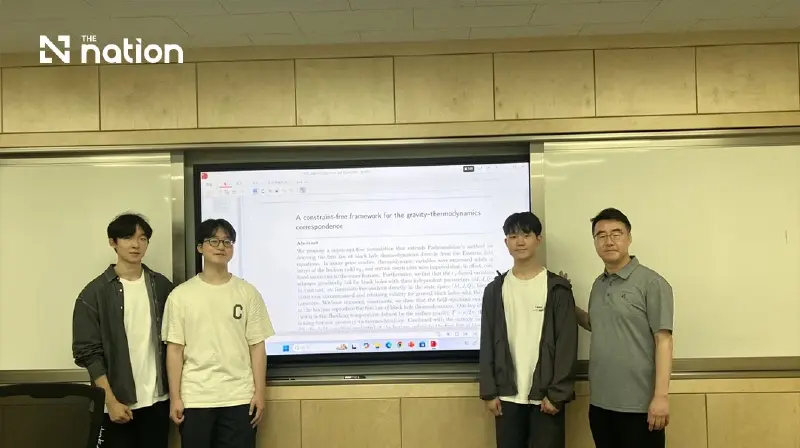


High school researchers developed an entropy-based approach to derive black hole thermodynamics more naturally in general cases.
- Three students from Seoul Science High School published a research paper on black hole thermodynamics in the International Journal of Modern Physics D, a rare achievement for high schoolers.
- The paper proposes a new method for deriving the first law of thermodynamics for black holes by focusing on changes in entropy rather than volume in gravitational field equations.
- This new approach allows the thermodynamic law to be applied more generally to complex black holes, such as rotating or charged ones with multiple event horizons.
- The students conducted their research as part of their school's curriculum without support from a university or other outside institution.
Three students from Seoul Science High School have published a paper on black hole thermodynamics in the International Journal of Modern Physics D, a rare achievement for high school researchers working without university or outside institutional support.
The paper, titled “A Constraint-Free Formulation of Black Hole Thermodynamics from the Field Equations”, examines the relationship between black hole thermodynamics and gravitational field equations.
The school said deriving the first law of thermodynamics for black holes from field equations has long been a challenge in physics.
Previous studies have largely centred on changes in the outer event horizon while taking the volume of a black hole into account.
That framework has made it difficult to apply the same approach to more complex black holes, including rotating or charged black holes with both inner and outer event horizons.
The outer event horizon is the boundary in space-time beyond which gravity becomes so intense that nothing, including light, can escape.
The inner event horizon is a theoretical boundary inside certain rotating or charged black holes.
The student researchers proposed a new approach by introducing changes in entropy, rather than volume, into the field equations.
Because entropy can account for information from both the inner and outer horizons, the paper argues that the first law of thermodynamics can be derived more naturally for more general types of black holes and higher-order theories of gravity.
The school said the finding could provide theoretical support for expanding the theory of emergent gravity, which interprets gravity not as a fundamental force of nature, but as a thermodynamic phenomenon.
The research grew out of the school’s regular curriculum and research programmes.
The three students, Ahn Geon-woo, Bae I-jin and Jang Geun-young, took part in the research last year under the guidance of their physics teacher, Kwon Yong-joon.
All three graduated in February.
They developed their research topic through the school’s research and education programme, graduation thesis track and creative convergence lectures.
The paper was submitted in January and published in June.
The paper’s reviewers praised the work, according to the school, saying it was “particularly impressive” that such sophisticated research had been carried out by high school students.
“The students’ intellectual curiosity and passion bore fruit through the school’s systematic classes and support for research activities,” said Kwon.
Bae and Jang said the process of turning simple curiosity into a paper published in an international academic journal was both challenging and exciting.
“We gained valuable experience by directly taking part in the process of overcoming the limits of previous studies in black hole thermodynamics and adding a new interpretation,” they said.
The Korea Herald
