
Trump says Iran deal will end Tehran’s ‘reign of terror’
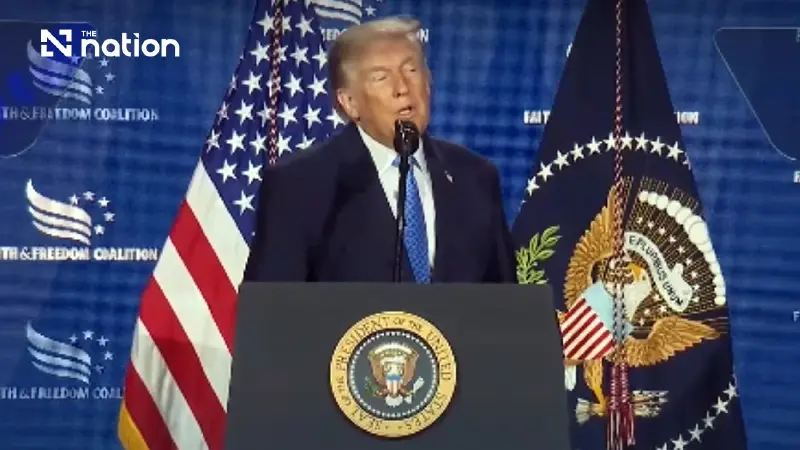


Donald Trump says a US-Iran memorandum will stop Tehran from obtaining nuclear weapons, while defending his record at a conservative event
- President Trump claims a new memorandum of understanding with Iran will end its "reign of terror" and permanently prevent it from obtaining a nuclear weapon.
- The agreement is described as an interim framework designed to reduce hostilities and initiate a 60-day diplomatic phase for further negotiations on Iran's nuclear program and sanctions.
- Trump presented the deal as a major foreign policy victory, arguing that a weakened Iran was offering significant concessions that previous presidents failed to secure.
- He linked the agreement to past US actions, such as the killing of General Qasem Soleimani, framing it as part of a broader strategy to confront Tehran and reduce future threats.
US President Donald Trump has claimed that a new memorandum of understanding with Iran will end what he described as Tehran’s decades-long “reign of terror”, insisting that the agreement will prevent the country from ever obtaining a nuclear weapon.
Speaking on Friday at the Faith and Freedom Coalition policy conference, Trump presented the deal as a major foreign-policy victory and said it achieved what previous presidents had failed to secure. A transcript of the speech shows Trump saying the United States had signed a “historic agreement” aimed at ensuring Iran would never possess a nuclear weapon.
The remarks came as Washington and Tehran continue to navigate the early stages of a fragile memorandum designed to reduce hostilities and open a path towards further negotiations. The agreement has been described by analysts as an interim framework rather than a final settlement, with unresolved questions still hanging over Iran’s nuclear programme, sanctions and regional security arrangements.
Trump told the conservative audience that Iran was eager to strike a deal and accused the country’s leadership of using violence and intimidation for decades. He said the issue should have been resolved long ago, while claiming Tehran was now giving Washington significant concessions.
The president also pushed back against US media outlets that had questioned his claims about Iran’s current military and strategic strength. Trump argued that Iran had been weakened and said coverage suggesting otherwise was misleading.
He then returned to one of the most consequential decisions of his first term: the US strike that killed General Qasem Soleimani, the powerful Iranian commander who led the Quds Force of the Islamic Revolutionary Guard Corps.
Trump accused Soleimani of being responsible for attacks that caused severe injuries to American service members, using the moment to frame the Iran agreement as part of a broader effort to confront Tehran’s past actions and reduce future threats.
The president’s language was characteristically combative, mixing praise for the agreement with sharp attacks on Iran, the media and his political opponents. While he cast the memorandum as a decisive breakthrough, the longer-term impact of the deal remains uncertain.
Talks are expected to focus on turning the memorandum into more durable commitments, including limits on Iran’s nuclear programme and arrangements linked to regional security. The Soufan Center said US and Iranian officials, along with regional mediators, had begun discussions aimed at moving from the memorandum towards a more permanent accord.
The agreement follows weeks of intense diplomacy and heightened regional tension. Le Monde reported that the framework was designed to end fighting and launch a 60-day diplomatic phase covering Iran’s nuclear programme, enriched uranium stockpiles and the gradual lifting of US sanctions.
For Trump, the political message was clear: he wants the agreement to be seen as proof that his administration can secure a tougher deal with Iran than past US governments.
For the region, however, the test will be whether the memorandum can survive its first weeks, translate broad pledges into enforceable commitments and prevent another cycle of confrontation.
