
Thailand, Kazakhstan mark 35 years with push for strategic partnership
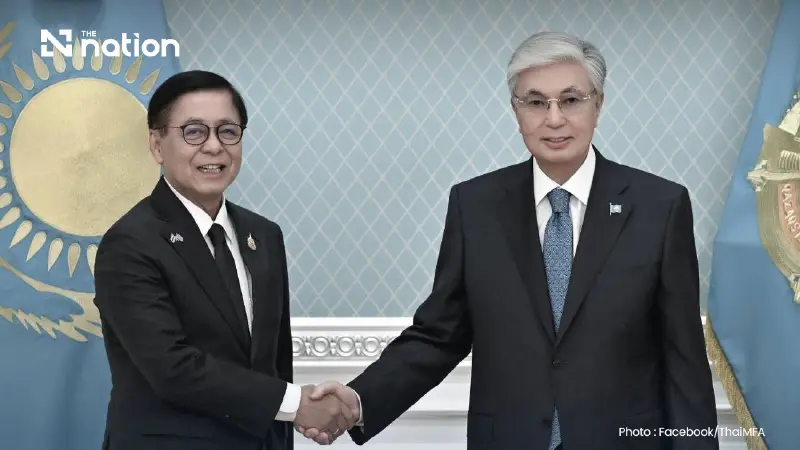


Thailand and Kazakhstan are deepening economic and strategic cooperation ahead of the 35th anniversary of diplomatic relations, with trade, investment, tourism, rare earths and free-trade talks high on the agenda.
- The push for a strategic partnership was advanced during an official visit by Thailand's Deputy Prime Minister to Kazakhstan, where a joint action plan was signed between the two foreign ministries.
- Economic cooperation is a core component, with Thailand targeting Kazakhstan as a market for food products and tourism, a source of rare earth minerals for its EV industry, and a gateway to Central Asia and Europe.
- As part of the partnership, Thailand is seeking Kazakhstan's support, as the current chair of the Eurasian Economic Union (EAEU), to help launch free trade agreement negotiations.
- Both countries view themselves as "middle powers" and aim for the partnership to promote a rules-based international order and enhance connectivity between their respective regions, ASEAN and Central Asia.
Sihasak Phuangketkeow, Deputy Prime Minister and Minister of Foreign Affairs, has completed his official visit to the Republic of Kazakhstan from June 24 to 27, 2026, at the invitation of Yermek Kosherbayev, Minister of Foreign Affairs of the Republic of Kazakhstan.
The visit aimed to strengthen cooperation between Thailand and Kazakhstan, a key partner for Thailand in Central Asia, while advancing economic diplomacy to promote cooperation in the economy, trade and investment in high-potential markets.

During the visit, the Deputy Prime Minister paid a courtesy call on Kassym-Jomart Tokayev, President of the Republic of Kazakhstan, and held bilateral talks with the Kazakh foreign minister. He also co-signed a joint action plan between the Ministry of Foreign Affairs of the Kingdom of Thailand and the Ministry of Foreign Affairs of the Republic of Kazakhstan.
The Deputy Prime Minister also led a Thai private-sector delegation from 11 companies to take part in the Thailand-Kazakhstan Business Forum in Almaty, with the aim of promoting interaction between the private sectors of the two countries before they celebrate the 35th anniversary of diplomatic relations in 2027.
The Deputy Prime Minister gave an exclusive interview to Thai media about his visit to Kazakhstan.

Talks with the President
Sihasak: There were two issues. The first is that Thailand views its relationship with Kazakhstan as a strategic partnership, not merely a bilateral one. In terms of bilateral relations, there are many areas in which we can cooperate. But we also share views on many issues relating to an increasingly disorderly world, where international cooperation and rules are being undermined.
As Thailand and Kazakhstan fall into the category of middle powers, Kazakhstan is regarded as a leader in Central Asia, while Thailand is a country with an important role in ASEAN.
Cooperation between Kazakhstan and Thailand could therefore become something new in terms of connectivity between organisations or regional-level cooperation, in order to preserve peace, rules-based international order, and free trade, which are all important.
The second issue we discussed was trade and investment between the two sides. I think the Thai private sector is enthusiastic and sees opportunities to do business in Kazakhstan. Although it is not a large market, with a population of about 20 million, Kazakhstan as a whole is a gateway to Central Asian countries and is located on the Trans-Caspian International Transportation Corridor, a route through which Thailand can send goods to Russia and Europe. That is why Thai businesses are interested.

Why Kazakhstan?
Sihasak: There are many reasons. One is that Kazakhstan needs food. It may be able to produce food commodities, but it does not produce consumer food products in the way we do. It could therefore be a market for Thai food products.
But we are looking further ahead. We would like to produce in Kazakhstan. Several Thai companies are exploring opportunities. At first, this may involve exporting products there for sale. In the future, however, they will likely want to establish production in Kazakhstan in order to use its strength as a gateway to Central Asia, Russia and Europe.
Strong potential in tourism
In tourism, as well as the hotel and spa industries, Kazakhstan’s purchasing power is rising. Per-capita income is around US$14,000-15,000. Kazakhstan also has tourism potential. If we co-invest in hotels and restaurants, there will be many opportunities, and Thai private companies are interested.
Rare earths could support Thailand’s EV industry
Sihasak: In the energy sector, we are interested in certain raw materials needed for plastics. Another interesting point is that Kazakhstan has rare earth minerals that Thailand currently needs, especially for our EV industry and battery production.
We need to have the capacity to produce batteries for electric vehicles. Kazakhstan has minerals that are important for developing the battery industry in Thailand. We will need to meet more often and build networks between each other. I think this should go well.
Government opens doors for the private sector
Sihasak: Thai private companies are capable and highly competent. But when entering new markets, they need confidence. This comes partly from political factors, from clear cooperation, from agreements on investment promotion and protection, and from agreements on avoiding double taxation.
These are things the government can help with by opening doors, creating a positive atmosphere and setting frameworks. The Thai private sector can then begin studying the market.
Answering the call of economic diplomacy
Sihasak: The Ministry of Foreign Affairs gives importance to economic diplomacy. We have to diversify and seek new markets. Of course, the United States remains an important market, but we are now facing tariff issues.
Europe may also have protectionist measures, while we are negotiating a free trade agreement with the European Union, which needs to move forward. But we also have to explore other markets. Even in Africa, there are many countries with potential. Central Asia certainly has potential, including Kazakhstan and Azerbaijan. These are wealthy countries, and we must try to move into new markets.
Support for a Eurasian FTA
Sihasak: At present, free-trade rules under the WTO are being undermined. We therefore need to find ways to maintain access to important markets. One mechanism is free trade agreements.
We are now negotiating with the EU. We have completed one with Sri Lanka. The Thailand-European Free Trade Association, or EFTA, free trade agreement has also just entered Parliament.
As for Kazakhstan, this year it holds the chairmanship of the Eurasian Economic Union, or EAEU, which consists of Armenia, Belarus, Kazakhstan, Kyrgyzstan and Russia.
Thailand has previously proposed free trade negotiations with the Eurasian Economic Union, but this has remained pending and has not moved forward very much. I therefore took the opportunity during this visit to ask Kazakhstan to help support this matter, as it currently holds the chairmanship. Kazakhstan said it was pleased to do so and wanted to support Thailand in opening FTA negotiations with the Eurasian Economic Union.
Putin has already approved
Sihasak: Although the chairmanship of the EAEU is a rotating position, Prime Minister Anutin Charnvirakul recently visited Russia, held bilateral talks with President Vladimir Putin, and raised this issue with him.
Of course, Russia is the major player in this grouping. The Russian side acknowledged our wish and said it would help support it. So, during this visit, we received support from Kazakhstan, while Russia has already been informed of our intention.
As for the chances of success, the first step is to open negotiations. Negotiations with the EAEU should be easier than with the EU, because the EU has many issues that are not directly related to trade, such as intellectual property, human rights and the environment. In the EAEU context, most of the issues are primarily trade-related.
Thailand and Kazakhstan as middle powers
Sihasak: Thailand and Kazakhstan are middle powers. When we use this term, it does not mean that we are ambitious. We do not view being a middle power in terms of wanting influence. We see it in terms of wanting to do something for the common good.
We see middle powers as countries that share the view that we want to do something beneficial for the wider community, but we cannot do it alone.
Middle powers are countries that emphasise rules, regulations and cooperation. Our countries are not in a position to dictate that things must be this way or that way. But we feel that we must work together, mobilise collective strength, and push forward issues that we believe are in the common interest.
The common interest now is about rules, international cooperation, and preserving the importance of institutions such as the United Nations and other international organisations. This world should not be one in which whoever is powerful can simply create legitimacy for themselves.
