
DNP and Nara institute develop AI guide for buried palace ruins
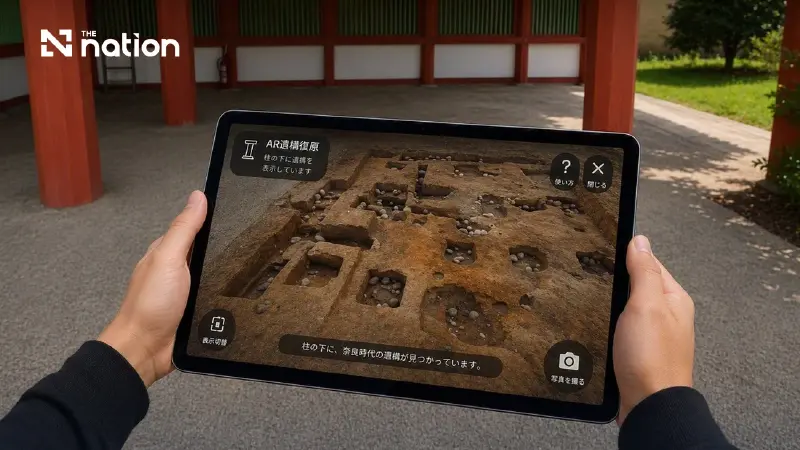


The partners will test an AI and augmented reality guide to reconstruct buried remains at the Heijo Palace site and answer visitors’ questions before a planned 2028 launch.
- Dai Nippon Printing (DNP) and the Nara National Research Institute for Cultural Properties are collaborating to create an interactive AI guide for the Heijo Palace ruins.
- The guide will use augmented reality (AR) on smartphones and tablets to visualize buried structures and reconstructed buildings for visitors.
- It will feature a conversational AI, trained on the institute's research data, allowing users to ask questions and receive explanations as if talking to a researcher.
- The service is scheduled to launch at the Nara site in 2028, with future plans to expand the technology to other archaeological sites nationwide.
Dai Nippon Printing Co., Ltd. (DNP) and the Nara National Research Institute for Cultural Properties have agreed to jointly develop a next-generation museum experience that uses digital technology to bring archaeological heritage to life.
The research partnership, signed on Friday (July 10), will initially focus on demonstration tests for an interactive artificial intelligence guide at the ancient Heijo Palace site in Nara Prefecture.
The service is scheduled to be introduced in 2028, marking 30 years since the Historic Monuments of Ancient Nara, including the palace site, were inscribed on the UNESCO World Heritage List.
Although structures including Suzakumon Gate and Daigokuden Hall have been restored, much of the former palace remains buried.
This makes it difficult for visitors to understand the full historical and cultural significance of what once stood at the site.
The planned service will use augmented reality to display reconstructed images of underground remains and former buildings on smartphones and tablets.
Visitors will also be able to ask questions and receive explanations in a conversational format designed to resemble an exchange with researchers.
An AI model developed by DNP will be trained using excavation reports, research findings and images accumulated by the institute over many years.
The demonstration tests will also be used to establish a standard operating framework for the guide service.
“We’ll be able to reunite with ancient ruins that sleep underground, hidden from view,” Makoto Motonaka, director-general of the institute, told a press conference in Nara.
“This project, which visualises underground ruins, holds great significance.”
DNP Senior Executive Corporate Officer Motoharu Kitajima said the company intended to extend the technology beyond Nara.
“Based on knowledge gained at the Heijo Palace ruins, we aim to scale the guide service for utilisation at archaeological sites nationwide in the future,” he said.

[Copyright The Jiji Press, Ltd.]
