
World reacts sharply to Trump’s new tariffs as countries weigh retaliation
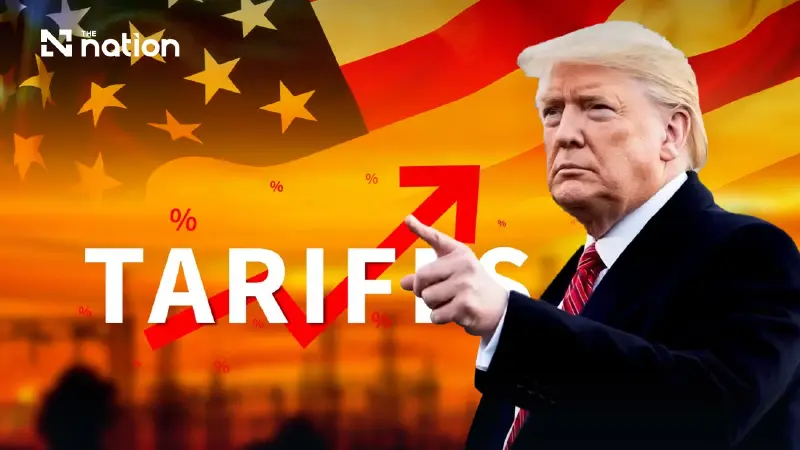


Several countries have rejected US claims over forced labour in supply chains after President Donald Trump announced new import tariffs of 10-12.5% on around 60 countries and territories, including Thailand.
After US President Donald Trump announced new import tariffs of 10-12.5% on around 60 countries and territories, including Thailand, over alleged failures to prevent forced labour in supply chains, governments around the world have reacted sharply.
Most countries have rejected the allegations as baseless and unreasonable. However, responses vary on whether they will retaliate against the United States.
China
China strongly condemned the measure, saying the US was using forced-labour allegations as a tool for trade protectionism.
Beijing insisted there is no forced labour in Chinese supply chains and called on Washington to immediately cancel all related tariff measures.
The Chinese government also threatened to take “necessary measures” to protect the legitimate rights and interests of Chinese businesses, though it has not yet announced specific retaliatory steps.
Singapore
Singapore was among the countries that clearly rejected the US allegations.
Foreign Minister Vivian Balakrishnan said there was neither a technical nor economic basis for the US to impose tariffs on Singapore.
He stressed that the United States has consistently recorded a trade surplus with Singapore, and that the surplus has continued to grow.
Balakrishnan said he had raised the matter with US Secretary of State Marco Rubio during the ASEAN foreign ministers’ meeting, in an effort to convince the US side that Singapore should not be targeted by the measure.
However, Singapore acknowledged that it must be careful not to become an unintended victim of the latest broad US tariff policy.
Earlier, Singapore’s Ministry of Trade and Industry submitted clarification to the Office of the United States Trade Representative, or USTR, stating that there was no evidence linking Singapore to supply chains involving forced-labour goods.
The ministry also stressed that forced labour is already a criminal offence under Singaporean law.
Malaysia
Malaysia expressed disappointment over the measure, insisting that it has laws and enforcement mechanisms to continuously prevent forced labour.
Malaysia said unilateral tariffs would create further uncertainty in the global trading system.
However, Malaysia has chosen to pursue diplomatic talks and consultations with the US rather than immediately announce retaliatory measures.
Japan
Japan expressed dissatisfaction with the US decision.
Chief Cabinet Secretary Minoru Kihara said it was “regrettable” that Japan was being subjected to tariffs.
The Japanese government is seeking confirmation from Washington that Japan will not face tariffs higher than those set out in last year’s bilateral trade agreement.
Tokyo will continue negotiations with Washington to ensure the measure is implemented in line with the existing agreement.
Canada
Canada has taken a tougher stance than many countries.
Prime Minister Mark Carney said “all options remain open”, and that any measures would depend on the outcome of negotiations with the US.
Canada will speed up efforts to diversify export markets to reduce reliance on the United States and prepare support measures for businesses affected by the tariffs.
When asked directly about possible retaliation, Carney said only that “we have a full range of measures available”, without giving details.
He stressed that the government would fully protect Canadian workers, families and businesses.
Australia
Australia said the US measure was “unjustified” and contradicted the free trade agreement between the two countries.
Trade Minister Don Farrell said Australia has some of the world’s strongest measures against forced labour and modern slavery, recognised internationally, including by the United States itself.
He said there was no reason for Australia to face such allegations.
However, the Australian government has not yet signalled whether it will introduce retaliatory trade measures.
New Zealand
New Zealand expressed disappointment with the US decision, but said it had been expected.
Trade and Investment Minister Todd McClay said Trump had campaigned on tariff increases, so the latest move was not a surprise.
McClay also rejected the forced-labour allegations, saying there was “very little credibility” in claims that New Zealand’s economy had any measurable level of goods produced with forced labour.
He described the USTR investigation as a “legal pretext” for imposing new tariffs.
US says tariffs aim to protect American workers
The Trump administration announced import tariffs of 10-12.5% on goods from around 60 countries and territories after an investigation by the USTR under Section 301 of the Trade Act of 1974.
The investigation concluded that these countries had failed to prevent forced labour in supply chains, allegedly affecting American workers and US manufacturing.
Washington said the measure is intended to restore a trade policy focused on protecting American workers, after an earlier round of reciprocal tariffs was struck down by the US Supreme Court.
The new tariff package has been designed to have a stronger legal foundation and will take effect immediately after the earlier global import tariff of 10% expires, preventing any enforcement gap.
US Trade Representative Jamieson Greer told members of Congress that the measure is part of a broader strategy to protect American workers and address the US trade deficit, which the Trump administration regards as a “national emergency”.
He also confirmed that trade negotiations with partner countries will continue, even after the new tariffs take effect.
Source: Krungthep Turakij
