
Tokyo survey puts easy Japanese ahead of English for foreign residents
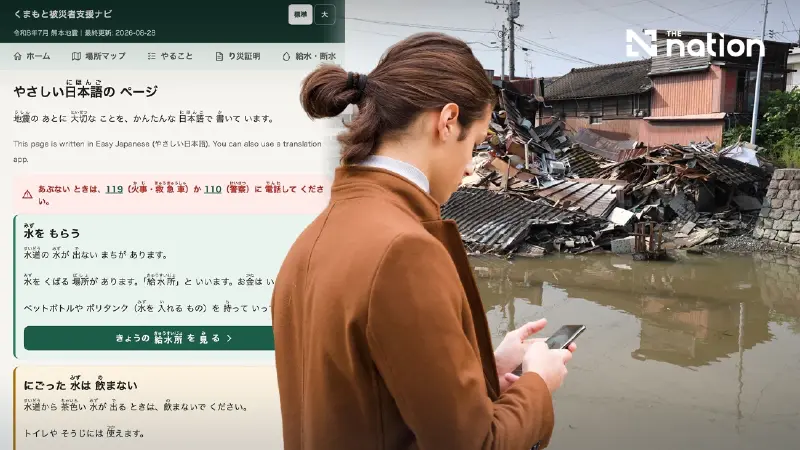


Kumamoto’s prefectural government and a local technology company are using clear Japanese to keep foreign residents informed after a powerful earthquake.
- A survey of foreign residents in Tokyo revealed a preference for information in "easy Japanese" (41.3%) over English (35.9%).
- This trend is attributed to the diversification of nationalities among foreign residents, with fewer people coming from English-speaking countries.
- "Easy Japanese" is a simplified format that uses brief, clear sentences and replaces complex loanwords with more easily understood native Japanese words.
- The practical importance of easy Japanese has been demonstrated in disaster situations, such as providing essential information to foreigners after the Kumamoto earthquake.
Easy Japanese drew more interest than English in a Tokyo survey of foreign residents, with 41.3% saying they wanted to read information in the simpler format and 35.9% seeking English.
Its role during disasters has also come into focus following a powerful earthquake in Kumamoto Prefecture in southwestern Japan.
WizTry, a technology firm based in Kumamoto, created a website providing essential information for those affected on July 29 (https://kumamoto-shien.jp/).
This was one day after the magnitude 7.1 quake produced a reading of up to 7, the highest on Japan’s seismic intensity scale.
The site includes an easy Japanese page for foreign residents (https://kumamoto-shien.jp/yasashii).
One notice tells users: “Mizu wo kubaru basho ga arimasu. Okane wa irimasen.”
It means that water is available at certain locations without charge.
WizTry President Kotaro Suematsu said he hoped the page would help foreign residents whom information often fails to reach.
People from Southeast Asian nations, including Vietnam and Indonesia, make up more than half of Kumamoto’s foreign residents.
“We have many people whose native languages are not English,” an official of the Kumamoto prefectural government’s international affairs division said.
“We are trying to provide information in easy Japanese rather than in English.”
Tokyo Metropolitan Foundation “TSUNAGARI”, which conducted the survey, promotes the approach and wider awareness of it.
Its guidance centres on keeping sentences brief and clear while avoiding onomatopoeia, mimetic language, loanwords and ambiguous wording.
For example, the English-derived “kyanseru”, or “cancel”, can be replaced by “yameru”; “teikyo-suru”, or “to provide”, can be expressed as “moraeru”, meaning “you can get”.
Offering an explanation for the survey finding, Nobuko Inoue of the foundation said: “It’s probably because the nationalities of foreigners living in Japan have diversified, and fewer people are from English-speaking countries and regions.”

[Copyright The Jiji Press, Ltd.]
