
Israel orders UK consulate closure over settlement sanctions
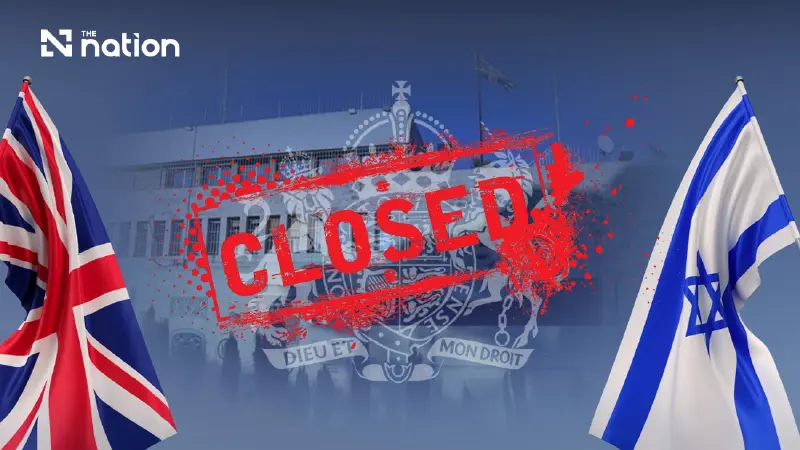


Israel has given Britain 30 days to close its East Jerusalem consulate after plans to ban imports from West Bank settlements
- Israel has ordered the closure of the UK's consulate in East Jerusalem in retaliation for planned sanctions on goods from Israeli settlements.
- The sanctions, announced by the UK, France, and Canada, are intended to ban imports from Israeli settlements in the West Bank to protect the two-state solution.
- In addition to closing the consulate, Israel will also exclude Britain from a US-led Gaza coordination mission and impose entry bans on some UK officials.
- Israel's Foreign Minister called the British move "blatant interference" and coordinated the retaliatory measures with the Prime Minister.
Israel has ordered the closure of Britain’s consulate in East Jerusalem in retaliation for plans by the UK, France and Canada to ban imports from Israeli settlements in the West Bank.
The decision was announced on Tuesday (September 8). Four sources told Reuters that the consulate had been given 30 days to close.
Israeli Foreign Minister Gideon Sa'ar said Britain would also be excluded from a US-led coordination mission for Gaza. Entry bans would apply to some British officials and other individuals, including former Labour leader Jeremy Corbyn.
“The British move is morally distorted, and constitutes blatant interference in the affairs of a sovereign state and its electoral process,” Sa'ar said.
He dismissed British Foreign Secretary Ed Miliband’s accusations of ethnic cleansing of Palestinians as “outrageous lies”.
Sa'ar said he had coordinated Israel’s response with Prime Minister Benjamin Netanyahu and accused Britain of interfering in Israeli elections scheduled for late October.
The trade measures announced by Britain, France and Canada are the latest targeting Israel’s settlement policy, underlining its growing diplomatic isolation among some longstanding allies.
Britain, France and Canada increase pressure
British Prime Minister Andy Burnham, French President Emmanuel Macron and Canadian Prime Minister Mark Carney described the announcement as a turning point in their joint efforts to protect a two-state solution.
“Today marks a further turning point in our approach to protecting the two-state solution,” the three leaders said in a joint statement on Tuesday.
They also indicated that they would promote those efforts at the United Nations General Assembly later this month.
Miliband said Britain could no longer simply “call out” injustice and suffering but needed to act against settlement expansion.
He said the new legislation would take effect within six to nine months, while sanctions against a number of extremist settlers would be imposed immediately.
Foreign ministers from nine other countries, including Denmark, Norway, Poland, Spain and Sweden, issued a separate statement reaffirming support for a negotiated two-state solution, with a Palestinian state living peacefully alongside Israel.
Canadian Foreign Minister Anita Anand wrote on X that Canada had for decades regarded a two-state solution as the best route to lasting peace in the Middle East and a means of addressing Israel’s security concerns.
“Illegal settlements in the West Bank significantly undermine these objectives,” she wrote.
The United Nations, Palestinians and most countries regard Israeli settlements in the West Bank as illegal under international law. Israel disputes this.
Limited trade impact, wider diplomatic significance
Britain’s Chief Rabbi Sir Ephraim Mirvis described the planned sanctions as “a dark day for British Jews” and accused the government of “gesture politics”.
Exports from West Bank settlements consist largely of agricultural products, including dates, citrus fruit, herbs and wine. They account for only a small proportion of Israel’s total exports.
The proposed import bans are therefore largely symbolic in economic terms, with little effect expected on overall bilateral trade. They form part of a broader effort to uphold a two-state solution.
The measures were announced as Israel unveiled plans on Tuesday for another 1,000 homes in the West Bank.
Particular concern surrounds Israel’s E1 settlement project near Jerusalem, which would cut across land Palestinians want for a future independent state.
A Reuters investigation published on Tuesday found that Israel’s government was financing some of the West Bank’s most radical settlers, who use illegal outpost farms to displace Palestinians.
Relations under growing strain
Relations between Britain and Israel have deteriorated in recent years as London has criticised Israel’s conduct in Gaza, settlement expansion in the West Bank and increasing attacks on Palestinians by settlers.
Britain joined other countries in recognising a Palestinian state in 2025 to support a two-state solution.
France’s planned import ban reflects growing frustration among some European Union members that have pushed for collective action. They have so far failed to secure the required qualified majority, largely because of opposition from several countries, including Germany.
Alongside the measures concerning the West Bank, Miliband acknowledged the threat Iran posed to Israel.
He said Britain would impose sanctions on Al-Qard Al-Hassan, a financial institution run by Hezbollah, and reimpose economic sanctions on Iran in line with the European Union and the United States.
