
Why CNN Still Bets on Humans, Not Algorithms, to Tell the Story
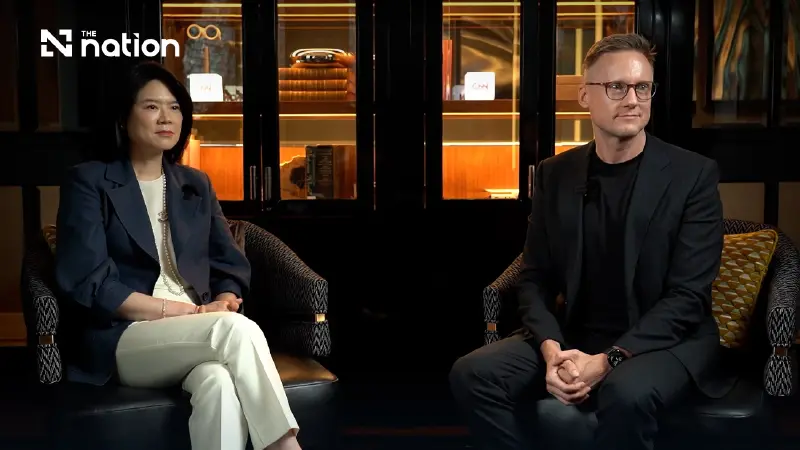


Ellana Lee and Will Ripley of CNN International tell The Nation how the network embraces AI without letting it replace human judgement or storytelling
- CNN uses AI as a tool for support tasks like condensing research, translation, and transcription, but a human journalist always has the final say before publication.
- The network believes human journalists provide an irreplaceable "spark" and authenticity to storytelling that algorithms lack and that audiences can distinguish.
- To maintain accuracy and trust, especially when fighting AI-generated misinformation, CNN relies on human judgment and traditional reporting for verification, prioritizing being correct over being first.
Ellana Lee and Will Ripley of CNN International tell The Nation how the network embraces AI without letting it replace human judgement or storytelling.
For an organisation built on chasing the next big story, CNN International's approach to artificial intelligence is refreshingly unhurried: use the technology, but never let it hold the pen.
That was the message from Ellana Lee, Group Senior Vice President, General Manager APAC and Global Head of Productions at CNN International, and Will Ripley, the network's Senior International Correspondent, in an exclusive interview with The Nation ahead of CNN's Global Perspectives event in Bangkok this October—the first time the franchise has come to Asia.
Speaking candidly about the pressures facing modern newsrooms, from AI-generated misinformation to the relentless demands of round-the-clock digital publishing, both executives were unequivocal that CNN's competitive edge lies not in outsourcing judgement to machines, but in doubling down on human craft.
"We should embrace artificial intelligence," Lee said. "It's a new technology; we should all learn about it, but we should be very clear on how it can help us and learn about the danger zones as well."
She described a recent training session in CNN's Hong Kong newsroom exploring practical uses of AI — condensing hundreds of pages of source material, assisting with translation, and speeding up transcription work that once consumed hours of staff time.
Yet Lee drew a firm line at the point of publication.
"We will never allow it to be the final say before we publish," she said. "A human journalist will always be looking at the final product, feel satisfied that it has checked all of our balances that we look at, and then we put it out into the world."

Ripley, who has spent nearly three decades in the field, likened AI to "an assistant that's really, really book smart but has zero street smarts."
He argued that audiences can increasingly tell the difference between human-crafted work and AI output.
"It doesn't have that spark... it can't add that magic touch to make something really sing, whether it's a piece of video or even text," he said, adding that he was encouraged to see younger audiences pushing back against AI-generated content rather than embracing it uncritically.
Fighting deepfakes with old-fashioned reporting
The conversation turned to one of the thorniest challenges facing newsrooms today: the flood of deepfake and manipulated video circulating on social media during breaking news events, including the recent flooding in Nepal.
Lee said CNN's response combines technology with traditional shoe-leather journalism. The network uses proprietary and third-party software to verify footage, employs journalists trained in open-source intelligence (OSINT) techniques, and draws on digital forensic analysis. But sometimes, she said, verification simply means picking up the phone.
"We pick up the phone and try to call someone in that neighbourhood next to a building that perhaps have collapsed, just to make sure that no one is using it as deepfake to make a political point," she explained.
That rigour, she acknowledged, can slow things down.
"Sometimes it takes a little bit longer to get videos out, published, because our team is working to verify that the video is accurate. So sometimes you see a video elsewhere, you don't see it on CNN."

For a network built on being first with breaking news, Lee said the priority has shifted to being both fast and correct.
"There's no point in being first if you're going to be wrong."
Ripley pointed to a growing public appetite for accountability online.
"I am gratified to see a lot of people online calling out AI as soon as they see it," he said, noting that when CNN itself uses AI-generated footage—for instance, in reporting on propaganda videos—it is always clearly labelled on screen. "We want people to feel that when they're watching us, they can trust that that video is an accurate, real piece of video."
From cable news to every screen
Lee, who joined CNN as an intern and now oversees news for Asia, features and Global Perspectives programming globally, reflected on the network's transformation from a 24-hour cable operation into a multi-platform storyteller spanning streaming, social media and long-form documentary.
"CNN is constantly innovating," she said, crediting the spirit of founder Ted Turner for a culture that "is almost like working in a startup in a very big organisation."
She noted regional nuances in how audiences consume news — viewers in Southeast Asia, for example, gravitate more towards video, while audiences in Australia and Europe still favour text — and said CNN was working to "meet our audiences where they are" rather than adopting a one-size-fits-all approach.
Ripley, who covers a broad remit stretching from North Korea — which he has visited 19 times — to cross-Strait tensions and, more recently, travel content, said the modern journalist increasingly needs to master multiple formats within a single assignment.
Reporting on the cave rescue in Laos earlier this year, his team produced live shots, an extended live stream, short social videos, and a mini-documentary—all from a single assignment. CNN was the first international network to report live from the country.
"I would say we're much busier, maybe three times busier now," he said, "but it's exciting trying to find new ways to engage with the audience."

Advice for the next generation
Both executives addressed the pressures facing young people considering journalism as a career, particularly in markets like Thailand where pay and workload can deter newcomers.
Lee said passion for the profession remains strong globally — a single vacancy in the United States recently drew 100 applicants — but urged media owners to compensate journalists fairly.
"This really is a passion project," she said. "But I think there's nothing more rewarding than being a really good journalist... a society is enriched not just by having financial jobs, I think by having a really healthy media environment."
She also championed internships as a route into the industry, recalling her own start in a newsroom in 1996, when reporters still ripped news off wire machines and relied on police scanners rather than smartphone footage.

Ripley's advice to aspiring reporters was to build genuine expertise in a subject that excites them.
"Get out from behind that computer and actually go and meet people face to face," he said. "If it doesn't feel like work... then you know that you're on the right track and it's a really fulfilling career."
On managing the burnout that comes with the job, both pointed to simple habits: sleeping well, eating clean, and walking — the pair covered six miles around Lumpini Park the day before the interview.
"I think simplifying your life is probably the best advice I can give," Lee said, "because we live in such a complicated world and we handle some really complicated stories."
CNN's Global Perspectives will make its Asian debut in Bangkok this October, bringing together global leaders, policymakers and CNN's own roster of correspondents and anchors, including Dr Sanjay Gupta, Richard Quest, Kristie Lu Stout, Will Ripley, and Hanako Montgomery—for a day of live discussions on economics, health, and the region's evolving role on the world stage.
