
World leaders convene amid conflicts and AI risks as UN faces strain
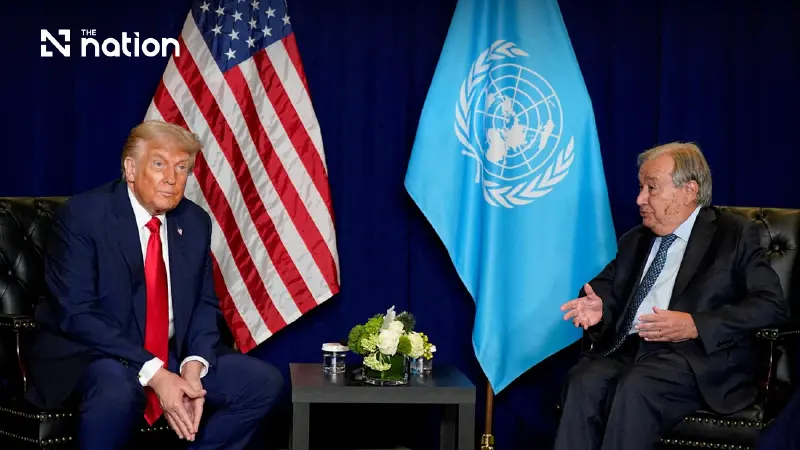


Nearly 130 heads of state arrive in New York as funding pressure, a leadership transition and disputes over global security deepen uncertainty around the United Nations.
- World leaders are gathering for the UN General Assembly, but the organization's relevance is under strain due to financial pressure, the absence of key leaders, and its inability to resolve global crises.
- The meeting is dominated by major conflicts, including the war in Ukraine, where the UN Security Council is paralysed by Russia's veto, and escalating tensions in the Middle East.
- The rapid development of artificial intelligence is a key topic, but leaders are divided on how to manage its risks, with UN Secretary-General Guterres calling for global governance while US President Trump dismisses such concerns.
The ability of the United Nations (UN) to respond to overlapping global crises will come under close scrutiny when nearly 130 heads of state gather in New York this week.
The General Assembly opens with the post-Second World War order under strain from widening conflicts in Ukraine and the Middle East, while the rapid development of artificial intelligence presents another challenge for international cooperation.
Richard Gowan of the International Crisis Group described the UN as caught in a prolonged crisis. More than a year into Donald Trump’s second presidential term, he said, “we would no longer say that the UN is in freefall, but we would say that it's stuck in an open-ended crisis.”
“The UN may not be in emergency care like it was last year, but it seems to be trapped in a trauma center for the foreseeable future,” Gowan added.
Institutional pressure shadows the gathering
US President Donald Trump is due to return to the General Assembly rostrum for a second consecutive year.
The organisation continues to face attacks from Trump, whose administration has sharply reduced US contributions and withdrawn from dozens of UN bodies.
Financial pressure has added to a broader crisis of morale within the organisation.
The United States paid US$725 million into the UN’s regular budget this week, allowing it to retain its General Assembly vote, but it still owes more than US$1 billion.
Washington also continues to demand spending cuts and reforms.
Chinese President Xi Jinping will not attend the gathering, having last addressed it by video in 2021.
He is instead scheduled to hold one-on-one talks with Trump in Washington on Thursday, reinforcing questions about whether governments still regard the UN as the main forum for addressing international emergencies.
Uncertainty also surrounds the future leadership of the 80-year-old organisation.
Secretary-General Antonio Guterres will complete his term at the end of 2026, but no clear frontrunner has emerged to replace him.
Diplomats said the 15-member UN Security Council could convene high-level meetings on Ukraine, the Middle East and artificial intelligence (AI), including discussions with Arab leaders.

Russian veto leaves Ukraine diplomacy blocked
Russia’s war in Ukraine, which has continued for more than four years, remains beyond the Security Council’s ability to resolve because Russia is a permanent member with veto power.
Ukrainian President Volodymyr Zelenskiy and Russian Foreign Minister Sergei Lavrov are both expected to address the General Assembly.
Diplomats said Zelenskiy would probably use the gathering to strengthen Ukraine’s position before another difficult winter.
Trump has shown frustration over his inability to negotiate an end to the conflict, despite making that objective a priority when he began his second term in January last year.
He spoke with Russian President Vladimir Putin earlier this month, although it remains unclear whether he will meet Zelenskiy in New York.
Guterres has drawn attention to the consequences for civilians as well as the disruption to food supplies and energy prices.
“The effective blockade existing in the Black Sea is creating enormous problems that add to the problems generated by the Middle East crisis, and I think it would be very important to find a way to allow Ukrainian exports and Russian exports of food, fertilisers and energy to take place in a safe way through the Black Sea,” he said.
Middle East speakers arrive amid escalation
Iranian President Masoud Pezeshkian is scheduled to speak on Wednesday, followed by Israeli Prime Minister Benjamin Netanyahu on Thursday.
Netanyahu is wanted by the International Criminal Court (ICC) over alleged war crimes and crimes against humanity in Gaza, allegations that Israel denies.
Their appearances come as the US-Israeli war on Iran continues to destabilise the region and drive global inflation.
Recent advances by Houthi militants have also placed shipping through the vital Bab el-Mandeb Strait under threat, potentially pushing energy prices higher.
Peace negotiations remain stalled while Iran and the United States exchange strikes and Trump threatens a major escalation of the war.
Guterres cautioned against relying on military force to resolve the situation.
“It’s very difficult to have a military solution for that problem, and the experience of fighting in Yemen demonstrated how complicated it is to have successful interventions,” he said, adding that the UN envoy on Yemen was making a “huge effort” to advance negotiations.
Palestinian President Mahmoud Abbas will not attend in person for the second consecutive year after the United States, a close ally of Israel, again refused him a visa.
The General Assembly voted on Thursday to allow him to address the gathering by video.
Diplomats also expect a high-level meeting on Sudan to take place on the sidelines, although they regard the prospect of a diplomatic breakthrough as remote.
AI safety divides Guterres and Trump
The debate over AI intensified shortly before the assembly after several industry leaders called for a coordinated slowdown in its development.
They warned that the technology could soon improve itself and escape human control.
Guterres, who has long advocated global governance of AI, has identified the issue as a major subject for the gathering.
The UN established an advisory body on the technology in 2023, bringing together technology executives, government officials and academics.
Countries at the forefront of AI development should establish “common guardrails in order to avoid this race to the bottom that could lead one day to a gigantic disaster at the global level,” Guterres said.
Trump has rejected such warnings as a “hoax” and alleged that there is a “sick conspiracy” against AI.
He has also argued that China would benefit from doubts being raised about the continued development of the technology.

Source: Reuters
