
Nophadol In-na elected to lead IPU science and technology group
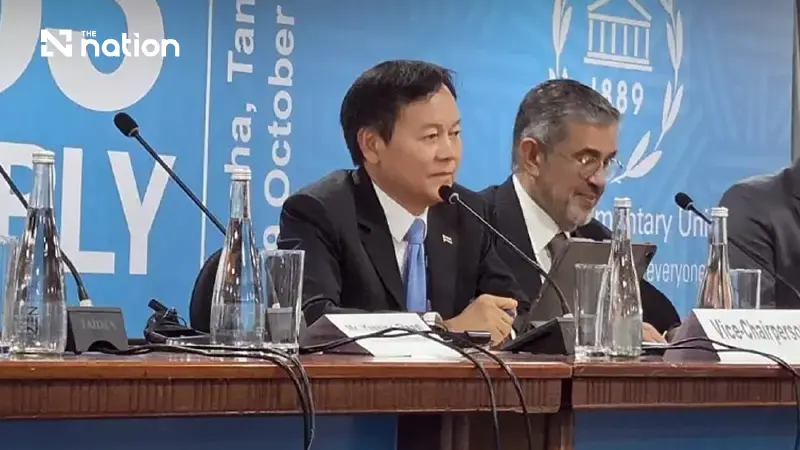


Thai senator Nophadol In-na has been elected to chair the IPU Working Group on Science and Technology, with AI ethics and science diplomacy among his priorities.
Thai senator Assistant Professor Dr Nophadol In-na has been elected chair of the Inter-Parliamentary Union’s Working Group on Science and Technology (WGST) during the 153rd IPU Assembly in Arusha, Tanzania, according to Thailand’s parliamentary delegation.
The election took place during the working group’s closed session on Wednesday (October 7), as parliamentarians gathered in Arusha for the IPU Assembly from October 5–9. The IPU describes the WGST as its global parliamentary focal point for science and technology issues.
The Thai delegation said the election was unanimous. The WGST itself comprises 21 parliamentarians with specialist knowledge and experience in science and technology; it is a subsidiary body of the IPU Governing Council.

AI ethics among key priorities
A major item in Nophadol’s work at the IPU has been the development of the AI Ethics Annex to the IPU Charter on the Ethics of Science and Technology.
As rapporteur, he had previously presented updated drafts incorporating principles including human rights, non-discrimination, transparency, accountability, oversight and safeguards for democratic processes. Official IPU records ahead of the Arusha meeting said the annex was scheduled for adoption at the 153rd Assembly.
According to the Thai delegation, the latest meeting endorsed the proposed AI ethics framework.
Nophadol has also promoted science diplomacy as a way of strengthening international cooperation and narrowing technological disparities between wealthier and developing countries.
After his election, he said the position represented recognition not only for him personally but also for Thailand as a developing country.
He said he intended to use science and technology diplomacy to strengthen international ties, reduce technology gaps between countries and continue advancing ethical approaches to AI.

From vice-chair to working group leader
Nophadol joined the IPU Working Group on Science and Technology in 2024 and was elected vice-chair in April 2025. He subsequently became rapporteur for the AI Ethics Annex.
At the IPU’s 152nd Assembly in Istanbul in April 2026, he represented the Thai Parliament and chaired an ASEAN Plus Three parliamentary coordination meeting. The 153rd Assembly in Arusha has included discussions on military AI, AI and the future of work, and ethical uses of the technology.
A day before the WGST meeting, Nophadol presented three proposals on military AI, calling for meaningful human control, stronger parliamentary legislation and oversight, and practical national policies based on international frameworks.

Engineering and academic background
Nophadol is a Thai senator serving a five-year term from 2024 to 2029 and previously served as a member of the House of Representatives from 2001 to 2005.
He holds a doctorate in engineering hydrology from McGill University in Canada, a master’s degree in Water Resources Engineering from the Asian Institute of Technology (AIT) and another postgraduate degree from the National University of Ireland, as well as an engineering degree from Khon Kaen University. His 1989 McGill doctoral thesis was titled New Plotting Position Formulas for Some Well-Known Distributions in Engineering Hydrology.
His academic career included work at Thammasat University, where he was involved in establishing its engineering programmes and became the first executive director of the Sirindhorn International Institute of Technology (SIIT). He later served as a vice-rector at Thammasat University.
Nophadol currently also chairs the Thai Senate’s Advisory Committee on Foreign Affairs.
His election to lead the IPU science and technology group places him at the centre of parliamentary discussions on emerging technologies, AI governance and the use of science as a tool for international cooperation.
