
US polls close in 7 states on Nov 3 with Congress at stake
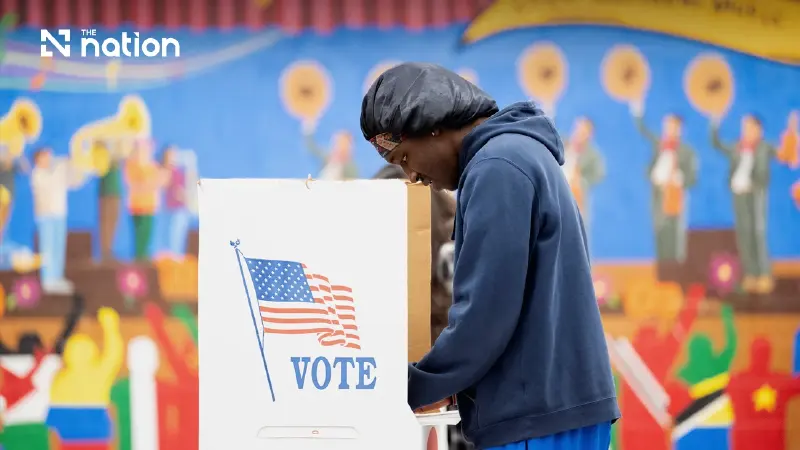


US exit polls show 70% of voters want stronger checks on Trump, as Democrats are favoured to take the House and Senate control remains uncertain.
- Polling stations began closing in seven states, including Indiana, Kentucky, and Georgia, for the November 3 midterm elections that will determine which party controls the US Congress.
- Democrats are favored to win a majority in the House of Representatives, while control of the Senate remains uncertain and dependent on several closely contested races.
- All 435 seats in the House and 35 of the 100 seats in the Senate are at stake in the election.
- Exit polls indicate the election is largely a referendum on President Trump, with a majority of voters wanting Congress to impose stronger checks and balances on the president.
Polling stations began closing in seven US states on November 3, 2026, as millions of Americans voted on whether President Donald Trump’s Republicans should retain control of Congress. Democrats entered the closing hours favoured to win the House of Representatives, while the Senate remained subject to closely fought contests across individual states.
Control of the House and Senate could remain unresolved for some time, with election workers counting ballots and voting continuing later into the night in dozens of states.
Polling stations in Indiana and Kentucky began closing at 6pm Eastern Time on November 3, equivalent to 11pm GMT. Georgia, South Carolina, Vermont, Virginia and most of Florida followed at 7pm Eastern Time.
All 435 House seats and 35 of the Senate’s 100 seats were being contested, although most races were not considered competitive. Democrats needed gains of at least three House seats and four Senate seats to secure majorities in both chambers.

Democrats have a clearer route to the House than the Senate
Democrats’ route to a House majority depended heavily on 47 races identified as competitive in a Reuters analysis of leading election forecasters. Provided all other contests followed those forecasts, Democrats would need to win only 13 of the competitive races.
The Senate presented Democrats with a more demanding task: defending every seat they already held while winning in at least two states that Trump carried by double-digit margins in 2024.
Alaska, Iowa, Kansas, Nebraska, Ohio, South Carolina and Texas were among the states fitting that description. Opinion polls placed Democratic Senate candidates either narrowly ahead or close enough to challenge in all seven.
Republicans also faced an unfavourable historical pattern. Since World War Two, the sitting president’s party has lost ground in Congress in all but two midterm elections.

Exit polls show demand for stronger checks on Trump
Exit polls conducted by SSRS for a consortium of US media organisations, including major television networks and the Associated Press, found that 70% of voters wanted Congress to impose stronger checks and balances on the president. Half viewed the midterms as a chance to rebuke Trump, while three-quarters described themselves as “angry” or “dissatisfied” with the country’s direction.
Trump’s approval rating was close to the lowest levels of his political career amid frustration over the Iran war, higher fuel prices and broader pressures on household budgets.
Opinion polls identified affordability as voters’ leading concern and showed disapproval of Trump’s handling of the issue. Trump’s import tariffs, many of which courts overturned, and his decision to attack Iran in February had increased costs for consumers.
Midterms usually serve as a judgment on the incumbent president, but Trump’s dominance of political debate made that connection especially pronounced. Trump urged supporters to “pretend I'm on the ballot”, a message Democratic leaders also embraced.
Trump held more than two dozen campaign rallies from the beginning of October in an effort to mobilise Republican supporters. Most took place in states he won comfortably in 2024, reflecting the party’s defensive position.
Trump’s Israel funding pledge puts Michigan contest in focus
Trump announced in televised remarks on November 3 that he intended to stop US$3.8 billion in promised annual funding to Israel after the end of 2026. Reuters described the remarks as appearing aimed at voters unhappy with US support for Israel, while noting that implementation remained unclear because a 2020 law mandates the funding levels.
US ties with Israel have been particularly contentious in Michigan, where progressive Democratic Senate candidate Abdul El-Sayed has faced millions of dollars in opposition spending from Israel-linked groups over his criticism of the US ally. El-Sayed, 42, would become the first Muslim US senator if elected.
Trump and other Republicans have characterised El-Sayed and fellow Democratic candidates as radical, un-American and communist. Democrats have dismissed those descriptions as familiar examples of Trump’s exaggerated rhetoric.
Justice Department monitoring draws criticism as Alaska dispute continues
The US Justice Department announced the deployment of 1,000 election monitors and observers across all 50 states, describing the operation as the largest Election Day monitoring effort in its history.
Democrats criticised the Justice Department deployment as a potential source of voter intimidation. A Reuters analysis found that voters in roughly two-thirds of the jurisdictions listed by the department had backed Democrat Kamala Harris over Trump in the 2024 presidential election.
Legal observers and Democrats also expressed concern that Trump might challenge the November 3 results if Republicans lost. Trump has repeatedly made false claims that US elections are rigged.
In Alaska, a New York Times report alleged that Democratic Senate candidate Mary Peltola’s campaign helped recruit an independent candidate who shared the first and last name of her Republican opponent, incumbent Dan Sullivan, 61. Peltola, 53, denied involvement.
The Justice Department launched a criminal investigation into the candidate-recruitment allegations in Alaska and separately brought a lawsuit seeking to block certification of the election results. A judge dismissed the certification lawsuit.
Supporters of the incumbent Sullivan said the presence of two candidates known as Dan Sullivan had not confused them.
“They make it pretty obvious: It says ‘incumbent’ after his name,” said Jake Wesley, 27, who grew up in Anchorage and is now stationed there with the US Air Force.
Trump has repeatedly complained in recent days that voters might not understand the word “incumbent”.

