
Thailand Must Move From Being Liked to Being Trusted, Says Foreign Minister’s Adviser
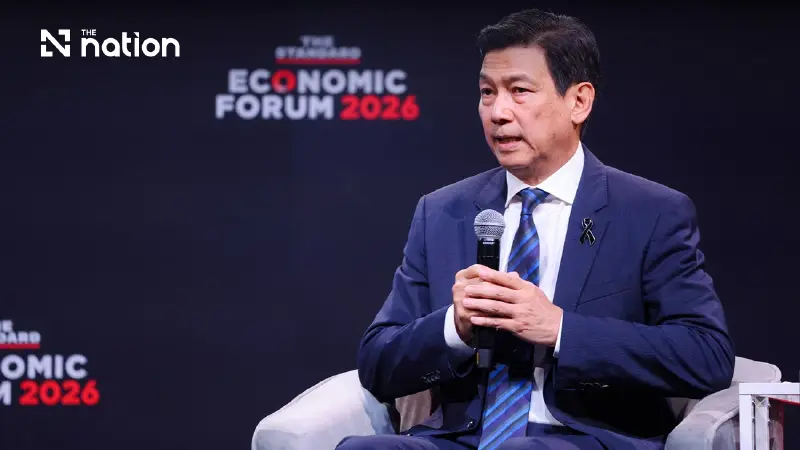


Adviser says Thailand must build trust across security, economy and technology, and show results after hosting the IMF–World Bank meetings
- A senior foreign ministry adviser argues that Thailand's traditional diplomatic approach of being a "friend to all" is no longer sufficient in a world of shifting alliances.
- The country must now earn lasting trust through "proactive diplomacy and visible results," turning discussions from events like the hosted IMF-World Bank meetings into concrete actions.
- Building trust requires focusing on security, the economy, and technology, particularly by navigating the global technology divide to protect its supply chains and investments.
- This strategy involves moving from simple neutrality to "active neutrality," where Thailand more assertively pursues its interests and sets measurable goals for its diplomats to achieve.
The adviser says Thailand must build trust across security, economy and technology and show results after hosting the IMF–World Bank meetings.
Thailand has won goodwill as a gracious host and a friend to all, but that is no longer enough in a world of shifting alliances, a senior foreign ministry adviser has said. He argued the country must now earn lasting trust through proactive diplomacy and visible results.
Speaking on Wednesday (November 4) at the opening of “Economic Forum 2026: Reinvent Thailand”, hosted by The Standard, Panpree Phahitthanukorn described the global environment as a “whirlwind”.
Panpree, a former deputy prime minister, chairs the advisory board to the deputy prime minister and foreign minister.
“In the past, the image was bamboo bending with the wind,” he said, noting that Vietnam once took a similar approach. “Now it is not like that.”
A successful host, with work still to do
Panpree called Thailand’s hosting of the IMF–World Bank annual meetings a major success, coming 35 years after the country last staged them.
Nearly 20,000 delegates attended, including finance and economic ministers, giving Thailand a broad network of trade and investment contacts. Thailand’s own agenda, developed with the IMF and World Bank, produced a Bangkok Roadmap that includes technology security.
International audiences, he said, will now want to see these discussions turn into action. He suggested the World Economic Forum in Davos in mid-January as a chance to report progress against the government’s 90-day delivery target.
“Not everything needs to be finished,” he said, “but whatever is done, we can go and tell the world.”

He acknowledged that investors still raise long-standing concerns, including overlapping regulations, cumbersome procedures and corruption.
Reform plans have been drawn up, he said, but practical implementation has lagged. These were “old karma” that predated the current government, he said, but Thailand must now deliver.
Trust across security, economy and technology
Panpree said trust must extend beyond selective cooperation to every field: security, the economy and, above all, technology. He said the world is splitting into two technology camps and that security and economics are now tightly intertwined.
As an example, he cited the US decision, announced that morning, to block shipments of advanced chipmaking equipment to China, which left a large South Korean company waiting.
Thailand, he said, must be clear about where its exports go and where their components originate, or it risks being caught out. Foreign technology companies setting up in Thailand should be able to ship to their intended markets without being blocked.
From neutrality to ‘active neutrality’
Being neutral and likeable, with friends in every capital, will not be sufficient, he said. “It must be active neutrality,” he said, with Thailand reaching out more assertively in each region. The foreign ministry is assessing each country’s importance to Thailand’s economy, security and technology needs.
It will set targets for each of its embassies and consulates, which number nearly 100 worldwide. He pointed to Australia’s Southeast Asia economic strategy as a model for setting clear investment goals.

Diplomats, he said, should open doors, while the commerce ministry, the Board of Investment and the finance ministry help close deals. “Team Thailand” is working well but may need to grow into something broader.
Performance must be measurable, and closing a deal should count as an achievement. He identified siloed ministries as a bottleneck. The international economic policy committee that once coordinated agencies under a deputy prime minister no longer exists, he said.
Neighbours: patience and engagement
Panpree said some neighbours remain a source of concern. Of Cambodia, he said Thailand once regarded it as a sibling, and the current dispute is unwelcome.
He described a conflict spanning diplomacy, information, military, economic and legal fronts, with border traders and foreign manufacturers supplying parts to Cambodia affected. Thailand is ready to negotiate when Cambodia is, he said, but remarks from the Cambodian side that Thailand finds unacceptable make constructive dialogue difficult.
The issue has been raised at a bilateral committee, which asked for more constructive exchanges.
On Myanmar, with which Thailand shares a 2,400-kilometre border, he said Thailand must engage all parties, including ethnic groups and the government that emerged from elections.
Thailand sees itself as a “bridge” to ASEAN, whose five-point consensus the military leadership rejected. Bangkok is pursuing a parallel track, he said: following ASEAN’s approach while handling bilateral problems such as illegal labour, scam operations, narcotics and river pollution in the north. Major powers could help, he added, with coordination through ASEAN.
“We need delivery, not dialogue alone,” he said.

Tariffs, the US midterms and energy
He said Thai exporters share the anxiety of those in Vietnam over the unresolved US tariff rates. Thai diplomats are working with the commerce ministry to secure the best possible terms, with an agreement expected this year, according to the commerce minister.
On the US midterm elections, he said the outcome would change little for Thailand because the president retains authority over tariffs. His greater concern was the Middle East, where disruption to shipping through the Strait of Hormuz has pushed up energy prices.
He said Qatar is reportedly relaying messages between Washington and Tehran, but the situation remains fragile. High energy costs strengthen the case for fiscal reform, he said, warning that spending without explaining where revenue will come from would swell public debt.
He welcomed the Deputy Prime Minister’s pledge to cap debt at 70 per cent of GDP, while some countries have reached 90 per cent.
Panpree endorsed the World Bank’s “small AI” proposal as a way to help smaller businesses and communities. He suggested applications in agriculture and local health centres and said the digital economy ministry should coordinate with the agriculture ministry.
Thailand, he said, must set priorities and focus on them.
