
Next step towards reconciliation: Six-party peace talks?


Play
What's the next step in the much-hyped but elusive national reconciliation? If one of the new advisers named to the national commission on patching up old wounds and moving the country forward has his way, some serious behind-the-scenes talks among parti
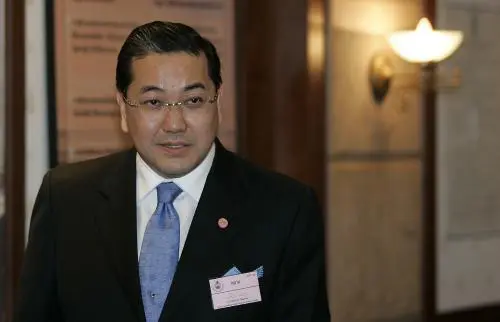
Surakiart Sathirathai, recently appointed as an adviser to the Truth for Reconciliation Commission (TRC), doesn’t believe that even if Thaksin Shinawatra and General Prem Tinsulanonda sit down and work out a compromise, Thailand's long-standing conflict can be brought to an end. It isn’t as simple as that.
“The problem has gone much beyond that. Besides, that kind of a forum can’t be organised because a privy councillor can’t get involved in politics in the first place,” the former deputy premier told Matichon in an interview published last week.
Surakiart believes though that a series of “unpublicised negotiations” could be held whereby five to six parties are represented: the yellow shirts, the red shirts, the Pheu Thai Party, the Democrats, and the security leadership.
But then, the “secret talks” concept may be more complicated than how it’s being portrayed. For one thing, who determines the identities of the representatives of each “faction”? The red-shirt movement, for example, comprises several groups of people who don’t necessarily agree with one another on basic notions of what constitutes “real democracy”. There is also the question of who the yellow shirts represent under the new political scenario. Also, some “liberal” elements could pose a very valid question: Why would the “security circle” be considered a factor in this equation?
The other controversial question is: What about the “invisible hands”? Surakiart says, if one talks about “invisible hands”, they could be from many sides. “In fact, each party to the conflict has its own invisible hands as well.”
Yes, they would have to be included in the process, he said, stressing that some of the discussions may have to be off the record.
In fact, I wouldn’t be surprised if some unofficial sounding-out through informal channels has already been made without any publicity.
Surakiart believes privy councillors shouldn’t, however, be dragged into the proposed formula. They aren’t supposed to be involved in politics. And that’s the way it should remain.
There is even the question about who he himself represents in this new peace-making role.
Surakiart reacted promptly and forcefully to this: “This kind of question shouldn’t be raised anymore. People should stop following that line of thinking. I am not a new face in politics, and I have a long record of academic work,” he said.
Although his wife is related to the royal family, Surakiart says, “We never discuss politics. We in the family discuss everything else except politics. And I have no special connections to speak of.”
Surakiart has obviously assumed a new role. He was once close to Thaksin. He also was seen to be close to the Abhisit government when he was made chairman of the advisory board of the Pheu Pandin Party. Today, he wears a new hat – as an adviser to the national reconciliation body. Of course, there is little doubt that he is extremely well connected. And that probably is why he is testing the water by proposing a new formula to make peace, to perhaps enhance the TRC’s role.
On the other hand, because of the highly sensitive and complicated nature of the proposed “unofficial peace negotiations”, the idea could boomerang and undermine the commission’s less controversial and more effective mission to pursue “transitional justice” for all who have claimed to have suffered from the abuses of the “other side”.
He realises of course that the challenge is enormous. “The problem over the past five to six years has been that we haven’t had a referee trusted by all the parties concerned. Everyone who has proposed a way out has been given a label. He or she has been inevitably branded as siding with one side or the other. Now, the Truth for Reconciliation Commission appears to be the most trusted body. That’s why I feel more optimistic,” Surakiart said.
TRC Chairman Kanit na Nakhon has so far not discussed in public any possibility for this formula for “six-party talks”. Obviously, any action along that line would have to be very well thought out and handled with thorough care and discretion. The line between the role of an “honest broker” and “truth-seeking reconciliator” is very thin indeed.
