
Yingluck must decide; this is her biggest test so far


Play
Gun-toting soldiers guarding flood barriers are a scary scene.
A news blackout is certainly bad. Handing absolute decision-making power to a certain group of people is risky, if not downright dangerous. These scenes, and more, are what we may get if Prime Minister Yingluck Shinawatra decides to invoke an emergency decree to fight the unfolding flood disaster.
But talking about those nasty scenarios at this particular moment is like telling a near-dead patient that surgery he badly needs requires slicing open his chest, removing his heart from his body and his chance of survival will depend largely on the steadiness of the doctor’s hands. Does he deserve to know all that? Probably. Does he deserve the most effective, albeit painful, treatment? Definitely.
Thailand is that patient. The first thing Yingluck has to admit is that the patient is now in a coma. Six industrial estates submerged and millions affected, a large portion of whom are displaced, cannot tell her otherwise. Her choice is simple now: either the patient must get an operation immediately or the conventional treatment continues despite the increasingly slim hope that he will bounce back.
It’s a dilemma that comes with the job. However, even the Democrats are suggesting she exercise her mandate to declare an emergency decree. That takes away one key political element that might make her hesitate. The media are split, of course, but at the end of the day, this is what Yingluck is supposed to do after her party won the July 3 election. Her job description since she became Thailand’s prime minister is to make tough decisions for the country’s best interests.
To say that an emergency decree is undemocratic is a luxury only the critics have. To Yingluck, anything that is within her power is democratic. Or, to put it another way, democracy gives her the right to be undemocratic when the situation warrants. And this is not about anti-government protesters occupying downtown intersections; it’s about the real suffering of millions, about the risk of that figure being doubled or even tripled, and about using a stringent law to prevent a really bad thing from getting worse.
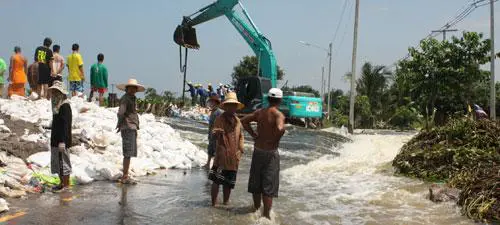
That leaves the question whether a state of emergency can really help. That is an emergency question in itself. So far, the handling of the crisis has been largely misguided and influenced by vested interests big and small. Local conflicts have stalled huge volumes of water or made them flow unnatural paths. The government and the Bangkok Metropolitan Administration are not singing the same tune on what to do for the capital and where and when to do it. Relief efforts for the still-inundated rural areas have been insufficient.
If Yingluck is afraid of political consequences of invoking an emergency decree, she is already suffering from a major backlash for apparently being too soft. More importantly perhaps, this is no time to think of what will politically come next. Her “success” as Thailand’s leader will not be measured by how long she stays in power, but how many lives she can save from now on, even if few or nobody will ever know about it. There are times when governance and promotion have to part ways, and this is one of them.
The menacing water is still testing Thailand’s character. But whether or not it can dilute the “colours”, Yingluck is not in a position to think about it. She should not even think of herself as an elected leader, as that could politicise her thinking. This is truly a critical situation facing a leader, and it’s not a political crisis. As far as Yingluck is concerned, whether or not she will invoke the emergency decree must not be based on political considerations. It should be based purely on how best to save the patient.
If she honestly thinks the conventional method still works, her mandate allows her to continue doing what she thinks is right. That is totally acceptable, as long as she and her government clearly understand the concept of “emergency” and their job requirement that they must not let politics and personal interests play any part in their action until the disaster is over.
The floodwater has put on hold many controversial or politically explosive agendas. It’s hard to imagine that anyone in the government will revive the “amnesty” plan or charter amendment ideas over the next two months. Yingluck must find her political life now quite different from the first three or four weeks as prime minister. “I won’t work for any particular group or person” was her inauguration-day pledge. That probably coincided with the beginning of the downpours in the North, which put her to the test immediately. Only the test proves relentless and is getting bigger.
