
Community-based approach needed for next big flood


Play
The devastating floods have cast doubt on the ability of cumbersome political and bureaucratic mechanisms to fight future natural disasters.
A community-based approach that involves local people working closely with all adjacent communities in flood prevention may prove to be much more effective in coping with the next flood, bigger than what we have seen in the past few weeks.
Local community leaders of Tambon Bangrakam in Banglane district, Nakhon Pathom province (not to be confused with the government’s “Bangrakam Model” of Buri Ram province) have set a good example of small-scale, down-to-earth collaboration.
The 2006 flood that severely damaged this farming area west of Bangkok drew the Bangrakam community leaders together to map out their own anti-flood scheme. They gave up any hope of waiting for government assistance in coping with natural disasters.
“We got together with leaders of communities nearby to work out preparedness, emergency responses, evacuation and recovery plans,” said a local leader.
They didn’t wait for the provincial governor, not to mention the central government, to tell them what to do.
“Nobody knows the local terrain and social network better than we do,” said another community leader.
Their coordinated plan called for areas set aside for evacuation, erection of embankments to protect roads vital for communications and heavily populated areas. Excess water was released into farmland, and only those agricultural areas where crop harvests had not been finished were placed under special protection.
The local disaster network also works closely with the “Love Thajeen River Club”, comprised of local people from all professions, which protects the environmental quality of the river to cope with any future flooding.
“Lessons from 2006 tell us that we can’t do it just for our province. We have therefore joined with nearby provinces such as Chai Nat, Suphan Buri, all the way to Samut Sakhon to form this anti-flood alliance,” the Bangrakam tambon chief says.
As a result, flooding so far has been limited to about three to five centimetres above the road surface at the most vulnerable spot, a level that is manageable with evacuation and prompt aid delivered to affected villagers.
Lessons from other countries suggest that a key anti-flood measure is to develop a flood emergency response plan (FERP). The plan must be in place so that trained personnel can respond effectively to a disaster. Once the floodwaters hit a record high, split-second decision-making to respond promptly becomes an absolute necessity.
Experienced flood-fighters have warned that you have to plan for the next disaster, not the last one. Thailand’s big deluge has hopefully taught us a very expensive and valuable lesson: Don’t set the bar at the previous worst experience. Set it for something worse than ever.
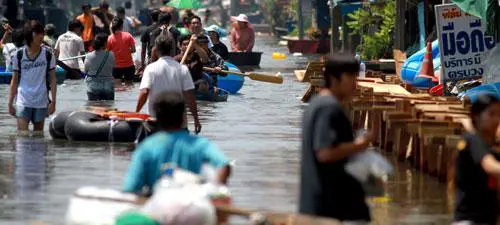
Most people in provinces close to Bangkok who refused to leave their homes despite the rising waters were convinced they could survive the disaster simply because “last time, it reached the first floor of our houses”. They were mostly wrong. The water kept rising and they became isolated because relief personnel, short of boats and supplies, couldn’t reach them even in the suburbs, not to mention remote villages cut off from the outside world from the very first few days the deluge hit.
The devastating floods in Britain in 2008 sparked a debate on the whole issue of flood prevention. Experts drew lessons from the severe damage and concluded that flood defences were overwhelmed by the sheer volume of rainwater. Few flood systems were designed to cope with such volumes. In Thailand’s case this year, the convergence of the water flow from the north, the rising sea levels and heavy rain made it clear that the embankments, no matter how strong, could become highly vulnerable.
It is also clear that erecting barriers to block the flow of floodwaters can prove counter-productive. They are not always effective, and this can lead to a build-up of water elsewhere, which can cause even more damage. Some experts say that artificially increasing a river’s flood capacity by widening, dredging or straightening rivers can create long-term problems.
Many experts, drawing lessons from several countries, now suggest that urban areas need to be redesigned to absorb floodwater before it reaches them. Water can be “stored” on moors, in river valleys and open land, or held back on playing fields.
Who should be responsible for flood defences? In the case of Britain’s flood of 2008, five or more bodies were involved: water companies, local authorities, the environment agencies, flood defence committees and developers and farmers all had some responsibility for averting and coping with floods. Not unlike in our case, the system was criticised for creating “institutional confusion”.” Effectively, if everybody was in charge, nobody was in charge.
The Bangrakam case offers a model that promotes community-level efforts to cope with future floods at the local level while the central government takes care of the “big picture” and maps out an all-round and well-defined master plan for the whole country.
So far, the master plan isn’t there yet. Local communities have only themselves to lean on.
